Aircraft library Bell 206 JetRanger
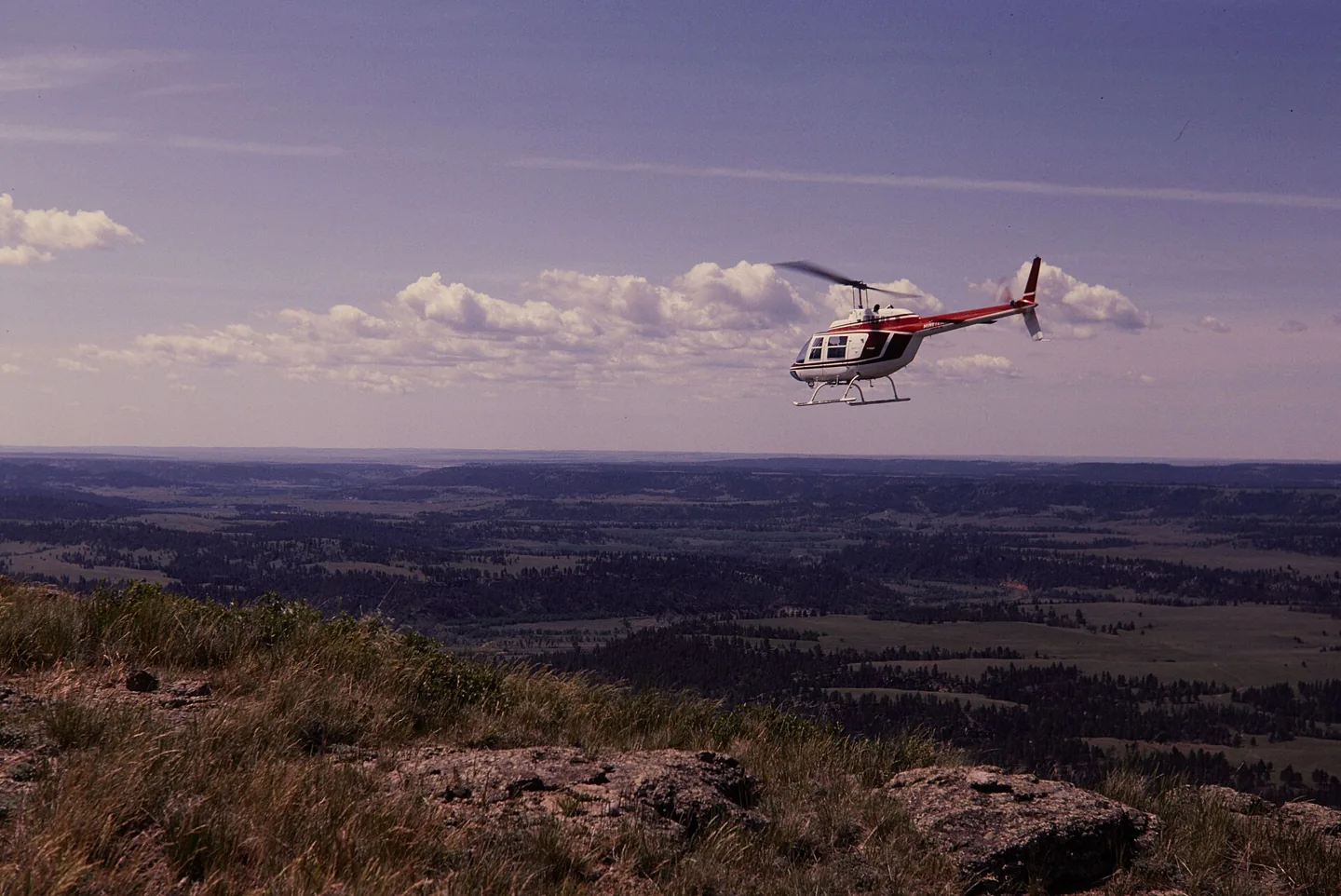
Bell 206 JetRanger Photo: Thomas C. Gray / National Park Service, public domain

Bell 206 JetRanger

The certified force-trim feel, verbatim: magnetic-brake hold with breakout-gradient springs, two-per-rev felt in the cyclic, and honest ETL and VRS shudders.

HelicopterB06Rotorcraft controlsStarter v2 · 2026-07-25

Know the plane

Powerplant
Rolls-Royce 250-C20J, 420 shp
Seats
5
Max takeoff weight
3,200 lb (1,451 kg)
Main rotor diameter
33 ft 4 in (10.16 m)
Length overall
39 ft 8 in (12.09 m)
Never exceed (Vne)
122 KIAS
Cruise
≈110 kt
Service ceiling
13,500 ft
Range
≈374 nm
Usable fuel
91 US gal
Rotor system
Two-blade teetering, hydraulically boosted
First flight (206A)
1966

Sources: Bell 206B-3 Flight Manual; FAA TCDS H2SW; Bell published data.

The JetRanger is the helicopter most people picture when they hear the word: news, police, charter, training, and forty years of television. It is simple, forgiving by turbine standards, and its two-blade rotor gives it the most recognizable sound in rotary aviation.

For a simmer the 206 is the classic hydraulically-boosted light turbine: the cyclic is light and nearly load-free, so the feel story is textures and cues, not forces: the two-per-rev beat, ETL shudder, and the force-trim system that holds the cyclic where you release it.

A little history

The 206 grew out of Bell's losing entry in a US Army scout competition; Bell civilianized it in 1966 and accidentally created the best-selling civil helicopter of its century. The Army later bought it anyway as the OH-58 Kiowa.

More than 7,000 civilian JetRangers were built through 2010, training generations of pilots, and thousands still work. The B-3 modeled here is the definitive late-production variant.

What the real one feels like

Each finding pairs our reading with the evidence it rests on. Fly the type and read something wrong? Every claim links straight to the corrections form.

01

The force-trim architecture is the certified system, verbatim

The RFM describes adjustable friction on cyclic and collective plus a force trim system of magnetic brakes and force-gradient springs in the cyclic circuits — exactly the magnetic-brake hold and breakout-gradient model the profile renders.

Fly the type? Correct this claim

Published speeds

GateKnotsNotes
VyBest rate of climb 52 Representative
VappApproach 40 Representative
VneNever exceed 130 Power-on, sea level · Bell 206B3 Rotorcraft Flight Manual (BHT-206B3-FM-1) — flight controls description

How the profile models it

Starter JSON · v2

The complete starter profile, in the same order and with the same names as the desktop Tuning page. Highlighted rows cite evidence. Hover a row to see its profile-JSON path.

13 kt 100 kt 0.06
Pitch load at a constant elevator input, from standstill to the cruise reference.

Master gain & control system

Master gain 85%

The final overall output scale applied to everything the model produces, before the device cap.

▲ More: everything (spring, loads, effects) gets stronger together. ▼ Less: everything softens together.

Why here: Class default 85%.

Control system Rotorcraft controls

Why here: Rotorcraft, hydraulically boosted: the cyclic carries almost no aerodynamic load, so cues and textures do the talking.

Forces

Spring deadband 2%

A small neutral zone around centre where the spring stays quiet, so tiny movements at rest don't chatter. Wider is calmer but looser; narrower is more precise but can twitch around centre.

▲ More: a calmer but looser centre with more free play. ▼ Less: a tighter centre that may chatter at rest.

Why here: 2%: nearly none. A boosted cyclic has no slack worth modeling.

Low-speed spring floor 100%

How much of the spring survives at a standstill, before airspeed can build any aerodynamic force. A high floor keeps the parked stick firm; a low floor gives the loose, cable-slack feel of a parked light aircraft.

▲ More: a firmer stick while parked and taxiing. ▼ Less: a floppier parked stick that only wakes up with airspeed.

Why here: 100%: the floor IS the spring. A helicopter's centering does not build with airspeed; it is constant from hover to Vne.

QBlend enabled on · QSpring start knots 15 · QSpring full knots 55
Elevator load 100%

The sustained pitch load from elevator deflection and airspeed, balanced independently of roll. This is the main lever behind a type's pitch weight. It does not touch aileron, spring, trim, or buffet forces.

▲ More: heavier sustained pitch forces at speed. ▼ Less: a lighter elevator that takes less muscle to hold.

Why here: Symmetric 100%: cyclic axes are balanced.

Aileron load 100%

The sustained roll load from aileron deflection and airspeed, balanced independently of pitch. Together with the elevator load it sets the control-harmony ratio reviewers talk about.

▲ More: heavier roll forces. ▼ Less: lighter, quicker-feeling ailerons.

Why here: Symmetric 100% for the same reason.

Overall aerodynamic load 35%

A master scale over both sustained axis loads, applied before their independent balance. Profiles normally leave this alone and tune the two axis loads instead.

▲ More: both axes load up harder. ▼ Less: both axes lighten together.

Hydraulics-on cyclic is light; a low-but-real forward-flight tension replaces an airplane q-ramp.

Cruise reference (kt) 100

The indicated airspeed where aerodynamic load reaches its designed full level. It anchors the whole load curve to the aircraft's real speed range: a 172 loads up by 110 knots, a jet much later.

▲ More: loads arrive later; the stick stays light up to a higher speed. ▼ Less: loads arrive earlier and cruise feels heavier.

Why here: 100 kt: JetRanger cruise.

Airspeed curve 1.4

How sharply stick load builds with airspeed. 1.0 is linear; about 2.0 matches real aerodynamics, where dynamic pressure grows with the square of speed, so controls are much lighter slow and firm up fast. Felt when holding the stick off centre, not at rest.

▲ More: lighter at low speed with a steeper rise toward cruise. ▼ Less: a more linear build that loads up earlier.

A gentle rise with speed — rotor feel, not wing feel.

Max output force 55%

A cap on each steady pitch or roll force before it reaches the device, guarding against slamming or saturating the hardware in strong maneuvers.

▲ More: stronger peak steady forces before clipping. ▼ Less: a gentler ceiling; hard maneuvers flatten out sooner.

Why here: 55%: helicopter forces never slam.

Hydraulic load factor 60%

For hydraulically-boosted or fly-by-wire types: how much of the raw aerodynamic load actually reaches the pilot's hand. 1.0 is a fully manual control run; lower values model the artificial-feel systems that isolate the pilot from true surface loads.

▲ More: more raw aerodynamic load reaching your hand. ▼ Less: more isolation, closer to pure artificial feel.

Why here: Active: this is the boost model, passing only a fraction of rotor loads to the hand.

Trim

Aileron strength 30%

The same relief for roll trim. Most GA types have no real aileron trim, so this stays at zero; types with roll trim get a matching value.

▲ More: roll trim removes more held roll force. ▼ Less: roll trim does less.

Why here: Symmetric with pitch.

Aileron authority 0.3

Stick feel

G-load gain 6%

Extra spring stiffness as positive G rises above 1G: the pull-up loads your arm as well as the wing. Too little and steep turns feel weightless; too much and maneuvering becomes tiring.

▲ More: pull-ups and steep turns stiffen the stick more per g. ▼ Less: g has less effect; maneuvering stays light.

Why here: 6%: a teetering rotor must never be unloaded, and G play is minimal in the type's envelope.

GLoad enabled on · Min factor 0.6 · Max factor 1.15
Control-edge gain 30%

How strong that edge-of-travel boost is once triggered: a soft warning versus a hard stop near full throw.

▲ More: a harder stop near full deflection. ▼ Less: a softer edge you can push through.

Why here: 30%: definite stops; running out of cyclic in a helicopter is an emergency you feel coming.

Helicopter

Force trim hold 55%

Helicopter force trim: how firmly the cyclic holds its trimmed position after the force-trim release, the magnetic-brake feel. Hold the FTR button to reposition freely; release and it holds there.

▲ More: the cyclic snaps back harder to its trimmed spot. ▼ Less: a softer magnetic hold you can lean through.

Why here: 55%: the magnetic-brake force trim is the JetRanger's defining cyclic behavior: press, move, release, and it holds there.

Deadband 0.02 · Breakout travel 0.3 · Beep trim rate 0.25 · Follow up trim off · Follow up rate 0.15 · Follow up max airspeed kt 40 · Follow up deadband 0.06
ETL shudder 35%

The transition shudder through effective translational lift (roughly 12 to 24 kt), felt accelerating away from a hover and again decelerating back into one. Rotorcraft only.

▲ More: a more pronounced translational-lift shudder. ▼ Less: a subtler transition cue.

The 12–24 kt shudder band matches the handbook's 16–24 kt onset.

Start kt 12 · Stop kt 24
VRS buffet 45%

The settling-with-power buffet of descending into your own downwash, building with sink rate below translational lift. As much a safety cue as an effect: if the stick starts kicking in a slow, steep descent, fly forward and out. Rotorcraft only.

▲ More: a harsher settling-with-power kick. ▼ Less: a softer warning.

Gated on collective, sink rate, and low airspeed per the handbook picture.

Max ias kt 28 · Onset sink fps 5 · Full sink fps 15 · Min engine rpm pct 0.5 · Min collective pct 0.4
Two-per-rev vibration 15%

The signature steady vibration of helicopter forward flight, building from about 30 kt to cruise: a rhythm through the grip, not a buffet. Rotorcraft only.

▲ More: a stronger forward-flight rhythm through the grip. ▼ Less: a smoother ride.

The in-cyclic two-per-rev with its airspeed ramp; the "grows past 110 kt" evidence would support a modest raise if the bench agrees.

Min speed kt 30 · Full speed kt 100
Retreating blade stall 30%

The roll-biased 'slow down' buffet approaching rotor Vne. The retreating blade runs out of lift first, so the shake leans to one side. Rotorcraft only.

▲ More: a harder, more roll-biased slow-down warning near VNE. ▼ Less: a gentler onset.

Why here: 30%: the roll-biased shake approaching Vne says slow down like the real rotor does.

Vne kt 130 · Onset fraction 0.85
Skid scrape 30%

The coarse grind of skid gear sliding through a run-on landing, harsher-edged than wheeled rumble. Rotorcraft only.

▲ More: a coarser run-on grind. ▼ Less: quieter skids.

Why here: 30%: skids on pavement during run-on practice grind exactly like this.

Min speed kt 2 · Full speed kt 10 · Max speed kt 25
Rotor rumble 12%

Rumble that follows the main rotor instead of the engine when the sim reports rotor RPM: a heavy chug at spool-up, a steady thrum at flight RPM, and it keeps turning in autorotation. Rotorcraft only.

▲ More: more rotor presence through the grip. ▼ Less: a smoother rotor.

Why here: 12%: rotor-following rumble: spool-up chug, flight-RPM thrum, and it keeps turning in autorotation.

Nominal rotor rpm 394 · Idle rpm pct 0.05 · Full rpm pct 1 · Governor droop below pct 0.97 · Governor droop floor pct 0.85 · Governor droop gain 0.15

Effect gains · Ground

Runway rumble 15%

Rolling surface vibration from wheel speed and surface type: pavement, grass, or gravel under the gear.

▲ More: louder surface texture through the stick. ▼ Less: a smoother taxi.

Why here: 15%: ground contact is brief and soft on skids.

Enabled on · Min speed kt 2 · Full speed kt 30 · Surface scaling enabled on · Undercarriage 0
Ground accel 10%

The fore-aft pull on the pitch axis from acceleration on the ground. The takeoff surge draws the column aft; braking pushes it forward.

▲ More: a stronger fore-aft pull under acceleration and braking. ▼ Less: a subtler surge cue.

Why here: A light cue for taxi-slide dynamics.

Deadband g 0.03

Effect gains · Airframe

Overspeed buffet 10%

Airframe shake past the overspeed warning, the airframe's own protest at exceeding Vne/VMO.

▲ More: a harsher protest past the redline. ▼ Less: a gentler overspeed warning.

Why here: 10%: low: RBS above carries the high-speed warning; the airframe buffet is secondary.

Effect gains · Engine, mechanical & drag

Turbulence 30%

Random shake from short-term G variation in rough air, so bumpy air is felt and not just seen.

▲ More: rough air hits the stick harder. ▼ Less: calmer chop.

Why here: 30%: rotors smooth gusts that would toss a light airplane; chop is felt as rotor disc activity.

Min stddev 0.02 · Full stddev 0.3 · Ambient gain 0.7 · Turbulence window samples 20
Engine rumble 12%

Continuous powerplant vibration following RPM between idle and full power, the ever-present reminder that something is burning fuel up front.

▲ More: more engine through the stick. ▼ Less: a quieter powerplant.

Why here: 12%: the C20 turbine hums behind the rotor's rhythm.

Enabled on · Idle rpm pct 0.55 · Full rpm pct 1
Touchdown thump 50%

The one-shot kick when the wheels meet the runway, scaled by sink rate: a greaser whispers, a firm arrival thumps.

▲ More: a harder kick at touchdown. ▼ Less: softer arrivals.

Why here: 50%: skid touchdowns are slides, not impacts.

Reference sink fps 6 · Min sink fps 1

Rate damping

Pitch gain 12%

Resistance proportional to the aircraft's pitch rotation rate. It settles the stick after abrupt pitch inputs; zero on both axes turns rate damping off.

▲ More: the stick settles harder against pitch rotation. ▼ Less: less resistance to quick pitch changes.

Why here: 12%: hydraulic viscosity: the boosted cyclic moves like it is in oil, and that damping is the feel.

Rate damping enabled on · Max force 0.2
Roll gain 12%

The roll-axis counterpart: damping against roll rate to stop post-input wobble.

▲ More: more resistance to roll rate. ▼ Less: a livelier roll axis.

Why here: Matching viscosity.

Stick drop

Fade airspeed 30

The airspeed where the forward slump has fully faded, typically almost as soon as airflow builds on the takeoff roll.

▲ More: the slump lingers further into the takeoff roll. ▼ Less: it vanishes almost as soon as you roll.

Why here: Fades as the system pressurizes and airspeed builds.

Autopilot follow

Strength 25%

How firmly the stick holds the autopilot's commanded position while following is active.

▲ More: a firmer hold on the AP's commanded position. ▼ Less: softer, easy to override.

Why here: Minimal.

Starter history

Version 22026-07-25

Research pass validated the ADR-0027 panel-tuned profile — no value changes; the force-trim architecture, in-cyclic two-per-rev, and ETL/VRS gates now carry certification-grade citations.

Version 12026-05-30

Initial starter baseline from the panel-validated helicopter pass.

Community & corrections

If your time in the type says this page got something wrong, correct it here.

Pilot corrections

Fly this aircraft? Correct this page.

This page is built from cited references, and real time in the type beats a citation. Quote the claim that reads wrong and tell us what the actual aircraft does. Corrections go to the maintainer for review and feed the next revision of this research.

Help wanted

What the research could not pin down. If you fly the type, or can point at a source, a correction on any of these feeds the next revision directly.

  • No citable measurement of boosted-cyclic force — universally described as light, never with numbers. Absolute magnitudes are bench-set from the panel-validated pass.

  • No 206-specific ground-handling feel anecdotes found.

Hangar talk

Open conversation about flying and tuning the Bell 206 JetRanger, in the community forum. Corrections above go privately to the maintainer; hangar talk is public.

No hangar talk for the Bell 206 JetRanger yet. Be the first.

Community

Community profiles for this aircraft

No community profiles for this aircraft yet. Tuned it your way? Share a profile and it will appear here.