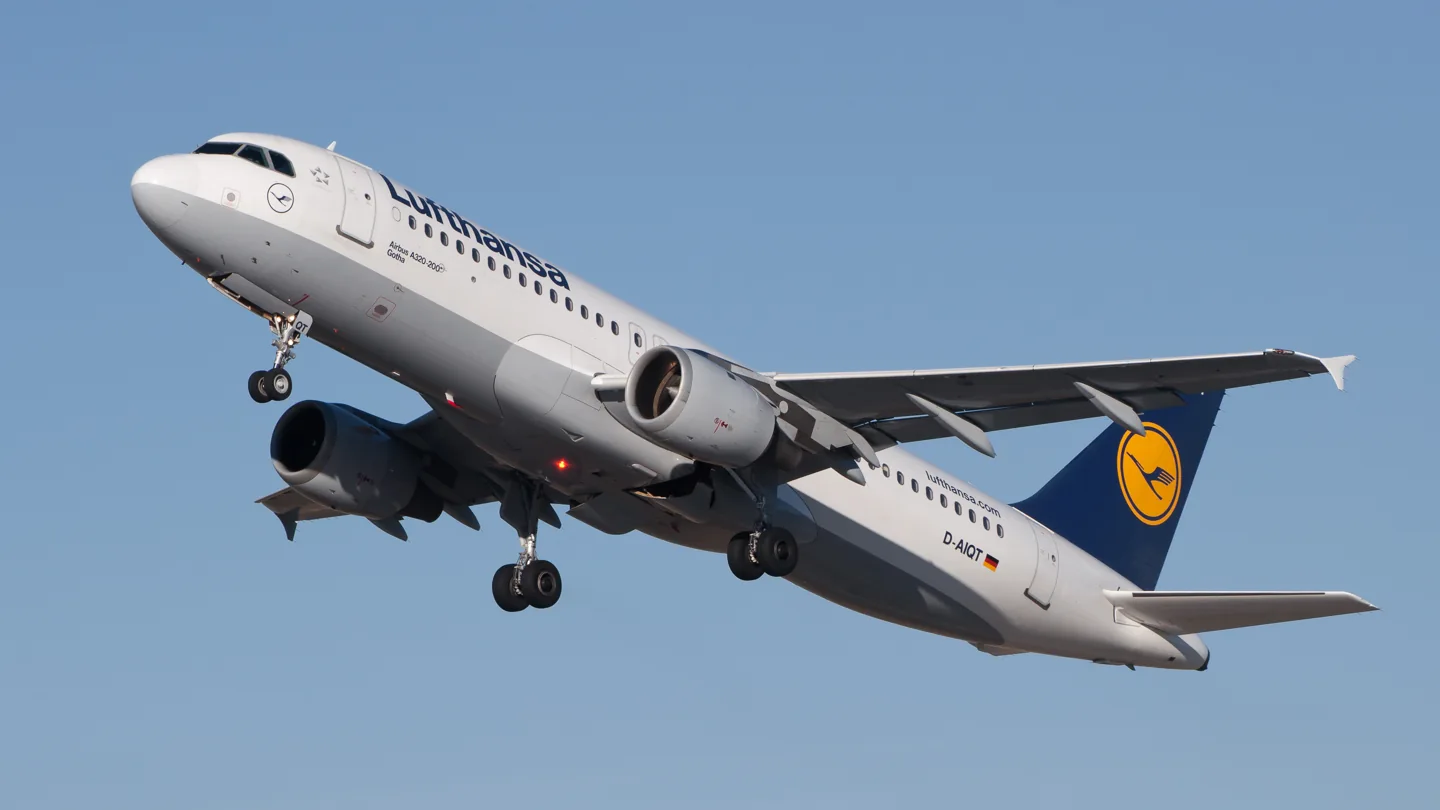
Aircraft library Airbus A320neo
Airbus A320neo Photo: BriYYZ, CC BY-SA 2.0, via Wikimedia Commons

Airbus A320neo

A fixed spring, on purpose: published sidestick force data — 1.1 lb breakout, ~22 lb full pitch, roll 3–4× lighter — and no force variation with speed, trim, or configuration.

AirlinerA20NFly-by-wireStarter v2 · 2026-07-25

Know the plane

Powerplant
2× CFM LEAP-1A or PW1100G, ≈27,000 lbf each
Seats
150–180 typical
Max takeoff weight
79,000 kg (174,165 lb)
Wingspan
117 ft 5 in (35.80 m) with Sharklets
Length
123 ft 3 in (37.57 m)
Max operating (Vmo/Mmo)
350 KIAS / M0.82
Typical cruise
M0.78
Max operating altitude
39,800 ft
Range
≈3,500 nm
Fuel capacity
≈26,730 l (7,060 US gal)
Flight controls
Digital fly-by-wire, sidestick
First flight (neo)
2014

Sources: Airbus A320neo FCOM; Airbus published data; EASA TCDS A.064.

The A320neo is the aircraft that made fly-by-wire ordinary: a sidestick commanding load factor and roll rate through flight control computers, with envelope protections standing behind every input. The neo generation adds geared-fan and LEAP engines and the Sharklet wingtips.

For a simmer the Airbus is the deliberately artificial feel: the sidestick's centering is constant and synthetic by design, and the aircraft, not the airflow, decides what your hand feels. The profile models that honestly, which is why its force section looks nothing like the manual types.

A little history

Airbus launched the A320 in 1984 as the first airliner with digital fly-by-wire and sidesticks, a decision that reshaped the industry. The family became the best-selling airliner line in history, with the neo re-engining of 2010 selling faster than any airliner before it.

The neo's LEAP and GTF engines cut fuel burn around 15 percent and made the type the default narrowbody for a hundred airlines. The aircraft modeled here is the standard A320neo of current fleets.

What the real one feels like

Each finding pairs our reading with the evidence it rests on. Fly the type and read something wrong? Every claim links straight to the corrections form.

01

The sidestick forces are published

Two independent relays of Airbus's own tables agree to ~0.5 daN: breakout 0.5 daN pitch / 0.4 daN roll (≈1.1 lb), full pitch deflection 10 daN (≈22.5 lb) over ±16°, full roll 2–3.5 daN over ±20° — a pitch-to-roll ratio of roughly 3–4 : 1. The mechanism is spring plus snubber damping.

Fly the type? Correct this claim
02

Force never varies with speed, trim, or configuration

In normal law the stick is a rate/g demand against a fixed spring: autotrim runs underneath, and the feel does not change from approach to cruise. There is no stick shaker and no tactile stall cue in the stick — alpha protection and the aural warning do that job.

Fly the type? Correct this claim

Published speeds

GateKnotsNotes
VsoStall, landing configuration 113 Mid-mass ops numbers; FBW invariants don't depend on exact valuesRepresentative
VrRotation 140 Representative
VyBest rate of climb 165 Representative
VappApproach 137 Representative

How the profile models it

Starter JSON · v2

The complete starter profile, in the same order and with the same names as the desktop Tuning page. Highlighted rows cite evidence. Hover a row to see its profile-JSON path.

35 kt 280 kt 0.00
Pitch load at a constant elevator input, from standstill to the cruise reference.

Master gain & control system

Master gain 90%

The final overall output scale applied to everything the model produces, before the device cap.

▲ More: everything (spring, loads, effects) gets stronger together. ▼ Less: everything softens together.

Why here: 90%: the synthetic centering must feel solid and constant, so the overall output runs high.

Forces

Spring strength 55%

The base centring force that pulls the stick back to centre. Every other force stacks on it. Too low and the stick feels limp in normal flight; too high and it fights your hand and masks the smaller cues layered above it.

▲ More: firmer centring that resists your hand at all times. ▼ Less: a limper stick that leans on aerodynamic load alone.

One constant spring at all speeds.

Spring deadband 4%

A small neutral zone around centre where the spring stays quiet, so tiny movements at rest don't chatter. Wider is calmer but looser; narrower is more precise but can twitch around centre.

▲ More: a calmer but looser centre with more free play. ▼ Less: a tighter centre that may chatter at rest.

The published breakout is 0.5 daN of 10 daN full — about 5% of travel.

Low-speed spring floor 50%

How much of the spring survives at a standstill, before airspeed can build any aerodynamic force. A high floor keeps the parked stick firm; a low floor gives the loose, cable-slack feel of a parked light aircraft.

▲ More: a firmer stick while parked and taxiing. ▼ Less: a floppier parked stick that only wakes up with airspeed.

Why here: The spring is the same parked and at 350 knots: half floor with almost nothing added above it, because airspeed never reaches an Airbus stick.

QSpring start knots 20 · QSpring full knots 60
Dynamic-pressure blend off

Enables the low-speed spring engagement window (start/full knots above). Off, the spring is constant at all speeds.

Force never varies with speed: confirmed by the published tables.

Elevator load 100%

The sustained pitch load from elevator deflection and airspeed, balanced independently of roll. This is the main lever behind a type's pitch weight. It does not touch aileron, spring, trim, or buffet forces.

▲ More: heavier sustained pitch forces at speed. ▼ Less: a lighter elevator that takes less muscle to hold.

Why here: 100%, but scaled by the near-zero overall load below: axis balance is symmetric on a sidestick.

Aileron load 100%

The sustained roll load from aileron deflection and airspeed, balanced independently of pitch. Together with the elevator load it sets the control-harmony ratio reviewers talk about.

▲ More: heavier roll forces. ▼ Less: lighter, quicker-feeling ailerons.

Why here: 100%: identical to pitch. The sidestick is symmetric; there is no harmony story to model.

Overall aerodynamic load 4%

A master scale over both sustained axis loads, applied before their independent balance. Profiles normally leave this alone and tune the two axis loads instead.

▲ More: both axes load up harder. ▼ Less: both axes lighten together.

Why here: 4%: effectively zero aerodynamic load. This single number is the fly-by-wire story: the airflow does not touch your hand.

Cruise reference (kt) 280

The indicated airspeed where aerodynamic load reaches its designed full level. It anchors the whole load curve to the aircraft's real speed range: a 172 loads up by 110 knots, a jet much later.

▲ More: loads arrive later; the stick stays light up to a higher speed. ▼ Less: loads arrive earlier and cruise feels heavier.

Why here: 280 kt reference exists for the residual 4%; it is bookkeeping, not feel.

Airspeed curve 1.0

How sharply stick load builds with airspeed. 1.0 is linear; about 2.0 matches real aerodynamics, where dynamic pressure grows with the square of speed, so controls are much lighter slow and firm up fast. Felt when holding the stick off centre, not at rest.

▲ More: lighter at low speed with a steeper rise toward cruise. ▼ Less: a more linear build that loads up earlier.

Why here: 1.0: what little load exists grows linearly; a square law would imply aerodynamics the stick does not have.

Max output force 25%

A cap on each steady pitch or roll force before it reaches the device, guarding against slamming or saturating the hardware in strong maneuvers.

▲ More: stronger peak steady forces before clipping. ▼ Less: a gentler ceiling; hard maneuvers flatten out sooner.

Why here: 25%: the lowest cap in the fleet. A sidestick never fights you; protections mean never needing high forces.

Hydraulic load factor 60%

For hydraulically-boosted or fly-by-wire types: how much of the raw aerodynamic load actually reaches the pilot's hand. 1.0 is a fully manual control run; lower values model the artificial-feel systems that isolate the pilot from true surface loads.

▲ More: more raw aerodynamic load reaching your hand. ▼ Less: more isolation, closer to pure artificial feel.

Why here: Active for FBW: it scales the tiny residual load path down. With ForceGain at 4% its effect is academic.

Trim

Aileron strength 30%

The same relief for roll trim. Most GA types have no real aileron trim, so this stays at zero; types with roll trim get a matching value.

▲ More: roll trim removes more held roll force. ▼ Less: roll trim does less.

Why here: Symmetric with pitch for the same reason.

Aileron authority 0.1

Effect gains · Ground

Runway rumble 36%

Rolling surface vibration from wheel speed and surface type: pavement, grass, or gravel under the gear.

▲ More: louder surface texture through the stick. ▼ Less: a smoother taxi.

Why here: 36%: the airframe filters pavement through oleos and mass; the cockpit still reads the texture.

Enabled on · Min speed kt 5 · Full speed kt 120 · Surface scaling enabled on · Undercarriage 0
Gear bumps 30%

Short discrete bumps from expansion joints, ruts, and rough surface, punctuating the continuous rumble.

▲ More: sharper hits from joints and ruts. ▼ Less: softer ground detail.

Why here: 30%: taxiway joints at 70 tonnes are felt as thuds, not jolts.

Start speed kt 18 · Full speed kt 90
Brake shudder 42%

Vibration under brake pressure while rolling. Invisible braking feels wrong; too much makes every stop feel like an anti-skid event.

▲ More: more shudder under braking. ▼ Less: quieter stops.

Why here: 42%: carbon brakes and autobrake events register clearly.

Min speed kt 5 · Full speed kt 55 · Brake deadband 0.07
Nosewheel shimmy 14%

The rapid side-to-side wobble through the roll axis at taxi-rotation speeds, the classic worn-nosegear shimmy this type is or isn't known for.

▲ More: a livelier shimmy on the rollout. ▼ Less: a calmer nosewheel.

Why here: 14%: minimal; a damped airliner nosegear rarely shimmies.

Min speed kt 40 · Full speed kt 110
Ground accel 24%

The fore-aft pull on the pitch axis from acceleration on the ground. The takeoff surge draws the column aft; braking pushes it forward.

▲ More: a stronger fore-aft pull under acceleration and braking. ▼ Less: a subtler surge cue.

Why here: 24%: takeoff thrust at flex still shoves.

Deadband g 0.03

Effect gains · Airframe

Stall buffet 15%

Airframe shake approaching the stall and while the stall warning is active: how loudly this wing announces it is unhappy. Types with a crisp break get modest buffet and let the horn carry the warning.

▲ More: a louder pre-stall shake. ▼ Less: a quieter wing; the horn carries the warning.

Why here: 15%: in normal law you cannot stall it, so buffet is a rare, protected-corner event. The low value is the protection story.

Enabled on
Overspeed buffet 62%

Airframe shake past the overspeed warning, the airframe's own protest at exceeding Vne/VMO.

▲ More: a harsher protest past the redline. ▼ Less: a gentler overspeed warning.

Why here: 62%: overspeed is one place the airframe genuinely buffets and the event is serious.

Mach buffet 42%

Transonic buffet approaching the Mach limit. Meaningful for jets near MMO, zero for pistons and turboprops that never get there.

▲ More: stronger transonic buffet near the Mach limit. ▼ Less: a smoother high-Mach ride.

Why here: 42%: real transonic buffet approaching Mmo.

Min mach 0.78 · Full mach 0.82
Spoiler buffet 45%

Shake from deployed spoilers or speedbrakes at speed. Zero for types without them.

▲ More: more shake with boards out. ▼ Less: quieter speedbrakes.

Why here: 45%: spoiler extension rumbles the airframe, one of the most tactile events in an Airbus cabin and cockpit.

Min deploy 0.08 · Min speed kt 80 · Full speed kt 230
Flap buffet 22%

Low-frequency airframe vibration with flaps extended into the airflow, in the speed window where they actually work the air.

▲ More: a rougher ride with flaps working the air. ▼ Less: smoother approach flap.

Why here: Config changes at 180 knots drum the airframe.

Max flap index 5 · Min flap index 1 · Min speed kt 120 · Full speed kt 177
Gear buffet 20%

Airframe drumming from retractable gear hanging in the airstream. Zero for fixed-gear types, where the airframe never changes shape.

▲ More: more drumming with the wheels hanging out. ▼ Less: cleaner gear-down flight.

Why here: Gear in the slipstream is a steady rumble.

Min speed kt 140 · Full speed kt 250
Stick shaker 50%

The dedicated stall stick-shaker buzz, fired by the aircraft's own stall-warning system. Only types with a real shaker get a value; everything else relies on aerodynamic buffet and the horn.

▲ More: a harder stick-shaker buzz. ▼ Less: a subtler shaker.

Why here: Airbus has no stick shaker; protections replaced it. Enable is off.

Effect gains · Engine, mechanical & drag

Turbulence 30%

Random shake from short-term G variation in rough air, so bumpy air is felt and not just seen.

▲ More: rough air hits the stick harder. ▼ Less: calmer chop.

Why here: 30%: high wing loading; chop is damped to a firm ride, and the FBW smooths gust response further.

Min stddev 0.025 · Full stddev 0.32 · Ambient gain 0.7 · Turbulence window samples 24
Reverse rumble 44%

Rollout vibration while reverse thrust or beta-range props are working. Zero for types without reverse.

▲ More: a rougher rollout under reverse. ▼ Less: quieter reverse.

Why here: 44%: reversers at rollout shake the airframe honestly.

Min speed kt 35 · Full speed kt 125
Engine rumble 10%

Continuous powerplant vibration following RPM between idle and full power, the ever-present reminder that something is burning fuel up front.

▲ More: more engine through the stick. ▼ Less: a quieter powerplant.

Why here: 10%: high-bypass fans on wing pylons barely reach the stick. The quiet is authentic.

Enabled on · Idle rpm pct 0.28 · Full rpm pct 1
Touchdown thump 88%

The one-shot kick when the wheels meet the runway, scaled by sink rate: a greaser whispers, a firm arrival thumps.

▲ More: a harder kick at touchdown. ▼ Less: softer arrivals.

Why here: 88%: seventy tonnes arriving is unmistakable; firm airline touchdowns read as such.

Reference sink fps 8 · Min sink fps 1
Gear deploy 52%

The short shudder of gear extension and retraction in motion. Zero for fixed-gear types.

▲ More: a stronger shudder while the gear cycles. ▼ Less: a subtler gear cue.

Why here: 52%: the gear cycle is a whole-airframe event.

Flap movement 8%

Continuous vibration only while the sim reports the flap surfaces actually travelling. It follows real actuator motion and failures, not an estimated timer.

▲ More: more vibration while the flap surfaces travel. ▼ Less: quieter flap runs.

Why here: A distant hum while the tracks run.

Minimum position delta 0.001 · Packet hold seconds 0.12 · Arrival settle seconds 0.25
Flap arrival 10%

The small airframe settle when flap-surface travel completes, driven by the surface arriving, not the handle command.

▲ More: a firmer settle as flaps reach the notch. ▼ Less: a softer arrival.

Why here: A soft settle per detent.

Flap step 24%

The short mechanical click on each flap-handle detent. The handle, not the surfaces.

▲ More: a sharper detent click. ▼ Less: a fainter click.

Why here: 24%: the flap lever detents are light.

Enabled on

Rate damping

Pitch gain 4%

Resistance proportional to the aircraft's pitch rotation rate. It settles the stick after abrupt pitch inputs; zero on both axes turns rate damping off.

▲ More: the stick settles harder against pitch rotation. ▼ Less: less resistance to quick pitch changes.

Why here: 4%: the FBW does the damping; the stick needs almost none of its own.

Rate damping enabled on · Max force 0.12
Roll gain 4%

The roll-axis counterpart: damping against roll rate to stop post-input wobble.

▲ More: more resistance to roll rate. ▼ Less: a livelier roll axis.

Why here: Symmetric with pitch.

Autopilot follow

Authority 5%

How far autopilot commands may physically move the stick. Kept tiny in MSFS, where a moved axis can read back as pilot input; zero disables following entirely.

▲ More: the autopilot visibly moves your stick further. ▼ Less: a barely perceptible follow.

Why here: 5%: the real sidestick does NOT move with the autopilot, so follow is nearly off. The residual keeps a faint life in the stick.

Strength 25%

How firmly the stick holds the autopilot's commanded position while following is active.

▲ More: a firmer hold on the AP's commanded position. ▼ Less: softer, easy to override.

Why here: Minimal, for the same reason.

Starter history

Version 22026-07-25

Research pass validated the existing profile against Airbus's published sidestick tables — no value changes; the A320 is now the best quantitatively grounded starter in the fleet.

Version 12026-05-30

Initial starter baseline.

Community & corrections

If your time in the type says this page got something wrong, correct it here.

Pilot corrections

Fly this aircraft? Correct this page.

This page is built from cited references, and real time in the type beats a citation. Quote the claim that reads wrong and tell us what the actual aircraft does. Corrections go to the maintainer for review and feed the next revision of this research.

Help wanted

What the research could not pin down. If you fly the type, or can point at a source, a correction on any of these feeds the next revision directly.

  • The engine has one spring strength for both axes; the published 3–4 : 1 pitch-to-roll ratio awaits a per-axis spring capability. Snubber damping is likewise recorded but off — enabling a delayed velocity loop is a bench experiment, not an armchair change.

  • No neo-specific force publication found; none expected — same sidestick unit.

Hangar talk

Open conversation about flying and tuning the Airbus A320neo, in the community forum. Corrections above go privately to the maintainer; hangar talk is public.

No hangar talk for the Airbus A320neo yet. Be the first.

Community

Community profiles for this aircraft

No community profiles for this aircraft yet. Tuned it your way? Share a profile and it will appear here.