Development milestones
First flight: May 15, 1963 (Model 87) January 24, 1964 (Model 65-90)
Developed from: Beechcraft Queen Air
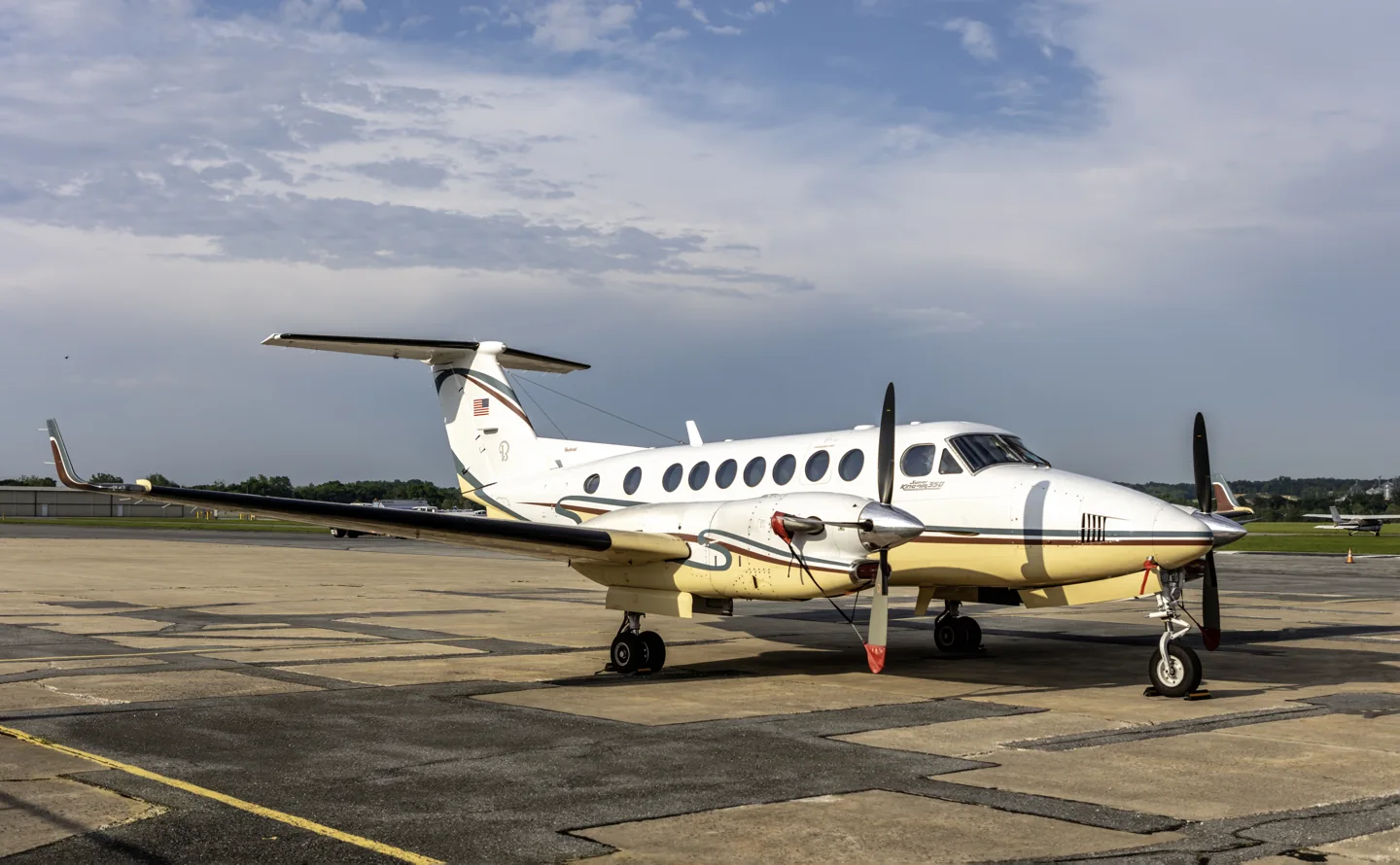 Acroterion · CC BY-SA 4.0 · Beechcraft King Air 350 N614CW FDK MD1.
Beechcraft's King Air range grew from the 90-series aircraft into a broad family of pressurised utility and business transports. The later 200 and 300 series were originally marketed as Super King Airs. Their T-tails provide a quick visual distinction from the smaller 90-series lineage.
The C90 and 350 aircraft gathered here differ in airframe, engines and systems. They also span conventional instrumentation and modern avionics. The named variants identify the airframe and equipment described in each source.
Beechcraft King Air 350i
More about this aircraft on AirframeDB
First flight: May 15, 1963 (Model 87) January 24, 1964 (Model 65-90)
Developed from: Beechcraft Queen Air
Aarons reports an evaluation of N120SK during the Super King Air 350's late certification programme. One of the two evaluation pilots already knew the Model 300, making the comparison especially revealing: that pilot initially overcontrolled in pitch because the new aircraft required less effort. The crew subsequently liked the balance between pitch and roll forces, its climb attitude and the view from the cockpit. Across six takeoffs, they did not encounter power surging that needed manual correction.
The report also describes slow flight and asymmetric airwork. The crew found useful aileron response through the stall exercises and liked the aircraft's engine-out handling. Their observations of longitudinal and lateral stability are tied to the test loading and configuration described in the article. Reduced control effort was a prominent difference from the earlier model he knew.
Horne accompanied Peter Herr on a delivery flight carrying a new King Air 350 from the United States to its European customer. From the cockpit, the high seating position, broad wing and substantial feel made an immediate impression. The journey then supplied a more demanding test of the aircraft's usefulness: the Goose Bay–Reykjavik leg lasted nearly five hours, with headwinds reaching 75 knots near Greenland and the predicted fuel reserve becoming an uncomfortable focus of attention.
They arrived with more fuel than the most worrying prediction had suggested, but the destination provided another challenge. Strong, gusty wind at Reykjavik moved even this heavy aircraft around, requiring an appreciable crab on approach. Horne's account also stresses the value of familiarity with the flare and of having another pilot share the navigation-system work.
McClellan writes from continuing experience in King Air 350 and 360 operations. He finds the cockpit demanding in small, physical ways: the pedestal makes getting into the seats awkward, propeller noise makes a good headset valuable, and changes in power or propeller speed call for attention to trim. The throttle response rewards careful, small movements. Once settled, however, he finds the seats comfortable, and passengers farther behind the propellers experience a quieter cabin.
His account also describes different crew preferences for operating the Pro Line Fusion avionics, which provide several ways to accomplish the same task. He favours cruising in the twenties rather than using the aircraft's highest available levels, partly for cabin comfort. Against those irritations, he sets his operation's dispatch experience: approximately 1,600 hours over four years with one cancellation attributed to a starter-generator. The combination helps explain his continued appreciation of an aircraft whose cockpit he describes without romanticising it.
Beechcraft's King Air range grew from the 90-series aircraft into a broad family of pressurised utility and business transports. The later 200 and 300 series were originally marketed as Super King Airs. Their T-tails provide a quick visual distinction from the smaller 90-series lineage.
The factory starting point selects Beechcraft King Air 350i across MSFS 2024, MSFS 2020, X-Plane 12, X-Plane 11.
Spring resistance builds with the selected airspeed response. A separate aerodynamic term adds speed-dependent control load.
Valid trim provides the configured pressure relief. Autopilot following is enabled for supported control references.
The King Air family spans C90, B200 and 350 airframes with different avionics and powerplants. The C90B manual documents mechanical elevator and aileron trim tabs, with rudder trim acting on yaw. A published 350 flight report describes heavier pitch than roll and effective trim wheels, supplying related-family handling context rather than a measured 350i force curve. The Black Square 350 and Airfoillabs 350 retain their own autopilot logic.
The gains are normalized profile settings. They describe the chosen effect balance; hand force depends on the device and its output limits. IAS references are tuning values rather than operating limits. Physical acceptance of this revision remains pending.
The final overall output scale applied to everything the model produces, before the device cap.
More: everything (spring, loads, effects) gets stronger together.
Less: everything softens together.
Why here: Scales overall profile strength while preserving effect balance, subject to device and output limits.
The base centring force that pulls the stick back to centre. Every other force stacks on it. Too low and the stick feels limp in normal flight; too high and it fights your hand and masks the smaller cues layered above it.
More: firmer centring that resists your hand at all times.
Less: a limper stick that leans on aerodynamic load alone.
Why here: Published 350 handling supports a qualitative pitch-heavy balance; it does not fix a universal pitch/roll force ratio for every King Air. The baseline spring is 0.9. Its low-speed blend reaches baseline strength at 105 KIAS.
Exact product researchBeechcraft King Air C90B POHA small neutral zone around centre where the spring stays quiet, so tiny movements at rest don't chatter. Wider is calmer but looser; narrower is more precise but can twitch around centre.
More: a calmer but looser centre with more free play.
Less: a tighter centre that may chatter at rest.
Why here: Sets travel around the centre before the baseline spring resists. Smaller values engage it sooner.
A master scale over both sustained axis loads, applied before their independent balance. Profiles normally leave this alone and tune the two axis loads instead.
More: both axes load up harder.
Less: both axes lighten together.
Why here: The aerodynamic-load gain is 0.68 with an indicated-speed reference of 210 KIAS. This supplies speed-dependent loading alongside the spring.
The airspeed where the spring reaches full strength. Between the start and this point, centring firms up progressively as airflow builds over the controls.
Why here: Sets the IAS where the low-speed blend reaches baseline strength; high-speed stiffening also uses it.
How much the centring itself stiffens with speed, on top of the deflection loads. Zero keeps centre feel constant; more makes the stick centre harder at cruise and looser in the pattern.
More: a centre that hardens noticeably as you go faster.
Less: constant centre feel at every speed.
Why here: The high-speed spring-stiffening gain is 0.1. It strengthens the permitted spring response above 105 KIAS, with the squared-speed ratio capped at 5.
The upper limit on speed-driven centre stiffening, so very fast flight can't wind the spring up without bound.
More: more total stiffening allowed at high speed.
Less: stiffening clamps off sooner.
Why here: Limits the squared airspeed ratio used for high-speed spring stiffening; it is not a device-force cap.
The sustained roll load from aileron deflection and airspeed, balanced independently of pitch. Together with the elevator load it sets the control-harmony ratio reviewers talk about.
More: heavier roll forces.
Less: lighter, quicker-feeling ailerons.
Why here: Roll and pitch aerodynamic scales are 0.75 and 1.05, respectively. They set the aerodynamic axis balance. No custom spring-travel curve is enabled.
The sustained pitch load from elevator deflection and airspeed, balanced independently of roll. This is the main lever behind a type's pitch weight. It does not touch aileron, spring, trim, or buffet forces.
More: heavier sustained pitch forces at speed.
Less: a lighter elevator that takes less muscle to hold.
Why here: Scales pitch aerodynamic loading; pitch spring travel and trim responses are separate settings.
A cap on each steady pitch or roll force before it reaches the device, guarding against slamming or saturating the hardware in strong maneuvers.
More: stronger peak steady forces before clipping.
Less: a gentler ceiling; hard maneuvers flatten out sooner.
Why here: Caps directed-force output. Native spring effects and device limits remain separate.
Enables the low-speed spring engagement window (start/full knots above). Off, the spring is constant at all speeds.
Why here: Allows baseline spring strength to rise with indicated airspeed where the control law permits it.
How much of the spring survives at a standstill, before airspeed can build any aerodynamic force. A high floor keeps the parked stick firm; a low floor gives the loose, cable-slack feel of a parked light aircraft.
More: a firmer stick while parked and taxiing.
Less: a floppier parked stick that only wakes up with airspeed.
Why here: Sets low-speed spring strength as a fraction of baseline when blending is enabled. One keeps full strength.
The airspeed where the spring begins climbing from its low-speed floor toward full strength: the controls "coming alive" on the takeoff roll.
Why here: Sets the IAS where the low-speed spring blend starts rising. This is a feel threshold, not a flight limit.
The indicated airspeed where aerodynamic load reaches its designed full level. It anchors the whole load curve to the aircraft's real speed range: a 172 loads up by 110 knots, a jet much later.
More: loads arrive later; the stick stays light up to a higher speed.
Less: loads arrive earlier and cruise feels heavier.
Why here: Sets the IAS reference for aerodynamic loading. It is an estimate, not published cruise TAS or a flight limit.
How strongly elevator trim relieves held pitch force and shifts where the stick settles. At 100%, a properly trimmed aircraft needs no held pressure, the trim-away-the-load workflow of real flying.
More: trim removes more of the held pitch force; at 100% full trim zeroes it.
Less: you keep holding force even when trimmed.
Why here: Mechanical elevator trim supports pitch relief, while aileron trim is separate from rudder trim. The selected authorities approximate those axis responses. Pitch authority 0.3 provides load relief and permitted centre movement; roll authority is 0.14.
Exact product researchBeechcraft King Air C90B POHThe same relief for roll trim. Most GA types have no real aileron trim, so this stays at zero; types with roll trim get a matching value.
More: roll trim removes more held roll force.
Less: roll trim does less.
Why here: Scales supported roll-trim relief and permitted centre movement. Zero removes roll response.
Rolling surface vibration from wheel speed and surface type: pavement, grass, or gravel under the gear.
More: louder surface texture through the stick.
Less: a smoother taxi.
Why here: Sets rolling texture strength, modified by speed, surface and undercarriage configuration.
Short discrete bumps from expansion joints, ruts, and rough surface, punctuating the continuous rumble.
More: sharper hits from joints and ruts.
Less: softer ground detail.
Why here: Sets gear-bump texture during ground motion, separate from touchdown impact.
The dedicated stall stick-shaker buzz, fired by the aircraft's own stall-warning system. Only types with a real shaker get a value; everything else relies on aerodynamic buffet and the horn.
More: a harder stick-shaker buzz.
Less: a subtler shaker.
Why here: Sets triggered shaker strength; inactive while the shaker feature is disabled.
Airframe shake approaching the stall and while the stall warning is active: how loudly this wing announces it is unhappy. Types with a crisp break get modest buffet and let the horn carry the warning.
More: a louder pre-stall shake.
Less: a quieter wing; the horn carries the warning.
Why here: Sets stall-buffet strength. Zero removes the cue without changing simulator stalls or warnings.
Transonic buffet approaching the Mach limit. Meaningful for jets near MMO, zero for pistons and turboprops that never get there.
More: stronger transonic buffet near the Mach limit.
Less: a smoother high-Mach ride.
Why here: Sets high-Mach buffet strength; onset and full-strength thresholds are separate.
Low-frequency airframe vibration with flaps extended into the airflow, in the speed window where they actually work the air.
More: a rougher ride with flaps working the air.
Less: smoother approach flap.
Why here: Sets flap buffet at the configured position and speed gates. Flap movement texture is separate.
Airframe drumming from retractable gear hanging in the airstream. Zero for fixed-gear types, where the airframe never changes shape.
More: more drumming with the wheels hanging out.
Less: cleaner gear-down flight.
Why here: Sets gear aerodynamic buffet; movement and ground-contact cues are separate.
The one-shot kick when the wheels meet the runway, scaled by sink rate: a greaser whispers, a firm arrival thumps.
More: a harder kick at touchdown.
Less: softer arrivals.
Why here: Sets landing-impact strength; landing telemetry and response shape determine the pulse.
Rollout vibration while reverse thrust or beta-range props are working. Zero for types without reverse.
More: a rougher rollout under reverse.
Less: quieter reverse.
Why here: Sets reverse-thrust vibration with valid reverser and engine conditions. Zero removes the cue.
Continuous powerplant vibration following RPM between idle and full power, the ever-present reminder that something is burning fuel up front.
More: more engine through the stick.
Less: a quieter powerplant.
Why here: Sets estimated engine vibration using configured telemetry and response, not measured cockpit vibration.
Continuous vibration only while the sim reports the flap surfaces actually travelling. It follows real actuator motion and failures, not an estimated timer.
More: more vibration while the flap surfaces travel.
Less: quieter flap runs.
Why here: Sets texture from observed flap movement; a command without movement does not establish the cue.
How far autopilot commands may physically move the stick. Kept tiny in MSFS, where a moved axis can read back as pilot input; zero disables following entirely.
More: the autopilot visibly moves your stick further.
Less: a barely perceptible follow.
Why here: Sets admitted AP-follow gain, not a percentage of travel. Runtime ownership and input limits still apply.
Whether this feature is active in this profile.
Why here: Following is on at 0.1 authority when a supported, valid autopilot control reference is available.
Whether this feature is active in this profile.
Why here: Permits centering hold during a supported AP state, separate from following a moving target.
Why here: Sets admitted AP neutral-hold strength; inactive while neutral hold is disabled.
Whether this feature is active in this profile.
Why here: Retained for compatibility and group membership. Trim relief, rather than this flag, controls centre movement.
Whether this feature is active in this profile.
Why here: Allows trim relief with supported control law and valid telemetry. Axis authorities set its amount.
Whether this feature is active in this profile.
Why here: Enables local force trim, separate from aircraft-owned trim and add-on integration qualification.
Whether this feature is active in this profile.
Why here: Allows load-factor changes to modify permitted spring laws. Passive fly-by-wire feel can suppress it.
Whether this feature is active in this profile.
Why here: Enables rate damping with the configured coefficients and control law.
Where this effect reaches full strength (or has fully faded, for washouts).
More: a more gradual build to a later peak.
Less: a quicker build.
Why here: Sets the final flap index for detent normalization. UP plus three detents uses maximum index3.
Where this effect begins fading in.
More: the effect begins later.
Less: it begins earlier.
Why here: Sets the first flap detent that admits buffet; this is a handle index, not degrees.
Whether this feature is active in this profile.
Why here: Enables aerodynamic cues; each still needs nonzero strength and its simulator conditions.
Whether this feature is active in this profile.
Why here: Permits shaker at supported warning conditions; the switch does not establish aircraft equipment.
Whether this feature is active in this profile.
Why here: Enables ground effects; each still needs its own strength and contact or motion telemetry.
Whether this feature is active in this profile.
Why here: Enables engine cues with nonzero settings and valid running-engine telemetry.
Whether this feature is active in this profile.
Why here: Enables accessory cues with configured strengths and observed accessory movement.
The strength of this effect.
More: a stronger effect.
Less: a weaker one.
Why here: Sets texture from observed gear movement, separate from aerodynamic and touchdown effects.
| Parameter | Value | What it controls and why |
|---|---|---|
| Spring strength | 0.9 | Published 350 handling supports a qualitative pitch-heavy balance; it does not fix a universal pitch/roll force ratio for every King Air. The baseline spring is 0.9. Its low-speed blend reaches baseline strength at 105 KIAS. |
| Spring deadband | 0.05 | Sets travel around the centre before the baseline spring resists. Smaller values engage it sooner. |
| Force gain | 0.68 | The aerodynamic-load gain is 0.68 with an indicated-speed reference of 210 KIAS. This supplies speed-dependent loading alongside the spring. |
| Master gain | 0.86 | Scales overall profile strength while preserving effect balance, subject to device and output limits. |
| Spring full-strength speed | 105 kt | Sets the IAS where the low-speed blend reaches baseline strength; high-speed stiffening also uses it. |
| Airspeed spring stiffening | 0.1 | The high-speed spring-stiffening gain is 0.1. It strengthens the permitted spring response above 105 KIAS, with the squared-speed ratio capped at 5. |
| Airspeed stiffening cap | 5 | Limits the squared airspeed ratio used for high-speed spring stiffening; it is not a device-force cap. |
| Aileron force scale | 0.75 | Roll and pitch aerodynamic scales are 0.75 and 1.05, respectively. They set the aerodynamic axis balance. No custom spring-travel curve is enabled. |
| Elevator force scale | 1.05 | Scales pitch aerodynamic loading; pitch spring travel and trim responses are separate settings. |
| Maximum output force | 0.66 | Caps directed-force output. Native spring effects and device limits remain separate. |
| Autopilot · Follow enabled | True | Following is on at 0.1 authority when a supported, valid autopilot control reference is available. |
| Autopilot · Follow authority | 0.1 | Sets admitted AP-follow gain, not a percentage of travel. Runtime ownership and input limits still apply. |
| Autopilot · Neutral hold enabled | False | Permits centering hold during a supported AP state, separate from following a moving target. |
| Autopilot · Neutral hold strength | 0.6 | Sets admitted AP neutral-hold strength; inactive while neutral hold is disabled. |
| StickFeel · Trim feel enabled | True | Retained for compatibility and group membership. Trim relief, rather than this flag, controls centre movement. |
| StickFeel · Trim relief enabled | True | Allows trim relief with supported control law and valid telemetry. Axis authorities set its amount. |
| Aero · Max flap index | 2 | Sets the final flap index for detent normalization. UP plus three detents uses maximum index3. |
| Aero · Min flap index | 1 | Sets the first flap detent that admits buffet; this is a handle index, not degrees. |
| Aero · Amplitude | 0.5 | Sets triggered shaker strength; inactive while the shaker feature is disabled. |
| Dynamic-pressure blend | True | Allows baseline spring strength to rise with indicated airspeed where the control law permits it. |
| Minimum spring factor | 0.55 | Sets low-speed spring strength as a fraction of baseline when blending is enabled. One keeps full strength. |
| Spring wake-up speed | 25 kt | Sets the IAS where the low-speed spring blend starts rising. This is a feel threshold, not a flight limit. |
| Force tuning speed | 210 kt | Sets the IAS reference for aerodynamic loading. It is an estimate, not published cruise TAS or a flight limit. |
| StickFeel · Elevator authority | 0.3 | Mechanical elevator trim supports pitch relief, while aileron trim is separate from rudder trim. The selected authorities approximate those axis responses. Pitch authority 0.3 provides load relief and permitted centre movement; roll authority is 0.14. |
| StickFeel · Aileron authority | 0.14 | Scales supported roll-trim relief and permitted centre movement. Zero removes roll response. |
| StickFeel · Force trim enabled | False | Enables local force trim, separate from aircraft-owned trim and add-on integration qualification. |
| StickFeel · G load enabled | True | Allows load-factor changes to modify permitted spring laws. Passive fly-by-wire feel can suppress it. |
| StickFeel · Rate damping enabled | True | Enables rate damping with the configured coefficients and control law. |
| Aero · Enabled | True | Enables aerodynamic cues; each still needs nonzero strength and its simulator conditions. |
| Aero · Gain | 0.28 | Sets stall-buffet strength. Zero removes the cue without changing simulator stalls or warnings. |
| Aero · Gain | 0.12 | Sets high-Mach buffet strength; onset and full-strength thresholds are separate. |
| Aero · Gain | 0.3 | Sets flap buffet at the configured position and speed gates. Flap movement texture is separate. |
| Aero · Gain | 0.24 | Sets gear aerodynamic buffet; movement and ground-contact cues are separate. |
| Aero · Shaker enabled | False | Permits shaker at supported warning conditions; the switch does not establish aircraft equipment. |
| Ground · Enabled | True | Enables ground effects; each still needs its own strength and contact or motion telemetry. |
| Ground · Gain | 0.42 | Sets rolling texture strength, modified by speed, surface and undercarriage configuration. |
| Ground · Gain | 0.32 | Sets gear-bump texture during ground motion, separate from touchdown impact. |
| Ground · Gain | 0.82 | Sets landing-impact strength; landing telemetry and response shape determine the pulse. |
| Ground · Gain | 0.48 | Sets reverse-thrust vibration with valid reverser and engine conditions. Zero removes the cue. |
| Engine · Enabled | True | Enables engine cues with nonzero settings and valid running-engine telemetry. |
| Engine · Gain | 0.16 | Sets estimated engine vibration using configured telemetry and response, not measured cockpit vibration. |
| Mechanical · Enabled | True | Enables accessory cues with configured strengths and observed accessory movement. |
| Mechanical · Gain | 0.18 | Sets texture from observed flap movement; a command without movement does not establish the cue. |
| Mechanical · Gain | 0.18 | Sets texture from observed gear movement, separate from aerodynamic and touchdown effects. |
If your time in the type says this page got something wrong, correct it here.
This page is built from cited references, and real time in the type beats a citation. Quote the claim that reads wrong and tell us what the actual aircraft does. Corrections go to the maintainer for review and feed the next revision of this research.
Open conversation about flying and tuning the Beechcraft King Air family, in the community forum. Corrections above go privately to the maintainer; hangar talk is public.