Development milestones
First flight: 14 July 1988
Developed from: Mooney 301
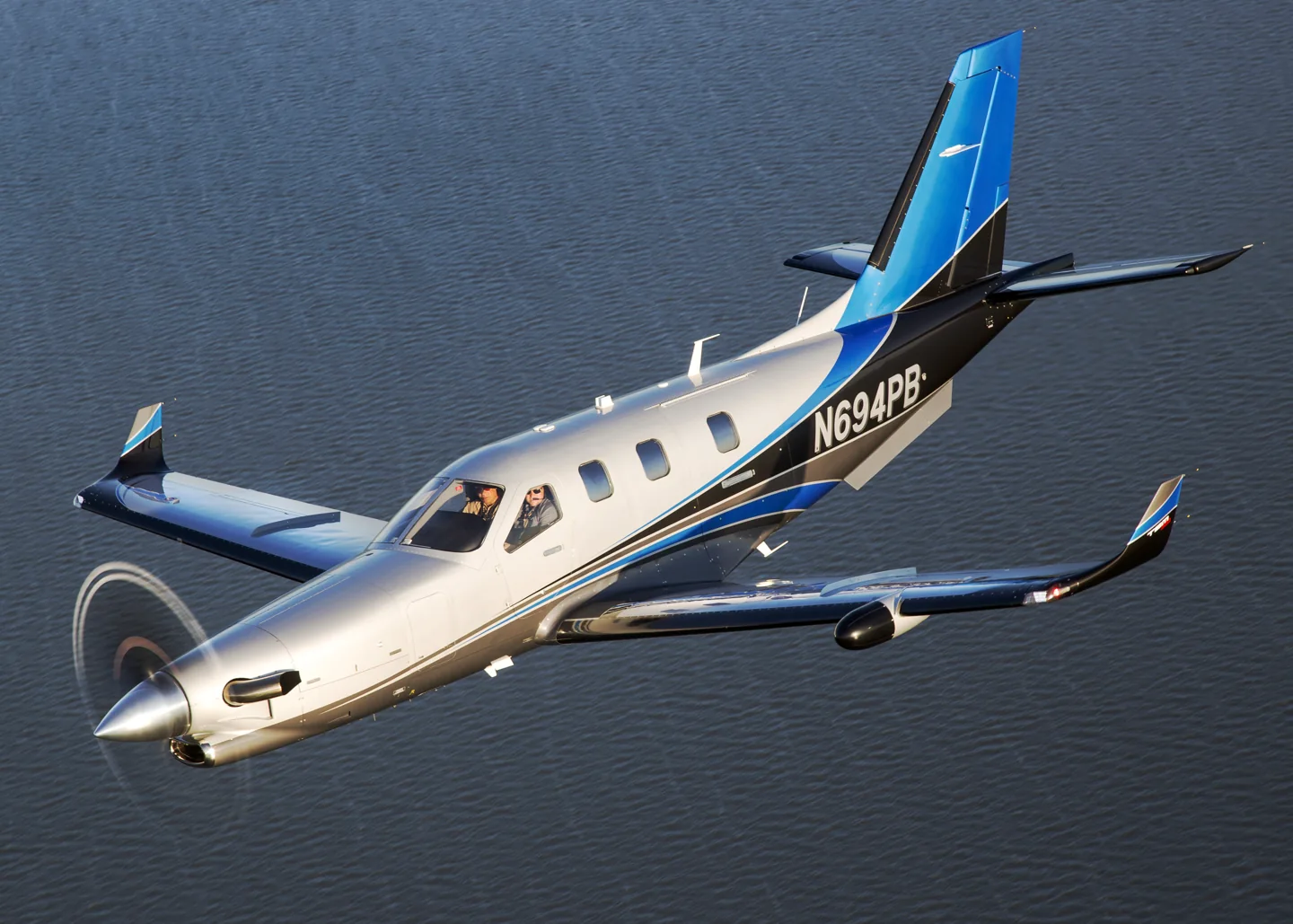 Michael Mainiero · CC BY-SA 3.0 · Daher-SOCATA TBM 900 in flight
The TBM programme began as a collaboration between SOCATA and Mooney and continued under Daher. The low-wing airframe carries one nose-mounted turboprop and a pressurised cabin. Successive versions developed the engines, aerodynamics, avionics and pilot interface.
The analogue-panel TBM 850, glass-cockpit TBM 900 and TBM 930 occupy different points in that progression. Simulator developers model these panel generations and different levels of persistent system behaviour, documented for each product.
Daher TBM 930
More about this aircraft on AirframeDB
First flight: 14 July 1988
Developed from: Mooney 301
Horne flew the TBM 930 at Tarbes with chief test pilot Stéphane Jacques in March 2016. Their demonstration deliberately explored the aircraft's response to a depressurisation scenario: at 20,000 feet they put on oxygen masks and shut off the bleed-air supply. Horne watched the emergency-descent function turn the aircraft and bring it down to a selected safe level, with terrain affecting the altitude used for the exercise. It was a planned demonstration with a test pilot, rather than an account of an in-service emergency.
He also explored the electronic stability protection and the new G3000 interface. The protective servo forces became noticeable as he pushed toward the system's limits. Meanwhile, the touchscreen menus introduced a learning task even for a pilot familiar with earlier TBMs: finding the right page and returning through layers of selections required practice.
Boatman joined owner-pilot Malte Lorenz on flights between Hagerstown and Republic Airport in his 2024 TBM 960. The trip put the aircraft into the congested Northeast airspace in which Lorenz regularly used it. A complicated initial clearance and relatively low assigned altitudes reinforced his preference for a turboprop on shorter journeys. At Republic, they made an instrument approach beneath a coastal cloud layer. Another practical moment came when extra passengers wanted to join: the on-board loading calculation showed the proposed load exceeded limits, and they declined the request.
Returning to Hagerstown brought strong southerly winds and a choice of the shorter runway with a more favourable alignment. Lorenz disconnected the autopilot early and controlled the approach speed carefully. Boatman describes a gentle touchdown and ample room remaining, while acknowledging how short the runway looked from the approaching aircraft.
Gerzanics evaluated TBM 940 F-HGDA with Daher demonstration pilot Wayman Luy at Pompano Beach. He found the ground steering precise and the yoke forces light during takeoff. In a fast descent the aircraft responded crisply in all three axes. His stall demonstrations were more varied: the clean stall produced a wings-level pitch break, while flap-extended stalls included a left wing drop that he arrested during recovery. Luy suggested the left-wing radar installation as a possible explanation for that asymmetry.
The flight also contrasted automation with hands-on flying. Gerzanics watched the autopilot and autothrottle manage an instrument approach and coupled go-around, then handled a simulated engine failure toward Belle Glade. They arrived a little high and touched down long, using braking and reverse to slow. He particularly enjoyed manoeuvring the aircraft through tight turns on the narrow runway afterward. The engine remained available during the simulated failure.
The TBM programme began as a collaboration between SOCATA and Mooney and continued under Daher. The low-wing airframe carries one nose-mounted turboprop and a pressurised cabin. Successive versions developed the engines, aerodynamics, avionics and pilot interface.
The factory starting point selects Daher TBM 930 across MSFS 2024, MSFS 2020, X-Plane 11.
The powered-control profile provides its selected yoke centering. Spring resistance builds with the selected airspeed response. A separate aerodynamic term adds speed-dependent control load.
Trim changes aircraft balance; the selected profile determines the amount of hardware relief. Valid trim provides the configured pressure relief. Autopilot following is enabled for supported control references.
The selected TBM documentation distinguishes elevator anti-tabs from other trim tabs. Automatic-flight disengagement can leave flight-director modes displayed, so the flight director, autopilot and manual trim are separate cockpit states. TBM model and avionics generations remain named in the individual product.
The gains are normalized profile settings. They describe the chosen effect balance; hand force depends on the device and its output limits. IAS references are tuning values rather than operating limits. Physical acceptance of this revision remains pending.
The final overall output scale applied to everything the model produces, before the device cap.
More: everything (spring, loads, effects) gets stronger together.
Less: everything softens together.
Why here: Scales overall profile strength while preserving effect balance, subject to device and output limits.
The base centring force that pulls the stick back to centre. Every other force stacks on it. Too low and the stick feels limp in normal flight; too high and it fights your hand and masks the smaller cues layered above it.
More: firmer centring that resists your hand at all times.
Less: a limper stick that leans on aerodynamic load alone.
Why here: The powered-control profile provides its selected yoke centering. The baseline spring is 0.86. Its low-speed blend reaches baseline strength at 90 KIAS.
operating manualTBM 850 manualTBM 900: Daher Builds a Near-JetDaher’s TBM 930: MAX Upset ProtectionTBM 900 — AOPA Pilot, April 2014A small neutral zone around centre where the spring stays quiet, so tiny movements at rest don't chatter. Wider is calmer but looser; narrower is more precise but can twitch around centre.
More: a calmer but looser centre with more free play.
Less: a tighter centre that may chatter at rest.
Why here: Sets travel around the centre before the baseline spring resists. Smaller values engage it sooner.
A master scale over both sustained axis loads, applied before their independent balance. Profiles normally leave this alone and tune the two axis loads instead.
More: both axes load up harder.
Less: both axes lighten together.
Why here: The aerodynamic-load gain is 0.7 with an indicated-speed reference of 205 KIAS. This supplies speed-dependent loading alongside the spring.
The airspeed where the spring reaches full strength. Between the start and this point, centring firms up progressively as airflow builds over the controls.
Why here: Sets the IAS where the low-speed blend reaches baseline strength; high-speed stiffening also uses it.
How much the centring itself stiffens with speed, on top of the deflection loads. Zero keeps centre feel constant; more makes the stick centre harder at cruise and looser in the pattern.
More: a centre that hardens noticeably as you go faster.
Less: constant centre feel at every speed.
Why here: The high-speed spring-stiffening gain is 0.12. It strengthens the permitted spring response above 90 KIAS, with the squared-speed ratio capped at 5.
The upper limit on speed-driven centre stiffening, so very fast flight can't wind the spring up without bound.
More: more total stiffening allowed at high speed.
Less: stiffening clamps off sooner.
Why here: Limits the squared airspeed ratio used for high-speed spring stiffening; it is not a device-force cap.
The sustained roll load from aileron deflection and airspeed, balanced independently of pitch. Together with the elevator load it sets the control-harmony ratio reviewers talk about.
More: heavier roll forces.
Less: lighter, quicker-feeling ailerons.
Why here: Roll and pitch aerodynamic scales are 0.85 and 1, respectively. They set the aerodynamic axis balance. No custom spring-travel curve is enabled.
The sustained pitch load from elevator deflection and airspeed, balanced independently of roll. This is the main lever behind a type's pitch weight. It does not touch aileron, spring, trim, or buffet forces.
More: heavier sustained pitch forces at speed.
Less: a lighter elevator that takes less muscle to hold.
Why here: Scales pitch aerodynamic loading; pitch spring travel and trim responses are separate settings.
A cap on each steady pitch or roll force before it reaches the device, guarding against slamming or saturating the hardware in strong maneuvers.
More: stronger peak steady forces before clipping.
Less: a gentler ceiling; hard maneuvers flatten out sooner.
Why here: Caps directed-force output. Native spring effects and device limits remain separate.
Enables the low-speed spring engagement window (start/full knots above). Off, the spring is constant at all speeds.
Why here: Allows baseline spring strength to rise with indicated airspeed where the control law permits it.
How much of the spring survives at a standstill, before airspeed can build any aerodynamic force. A high floor keeps the parked stick firm; a low floor gives the loose, cable-slack feel of a parked light aircraft.
More: a firmer stick while parked and taxiing.
Less: a floppier parked stick that only wakes up with airspeed.
Why here: Sets low-speed spring strength as a fraction of baseline when blending is enabled. One keeps full strength.
The airspeed where the spring begins climbing from its low-speed floor toward full strength: the controls "coming alive" on the takeoff roll.
Why here: Sets the IAS where the low-speed spring blend starts rising. This is a feel threshold, not a flight limit.
The indicated airspeed where aerodynamic load reaches its designed full level. It anchors the whole load curve to the aircraft's real speed range: a 172 loads up by 110 knots, a jet much later.
More: loads arrive later; the stick stays light up to a higher speed.
Less: loads arrive earlier and cruise feels heavier.
Why here: Sets the IAS reference for aerodynamic loading. It is an estimate, not published cruise TAS or a flight limit.
How strongly elevator trim relieves held pitch force and shifts where the stick settles. At 100%, a properly trimmed aircraft needs no held pressure, the trim-away-the-load workflow of real flying.
More: trim removes more of the held pitch force; at 100% full trim zeroes it.
Less: you keep holding force even when trimmed.
Why here: Trim changes aircraft balance; the selected profile determines the amount of hardware relief. Pitch authority 0.3 provides load relief and permitted centre movement; roll authority is 0.12.
operating manualTBM 850 manualTBM 900: Daher Builds a Near-JetDaher’s TBM 930: MAX Upset ProtectionTBM 900 — AOPA Pilot, April 2014The same relief for roll trim. Most GA types have no real aileron trim, so this stays at zero; types with roll trim get a matching value.
More: roll trim removes more held roll force.
Less: roll trim does less.
Why here: Scales supported roll-trim relief and permitted centre movement. Zero removes roll response.
Rolling surface vibration from wheel speed and surface type: pavement, grass, or gravel under the gear.
More: louder surface texture through the stick.
Less: a smoother taxi.
Why here: Sets rolling texture strength, modified by speed, surface and undercarriage configuration.
Short discrete bumps from expansion joints, ruts, and rough surface, punctuating the continuous rumble.
More: sharper hits from joints and ruts.
Less: softer ground detail.
Why here: Sets gear-bump texture during ground motion, separate from touchdown impact.
The dedicated stall stick-shaker buzz, fired by the aircraft's own stall-warning system. Only types with a real shaker get a value; everything else relies on aerodynamic buffet and the horn.
More: a harder stick-shaker buzz.
Less: a subtler shaker.
Why here: Sets triggered shaker strength; inactive while the shaker feature is disabled.
Airframe shake approaching the stall and while the stall warning is active: how loudly this wing announces it is unhappy. Types with a crisp break get modest buffet and let the horn carry the warning.
More: a louder pre-stall shake.
Less: a quieter wing; the horn carries the warning.
Why here: Sets stall-buffet strength. Zero removes the cue without changing simulator stalls or warnings.
Transonic buffet approaching the Mach limit. Meaningful for jets near MMO, zero for pistons and turboprops that never get there.
More: stronger transonic buffet near the Mach limit.
Less: a smoother high-Mach ride.
Why here: Sets high-Mach buffet strength; onset and full-strength thresholds are separate.
Low-frequency airframe vibration with flaps extended into the airflow, in the speed window where they actually work the air.
More: a rougher ride with flaps working the air.
Less: smoother approach flap.
Why here: Sets flap buffet at the configured position and speed gates. Flap movement texture is separate.
Airframe drumming from retractable gear hanging in the airstream. Zero for fixed-gear types, where the airframe never changes shape.
More: more drumming with the wheels hanging out.
Less: cleaner gear-down flight.
Why here: Sets gear aerodynamic buffet; movement and ground-contact cues are separate.
The one-shot kick when the wheels meet the runway, scaled by sink rate: a greaser whispers, a firm arrival thumps.
More: a harder kick at touchdown.
Less: softer arrivals.
Why here: Sets landing-impact strength; landing telemetry and response shape determine the pulse.
Rollout vibration while reverse thrust or beta-range props are working. Zero for types without reverse.
More: a rougher rollout under reverse.
Less: quieter reverse.
Why here: Sets reverse-thrust vibration with valid reverser and engine conditions. Zero removes the cue.
Continuous powerplant vibration following RPM between idle and full power, the ever-present reminder that something is burning fuel up front.
More: more engine through the stick.
Less: a quieter powerplant.
Why here: Sets estimated engine vibration using configured telemetry and response, not measured cockpit vibration.
Continuous vibration only while the sim reports the flap surfaces actually travelling. It follows real actuator motion and failures, not an estimated timer.
More: more vibration while the flap surfaces travel.
Less: quieter flap runs.
Why here: Sets texture from observed flap movement; a command without movement does not establish the cue.
How far autopilot commands may physically move the stick. Kept tiny in MSFS, where a moved axis can read back as pilot input; zero disables following entirely.
More: the autopilot visibly moves your stick further.
Less: a barely perceptible follow.
Why here: Sets admitted AP-follow gain, not a percentage of travel. Runtime ownership and input limits still apply.
Whether this feature is active in this profile.
Why here: Following is on at 0.1 authority when a supported, valid autopilot control reference is available.
Whether this feature is active in this profile.
Why here: Permits centering hold during a supported AP state, separate from following a moving target.
Why here: Sets admitted AP neutral-hold strength; inactive while neutral hold is disabled.
Whether this feature is active in this profile.
Why here: Retained for compatibility and group membership. Trim relief, rather than this flag, controls centre movement.
Whether this feature is active in this profile.
Why here: Allows trim relief with supported control law and valid telemetry. Axis authorities set its amount.
Whether this feature is active in this profile.
Why here: Enables local force trim, separate from aircraft-owned trim and add-on integration qualification.
Whether this feature is active in this profile.
Why here: Allows load-factor changes to modify permitted spring laws. Passive fly-by-wire feel can suppress it.
Whether this feature is active in this profile.
Why here: Enables rate damping with the configured coefficients and control law.
Where this effect reaches full strength (or has fully faded, for washouts).
More: a more gradual build to a later peak.
Less: a quicker build.
Why here: Sets the final flap index for detent normalization. UP plus three detents uses maximum index3.
Where this effect begins fading in.
More: the effect begins later.
Less: it begins earlier.
Why here: Sets the first flap detent that admits buffet; this is a handle index, not degrees.
Whether this feature is active in this profile.
Why here: Enables aerodynamic cues; each still needs nonzero strength and its simulator conditions.
Whether this feature is active in this profile.
Why here: Permits shaker at supported warning conditions; the switch does not establish aircraft equipment.
Whether this feature is active in this profile.
Why here: Enables ground effects; each still needs its own strength and contact or motion telemetry.
Whether this feature is active in this profile.
Why here: Enables engine cues with nonzero settings and valid running-engine telemetry.
Whether this feature is active in this profile.
Why here: Enables accessory cues with configured strengths and observed accessory movement.
The strength of this effect.
More: a stronger effect.
Less: a weaker one.
Why here: Sets texture from observed gear movement, separate from aerodynamic and touchdown effects.
| Parameter | Value | What it controls and why |
|---|---|---|
| Spring strength | 0.86 | The powered-control profile provides its selected yoke centering. The baseline spring is 0.86. Its low-speed blend reaches baseline strength at 90 KIAS. |
| Spring deadband | 0.045 | Sets travel around the centre before the baseline spring resists. Smaller values engage it sooner. |
| Force gain | 0.7 | The aerodynamic-load gain is 0.7 with an indicated-speed reference of 205 KIAS. This supplies speed-dependent loading alongside the spring. |
| Master gain | 0.85 | Scales overall profile strength while preserving effect balance, subject to device and output limits. |
| Spring full-strength speed | 90 kt | Sets the IAS where the low-speed blend reaches baseline strength; high-speed stiffening also uses it. |
| Airspeed spring stiffening | 0.12 | The high-speed spring-stiffening gain is 0.12. It strengthens the permitted spring response above 90 KIAS, with the squared-speed ratio capped at 5. |
| Airspeed stiffening cap | 5 | Limits the squared airspeed ratio used for high-speed spring stiffening; it is not a device-force cap. |
| Aileron force scale | 0.85 | Roll and pitch aerodynamic scales are 0.85 and 1, respectively. They set the aerodynamic axis balance. No custom spring-travel curve is enabled. |
| Elevator force scale | 1 | Scales pitch aerodynamic loading; pitch spring travel and trim responses are separate settings. |
| Maximum output force | 0.6 | Caps directed-force output. Native spring effects and device limits remain separate. |
| Autopilot · Follow enabled | True | Following is on at 0.1 authority when a supported, valid autopilot control reference is available. |
| Autopilot · Follow authority | 0.1 | Sets admitted AP-follow gain, not a percentage of travel. Runtime ownership and input limits still apply. |
| Autopilot · Neutral hold enabled | False | Permits centering hold during a supported AP state, separate from following a moving target. |
| Autopilot · Neutral hold strength | 0.6 | Sets admitted AP neutral-hold strength; inactive while neutral hold is disabled. |
| StickFeel · Trim feel enabled | True | Retained for compatibility and group membership. Trim relief, rather than this flag, controls centre movement. |
| StickFeel · Trim relief enabled | True | Allows trim relief with supported control law and valid telemetry. Axis authorities set its amount. |
| Aero · Max flap index | 2 | Sets the final flap index for detent normalization. UP plus three detents uses maximum index3. |
| Aero · Min flap index | 1 | Sets the first flap detent that admits buffet; this is a handle index, not degrees. |
| Aero · Amplitude | 0.7 | Sets triggered shaker strength; inactive while the shaker feature is disabled. |
| Dynamic-pressure blend | True | Allows baseline spring strength to rise with indicated airspeed where the control law permits it. |
| Minimum spring factor | 0.55 | Sets low-speed spring strength as a fraction of baseline when blending is enabled. One keeps full strength. |
| Spring wake-up speed | 20 kt | Sets the IAS where the low-speed spring blend starts rising. This is a feel threshold, not a flight limit. |
| Force tuning speed | 205 kt | Sets the IAS reference for aerodynamic loading. It is an estimate, not published cruise TAS or a flight limit. |
| StickFeel · Elevator authority | 0.3 | Trim changes aircraft balance; the selected profile determines the amount of hardware relief. Pitch authority 0.3 provides load relief and permitted centre movement; roll authority is 0.12. |
| StickFeel · Aileron authority | 0.12 | Scales supported roll-trim relief and permitted centre movement. Zero removes roll response. |
| StickFeel · Force trim enabled | False | Enables local force trim, separate from aircraft-owned trim and add-on integration qualification. |
| StickFeel · G load enabled | True | Allows load-factor changes to modify permitted spring laws. Passive fly-by-wire feel can suppress it. |
| StickFeel · Rate damping enabled | True | Enables rate damping with the configured coefficients and control law. |
| Aero · Enabled | True | Enables aerodynamic cues; each still needs nonzero strength and its simulator conditions. |
| Aero · Gain | 0.3 | Sets stall-buffet strength. Zero removes the cue without changing simulator stalls or warnings. |
| Aero · Gain | 0.2 | Sets high-Mach buffet strength; onset and full-strength thresholds are separate. |
| Aero · Gain | 0.32 | Sets flap buffet at the configured position and speed gates. Flap movement texture is separate. |
| Aero · Gain | 0.22 | Sets gear aerodynamic buffet; movement and ground-contact cues are separate. |
| Aero · Shaker enabled | True | Permits shaker at supported warning conditions; the switch does not establish aircraft equipment. |
| Ground · Enabled | True | Enables ground effects; each still needs its own strength and contact or motion telemetry. |
| Ground · Gain | 0.36 | Sets rolling texture strength, modified by speed, surface and undercarriage configuration. |
| Ground · Gain | 0.26 | Sets gear-bump texture during ground motion, separate from touchdown impact. |
| Ground · Gain | 0.72 | Sets landing-impact strength; landing telemetry and response shape determine the pulse. |
| Ground · Gain | 0.36 | Sets reverse-thrust vibration with valid reverser and engine conditions. Zero removes the cue. |
| Engine · Enabled | True | Enables engine cues with nonzero settings and valid running-engine telemetry. |
| Engine · Gain | 0.14 | Sets estimated engine vibration using configured telemetry and response, not measured cockpit vibration. |
| Mechanical · Enabled | True | Enables accessory cues with configured strengths and observed accessory movement. |
| Mechanical · Gain | 0.16 | Sets texture from observed flap movement; a command without movement does not establish the cue. |
| Mechanical · Gain | 0.18 | Sets texture from observed gear movement, separate from aerodynamic and touchdown effects. |
If your time in the type says this page got something wrong, correct it here.
This page is built from cited references, and real time in the type beats a citation. Quote the claim that reads wrong and tell us what the actual aircraft does. Corrections go to the maintainer for review and feed the next revision of this research.
Open conversation about flying and tuning the Daher TBM family, in the community forum. Corrections above go privately to the maintainer; hangar talk is public.