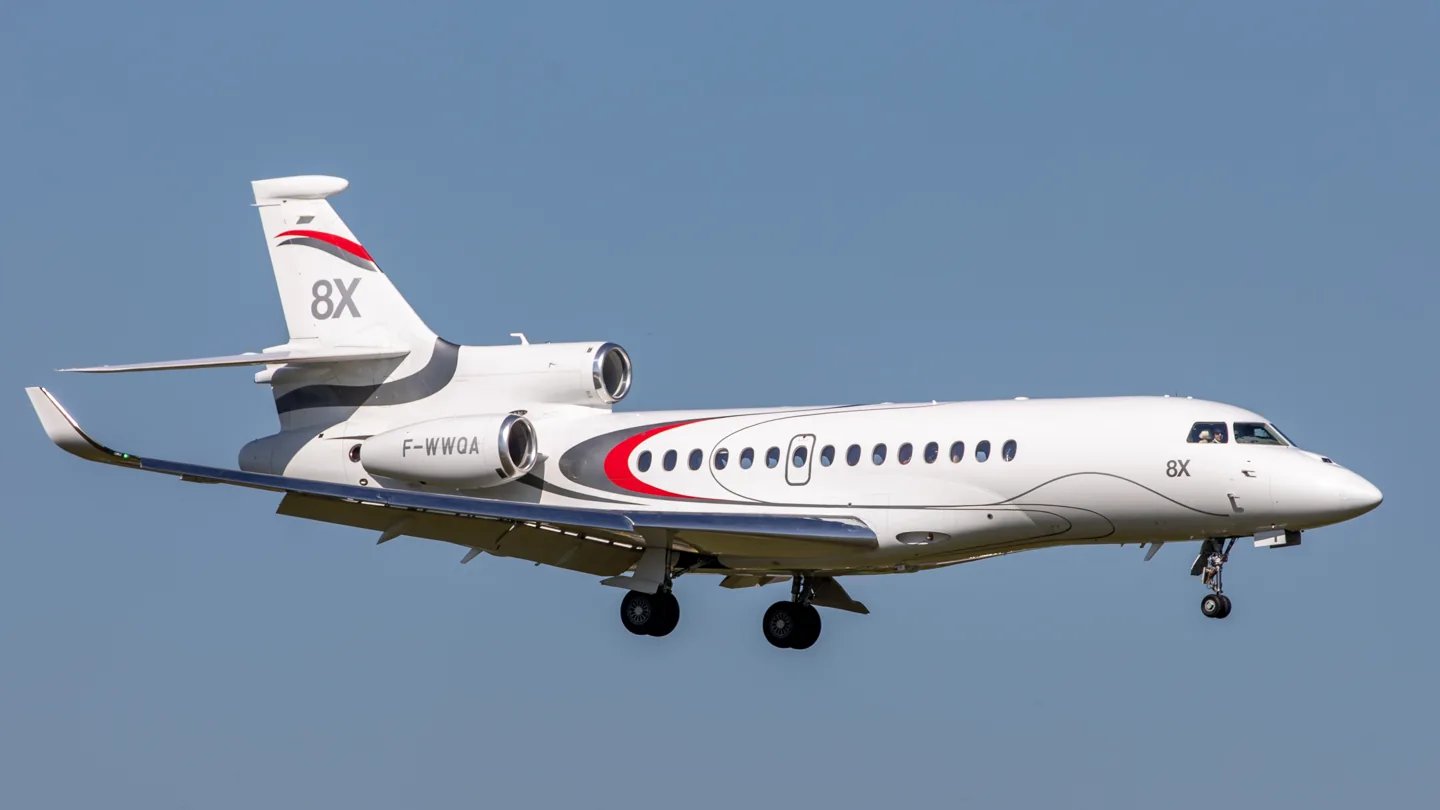
Aircraft libraryDassault Falcon 8X
Dassault Falcon 8XMatti Blume · CC BY-SA 4.0 · Falcon 8X in flight (Paris Air Show 2019)

Dassault Falcon 8X

Dassault's long-range Falcon 8X, developed from the three-engine 7X.
Business jet1 profile choices

Know the plane

The Falcon 8X extends the 7X lineage through aerodynamic changes, engine optimization and additional fuel capacity. First deliveries took place in October 2016. The selected background reference covers the 7X and 8X, with figures labelled by model. The simulator listing records its product's development status.

Falcon 8X: manufacturer specifications

Wingspan
26.29 m↗
Length
24.46 m↗
Height
7.94 m↗
Maximum takeoff weight
33,113 kg↗
Engines
3 Pratt & Whitney Canada PW307D↗
Maximum operating Mach
0.90↗
Maximum certified altitude
51,000 ft↗
Cabin length
13 m↗
Range
6,450 nm; 8 passengers, NBAA IFR reserves↗

More about this aircraft on AirframeDB

Bordeaux launches the 8X flight-test campaign

Dassault’s announcement dates the first flight to 6 February 2015 at Bordeaux-Mérignac. Eric Gérard and Hervé Laverne flew the first prototype, beginning the airborne phase of a programme whose remaining test and certification work lay ahead.

Approach figures depend on landing weight

Dassault quotes a 107 KIAS reference approach speed at typical landing weight. That condition belongs with the number: it is not a single approach speed for every weight and configuration. The 8X uses digital flight controls and three PW307D engines.

Learning the feel of an instrumented prototype

George encountered the 8X as a working test aircraft, with ballast tanks and instrumentation taking the place of a finished passenger cabin. Gérard occupied the right seat and Lascourrèges the jumpseat. He assessed handling during development in a test aircraft.

The first moments of taxiing required adjustment to the steering and brakes, which initially felt sensitive. Once flying, George appreciated the sidestick’s balance of pitch and roll forces and the feedback through his hand. His account follows the process of becoming comfortable with unfamiliar controls, keeping those personal impressions separate from the performance work still belonging to the wider test programme.

A first flight brings a test pilot both pride and anticipation

Gérard and Laverne took the first Falcon 8X prototype into the air from Bordeaux-Mérignac for a flight lasting one hour and forty-five minutes. The programme included handling checks, system tests and a climb to high altitude before the crew returned to the departure airport. It was the beginning of the aircraft’s flying test campaign.

Gérard described the experience with pride, saying the flight had met its objectives and exceeded some of them. He felt honoured to participate and expressed confidence about the work ahead. Those remarks record the pilot’s reaction to a successful first outing; his optimism concerned a programme still to be completed, rather than an announcement that development or certification had already finished.

Simulator preparation meets a real traffic alert and an imperfect flare

A simulator session gave Thurber time to explore the 8X’s controls before flying the aircraft at Istres the next day. In the air, small sidestick movements soon felt comfortable, although steep turns were less tidy when he worked against the stick’s resistance. He became more familiar with the aircraft through the manoeuvres.

The return included his first actual traffic-collision avoidance resolution advisory, followed by a landing that needed correction after he began the flare too high. A little additional power helped produce a smooth arrival.

Public sources 7
  1. Dassault Falcon 7XResearch background · retrieved 2026-09-12
  2. Falcon 8XOfficial developer / designated store catalogue · checked 2026-09-12
  3. Left Seat on Flight 92: Falcon 8XFred George · November 2015 issue
  4. Falcon 8X Completes First Flight6 February 2015 · Eric Gérard and Hervé Laverne
  5. Pilot Report: Falcon 8XMatt Thurber · January 2017; seven-page publisher PDF preserved by the Internet Archive
  6. ICAO Doc 8643 — aircraft type designatorsPublic search data retrieved 2026-09-14; authority update 2026-09-03
  7. Falcon 8X specificationsFalcon 8X: manufacturer specifications

How the profile models it

Dassault Falcon 8X

Free + Pro

The Falcon 8X extends the 7X lineage through aerodynamic changes, engine optimization and additional fuel capacity. First deliveries took place in October 2016. The selected background reference covers the 7X and 8X, with figures labelled by model. The simulator listing records its product's development status.

This starting point selects Dassault Falcon 8X. Its aircraft-level settings do not select a particular developer’s custom systems.

The fixed-centre choice represents an electronic-control inceptor. The spring stays independent of airspeed. Directed aerodynamic loading is omitted. Enabled travel curves shape pitch and roll resistance separately.

Aircraft trim is separate from the configured hardware centre. Aircraft trim retains the fixed hardware centre. Autopilot following is off.

This exact revision has not been enabled for public installation.

Controls and trim

The Falcon 8X extends the 7X through aerodynamic changes, optimized engines and additional fuel capacity. Deliveries began in October 2016. Its electronic flight-control background belongs to this later aircraft, while the simulator’s development status is a separate product fact.

Dassault DFCS backgrounder

About the values

The gains are normalized profile settings. They describe the chosen effect balance; hand force depends on the device and its output limits. IAS references are tuning values rather than operating limits. Physical acceptance of this revision remains pending.

Master gain & control system

Master gain85%

The final overall output scale applied to everything the model produces, before the device cap.

More: everything (spring, loads, effects) gets stronger together.

Less: everything softens together.

Why here: Scales overall profile strength while preserving effect balance, subject to device and output limits.

Forces

Spring strength55%

The base centring force that pulls the stick back to centre. Every other force stacks on it. Too low and the stick feels limp in normal flight; too high and it fights your hand and masks the smaller cues layered above it.

More: firmer centring that resists your hand at all times.

Less: a limper stick that leans on aerodynamic load alone.

Why here: The fixed-centre choice represents an electronic-control inceptor. The baseline spring is 0.55. The electronic-control law keeps centering independent of airspeed.

Dassault DFCS backgrounder
Spring deadband1%

A small neutral zone around centre where the spring stays quiet, so tiny movements at rest don't chatter. Wider is calmer but looser; narrower is more precise but can twitch around centre.

More: a calmer but looser centre with more free play.

Less: a tighter centre that may chatter at rest.

Why here: Sets travel around the centre before the baseline spring resists. Smaller values engage it sooner.

Forces · Center starting force0.03

Why here: The centre preload is 0.03. It ramps outside the 0.01 deadband across 0.05 travel, shaping the passive centre independently of aircraft autotrim.

Forces · Center starting force transition0.05

Why here: Sets the travel used to ramp in centre preload. Wider intervals make its onset more gradual.

Overall aerodynamic load4%

A master scale over both sustained axis loads, applied before their independent balance. Profiles normally leave this alone and tune the two axis loads instead.

More: both axes load up harder.

Less: both axes lighten together.

Why here: The stored 0.04 aerodynamic-load gain is inactive under the fixed-centre control law.

Airspeed blendingFalse

Enables the low-speed spring engagement window (start/full knots above). Off, the spring is constant at all speeds.

Why here: Allows baseline spring strength to rise with indicated airspeed where the control law permits it.

Low-speed spring floor50%

How much of the spring survives at a standstill, before airspeed can build any aerodynamic force. A high floor keeps the parked stick firm; a low floor gives the loose, cable-slack feel of a parked light aircraft.

More: a firmer stick while parked and taxiing.

Less: a floppier parked stick that only wakes up with airspeed.

Why here: Sets low-speed spring strength as a fraction of baseline when blending is enabled. One keeps full strength.

Spring engagement start20 kt

The airspeed where the spring begins climbing from its low-speed floor toward full strength: the controls "coming alive" on the takeoff roll.

Why here: Sets the IAS where the low-speed spring blend starts rising. This is a feel threshold, not a flight limit.

Spring engagement full90 kt

The airspeed where the spring reaches full strength. Between the start and this point, centring firms up progressively as airflow builds over the controls.

Why here: Sets the IAS where the low-speed blend reaches baseline strength; high-speed stiffening also uses it.

Force tuning speed270

The indicated airspeed where aerodynamic load reaches its designed full level. It anchors the whole load curve to the aircraft's real speed range: a 172 loads up by 110 knots, a jet much later.

More: loads arrive later; the stick stays light up to a higher speed.

Less: loads arrive earlier and cruise feels heavier.

Why here: Sets the IAS reference for aerodynamic loading. It is an estimate, not published cruise TAS or a flight limit.

Centre firmness vs speed0%

How much the centring itself stiffens with speed, on top of the deflection loads. Zero keeps centre feel constant; more makes the stick centre harder at cruise and looser in the pattern.

More: a centre that hardens noticeably as you go faster.

Less: constant centre feel at every speed.

Why here: Adds permitted spring resistance above the full-blend speed. Zero removes this high-speed increase.

Centre stiffening cap5

The upper limit on speed-driven centre stiffening, so very fast flight can't wind the spring up without bound.

More: more total stiffening allowed at high speed.

Less: stiffening clamps off sooner.

Why here: Limits the squared airspeed ratio used for high-speed spring stiffening; it is not a device-force cap.

Aileron load100%

The sustained roll load from aileron deflection and airspeed, balanced independently of pitch. Together with the elevator load it sets the control-harmony ratio reviewers talk about.

More: heavier roll forces.

Less: lighter, quicker-feeling ailerons.

Why here: Roll and pitch aerodynamic scales are 1 and 1, respectively. These stored weights do not create directed aerodynamic loading while that term is inactive. The pitch spring-travel curve reaches output 1 at input 1. The roll spring-travel curve reaches output 0.3 at input 1. Spring-travel response contributes separately to axis balance.

Elevator load100%

The sustained pitch load from elevator deflection and airspeed, balanced independently of roll. This is the main lever behind a type's pitch weight. It does not touch aileron, spring, trim, or buffet forces.

More: heavier sustained pitch forces at speed.

Less: a lighter elevator that takes less muscle to hold.

Why here: Scales pitch aerodynamic loading; pitch spring travel and trim responses are separate settings.

Max output force55%

A cap on each steady pitch or roll force before it reaches the device, guarding against slamming or saturating the hardware in strong maneuvers.

More: stronger peak steady forces before clipping.

Less: a gentler ceiling; hard maneuvers flatten out sooner.

Why here: Caps directed-force output. Native spring effects and device limits remain separate.

Trim

Trim relief (elevator)0%

How strongly elevator trim relieves held pitch force and shifts where the stick settles. At 100%, a properly trimmed aircraft needs no held pressure, the trim-away-the-load workflow of real flying.

More: trim removes more of the held pitch force; at 100% full trim zeroes it.

Less: you keep holding force even when trimmed.

Why here: Aircraft trim is separate from the configured hardware centre. Pitch relief is off, with stored authority 0; roll authority is 0.

Dassault DFCS backgrounder
Trim relief (aileron)0%

The same relief for roll trim. Most GA types have no real aileron trim, so this stays at zero; types with roll trim get a matching value.

More: roll trim removes more held roll force.

Less: roll trim does less.

Why here: Scales supported roll-trim relief and permitted centre movement. Zero removes roll response.

Effect gains · ground

Runway rumble0%

Rolling surface vibration from wheel speed and surface type: pavement, grass, or gravel under the gear.

More: louder surface texture through the stick.

Less: a smoother taxi.

Why here: Sets rolling texture strength, modified by speed, surface and undercarriage configuration.

Gear bumps0%

Short discrete bumps from expansion joints, ruts, and rough surface, punctuating the continuous rumble.

More: sharper hits from joints and ruts.

Less: softer ground detail.

Why here: Sets gear-bump texture during ground motion, separate from touchdown impact.

Effect gains · airframe

Stall buffet6%

Airframe shake approaching the stall and while the stall warning is active: how loudly this wing announces it is unhappy. Types with a crisp break get modest buffet and let the horn carry the warning.

More: a louder pre-stall shake.

Less: a quieter wing; the horn carries the warning.

Why here: Sets stall-buffet strength. Zero removes the cue without changing simulator stalls or warnings.

Mach buffet6%

Transonic buffet approaching the Mach limit. Meaningful for jets near MMO, zero for pistons and turboprops that never get there.

More: stronger transonic buffet near the Mach limit.

Less: a smoother high-Mach ride.

Why here: Sets high-Mach buffet strength; onset and full-strength thresholds are separate.

Flap buffet0%

Low-frequency airframe vibration with flaps extended into the airflow, in the speed window where they actually work the air.

More: a rougher ride with flaps working the air.

Less: smoother approach flap.

Why here: Sets flap buffet at the configured position and speed gates. Flap movement texture is separate.

Gear buffet0%

Airframe drumming from retractable gear hanging in the airstream. Zero for fixed-gear types, where the airframe never changes shape.

More: more drumming with the wheels hanging out.

Less: cleaner gear-down flight.

Why here: Sets gear aerodynamic buffet; movement and ground-contact cues are separate.

Stick shaker50%

The dedicated stall stick-shaker buzz, fired by the aircraft's own stall-warning system. Only types with a real shaker get a value; everything else relies on aerodynamic buffet and the horn.

More: a harder stick-shaker buzz.

Less: a subtler shaker.

Why here: Sets triggered shaker strength; inactive while the shaker feature is disabled.

Effect gains · engine, mechanical & drag

Touchdown thump0%

The one-shot kick when the wheels meet the runway, scaled by sink rate: a greaser whispers, a firm arrival thumps.

More: a harder kick at touchdown.

Less: softer arrivals.

Why here: Sets landing-impact strength; landing telemetry and response shape determine the pulse.

Reverse rumble0%

Rollout vibration while reverse thrust or beta-range props are working. Zero for types without reverse.

More: a rougher rollout under reverse.

Less: quieter reverse.

Why here: Sets reverse-thrust vibration with valid reverser and engine conditions. Zero removes the cue.

Engine rumble0%

Continuous powerplant vibration following RPM between idle and full power, the ever-present reminder that something is burning fuel up front.

More: more engine through the stick.

Less: a quieter powerplant.

Why here: Sets estimated engine vibration using configured telemetry and response, not measured cockpit vibration.

Flap motion0%

Continuous vibration only while the sim reports the flap surfaces actually travelling. It follows real actuator motion and failures, not an estimated timer.

More: more vibration while the flap surfaces travel.

Less: quieter flap runs.

Why here: Sets texture from observed flap movement; a command without movement does not establish the cue.

Autopilot follow

AP follow authority5%

How far autopilot commands may physically move the stick. Kept tiny in MSFS, where a moved axis can read back as pilot input; zero disables following entirely.

More: the autopilot visibly moves your stick further.

Less: a barely perceptible follow.

Why here: Sets admitted AP-follow gain, not a percentage of travel. Runtime ownership and input limits still apply.

Spring response

SpringResponse · Travel enabledTrue

Whether this feature is active in this profile.

Why here: Applies the configured pitch and roll spring travel curves.

SpringResponse · Output1

Why here: Sets response at the second pitch-curve point; it is an endpoint only if its input position is full travel.

SpringResponse · Output0.3

Why here: Sets response at the second roll-curve point; its input position and other points determine the travel law.

Stick feel

StickFeel · Trim feel enabledFalse

Whether this feature is active in this profile.

Why here: Retained for compatibility and group membership. Trim relief, rather than this flag, controls centre movement.

StickFeel · Trim relief enabledFalse

Whether this feature is active in this profile.

Why here: Allows trim relief with supported control law and valid telemetry. Axis authorities set its amount.

StickFeel · Force trim enabledFalse

Whether this feature is active in this profile.

Why here: Enables local force trim, separate from aircraft-owned trim and add-on integration qualification.

StickFeel · G load enabledFalse

Whether this feature is active in this profile.

Why here: Allows load-factor changes to modify permitted spring laws. Passive fly-by-wire feel can suppress it.

StickFeel · Rate damping enabledFalse

Whether this feature is active in this profile.

Why here: Enables rate damping with the configured coefficients and control law.

Autopilot

Autopilot · Follow enabledFalse

Whether this feature is active in this profile.

Why here: Autopilot following is off; the configured spring and load retain the hardware feel. Separate neutral hold is on at strength 0.28, when a supported autopilot state admits it.

Autopilot · Neutral hold enabledTrue

Whether this feature is active in this profile.

Why here: Permits centering hold during a supported AP state, separate from following a moving target.

Autopilot · Neutral hold strength0.28

Why here: Sets admitted AP neutral-hold strength; inactive while neutral hold is disabled.

Aero

Aero · EnabledTrue

Whether this feature is active in this profile.

Why here: Enables aerodynamic cues; each still needs nonzero strength and its simulator conditions.

Aero · Max flap index3

Where this effect reaches full strength (or has fully faded, for washouts).

More: a more gradual build to a later peak.

Less: a quicker build.

Why here: Sets the final flap index for detent normalization. UP plus three detents uses maximum index3.

Aero · Min flap index2

Where this effect begins fading in.

More: the effect begins later.

Less: it begins earlier.

Why here: Sets the first flap detent that admits buffet; this is a handle index, not degrees.

Aero · Shaker enabledFalse

Whether this feature is active in this profile.

Why here: Permits shaker at supported warning conditions; the switch does not establish aircraft equipment.

Ground

Ground · EnabledFalse

Whether this feature is active in this profile.

Why here: Enables ground effects; each still needs its own strength and contact or motion telemetry.

Engine

Engine · EnabledFalse

Whether this feature is active in this profile.

Why here: Enables engine cues with nonzero settings and valid running-engine telemetry.

Mechanical

Mechanical · EnabledTrue

Whether this feature is active in this profile.

Why here: Enables accessory cues with configured strengths and observed accessory movement.

Mechanical · Gain0

The strength of this effect.

More: a stronger effect.

Less: a weaker one.

Why here: Sets texture from observed gear movement, separate from aerodynamic and touchdown effects.

All profile settings
Estimated profile settings
ParameterValueWhat it controls and why
Spring strength0.55 The fixed-centre choice represents an electronic-control inceptor. The baseline spring is 0.55. The electronic-control law keeps centering independent of airspeed.
Spring deadband0.01 Sets travel around the centre before the baseline spring resists. Smaller values engage it sooner.
Forces · Center starting force0.03 The centre preload is 0.03. It ramps outside the 0.01 deadband across 0.05 travel, shaping the passive centre independently of aircraft autotrim.
Forces · Center starting force transition0.05 Sets the travel used to ramp in centre preload. Wider intervals make its onset more gradual.
Force gain0.04 The stored 0.04 aerodynamic-load gain is inactive under the fixed-centre control law.
Master gain0.85 Scales overall profile strength while preserving effect balance, subject to device and output limits.
Dynamic-pressure blendFalse Allows baseline spring strength to rise with indicated airspeed where the control law permits it.
Minimum spring factor0.5 Sets low-speed spring strength as a fraction of baseline when blending is enabled. One keeps full strength.
Spring wake-up speed20 ktSets the IAS where the low-speed spring blend starts rising. This is a feel threshold, not a flight limit.
Spring full-strength speed90 ktSets the IAS where the low-speed blend reaches baseline strength; high-speed stiffening also uses it.
Force tuning speed270.0 ktSets the IAS reference for aerodynamic loading. It is an estimate, not published cruise TAS or a flight limit.
Airspeed spring stiffening0 Adds permitted spring resistance above the full-blend speed. Zero removes this high-speed increase.
Airspeed stiffening cap5 Limits the squared airspeed ratio used for high-speed spring stiffening; it is not a device-force cap.
Aileron force scale1 Roll and pitch aerodynamic scales are 1 and 1, respectively. These stored weights do not create directed aerodynamic loading while that term is inactive. The pitch spring-travel curve reaches output 1 at input 1. The roll spring-travel curve reaches output 0.3 at input 1. Spring-travel response contributes separately to axis balance.
Elevator force scale1 Scales pitch aerodynamic loading; pitch spring travel and trim responses are separate settings.
Maximum output force0.55 Caps directed-force output. Native spring effects and device limits remain separate.
SpringResponse · Travel enabledTrue Applies the configured pitch and roll spring travel curves.
SpringResponse · Output1 Sets response at the second pitch-curve point; it is an endpoint only if its input position is full travel.
SpringResponse · Output0.3 Sets response at the second roll-curve point; its input position and other points determine the travel law.
StickFeel · Trim feel enabledFalse Retained for compatibility and group membership. Trim relief, rather than this flag, controls centre movement.
StickFeel · Trim relief enabledFalse Allows trim relief with supported control law and valid telemetry. Axis authorities set its amount.
StickFeel · Elevator authority0 Aircraft trim is separate from the configured hardware centre. Pitch relief is off, with stored authority 0; roll authority is 0.
StickFeel · Aileron authority0 Scales supported roll-trim relief and permitted centre movement. Zero removes roll response.
StickFeel · Force trim enabledFalse Enables local force trim, separate from aircraft-owned trim and add-on integration qualification.
StickFeel · G load enabledFalse Allows load-factor changes to modify permitted spring laws. Passive fly-by-wire feel can suppress it.
StickFeel · Rate damping enabledFalse Enables rate damping with the configured coefficients and control law.
Autopilot · Follow enabledFalse Autopilot following is off; the configured spring and load retain the hardware feel. Separate neutral hold is on at strength 0.28, when a supported autopilot state admits it.
Autopilot · Follow authority0.05 Sets admitted AP-follow gain, not a percentage of travel. Runtime ownership and input limits still apply.
Autopilot · Neutral hold enabledTrue Permits centering hold during a supported AP state, separate from following a moving target.
Autopilot · Neutral hold strength0.28 Sets admitted AP neutral-hold strength; inactive while neutral hold is disabled.
Aero · EnabledTrue Enables aerodynamic cues; each still needs nonzero strength and its simulator conditions.
Aero · Gain0.06 Sets stall-buffet strength. Zero removes the cue without changing simulator stalls or warnings.
Aero · Gain0.06 Sets high-Mach buffet strength; onset and full-strength thresholds are separate.
Aero · Gain0 Sets flap buffet at the configured position and speed gates. Flap movement texture is separate.
Aero · Max flap index3 Sets the final flap index for detent normalization. UP plus three detents uses maximum index3.
Aero · Min flap index2 Sets the first flap detent that admits buffet; this is a handle index, not degrees.
Aero · Gain0 Sets gear aerodynamic buffet; movement and ground-contact cues are separate.
Aero · Shaker enabledFalse Permits shaker at supported warning conditions; the switch does not establish aircraft equipment.
Aero · Amplitude0.5 Sets triggered shaker strength; inactive while the shaker feature is disabled.
Ground · EnabledFalse Enables ground effects; each still needs its own strength and contact or motion telemetry.
Ground · Gain0 Sets rolling texture strength, modified by speed, surface and undercarriage configuration.
Ground · Gain0 Sets gear-bump texture during ground motion, separate from touchdown impact.
Ground · Gain0 Sets landing-impact strength; landing telemetry and response shape determine the pulse.
Ground · Gain0 Sets reverse-thrust vibration with valid reverser and engine conditions. Zero removes the cue.
Engine · EnabledFalse Enables engine cues with nonzero settings and valid running-engine telemetry.
Engine · Gain0 Sets estimated engine vibration using configured telemetry and response, not measured cockpit vibration.
Mechanical · EnabledTrue Enables accessory cues with configured strengths and observed accessory movement.
Mechanical · Gain0 Sets texture from observed flap movement; a command without movement does not establish the cue.
Mechanical · Gain0 Sets texture from observed gear movement, separate from aerodynamic and touchdown effects.
Public sources 8
  1. Dassault Falcon 7XResearch background · retrieved 2026-09-12
  2. Dassault DFCS backgrounderDassault Falcon 8X
  3. Falcon 8XOfficial developer / designated store catalogue · checked 2026-09-12
  4. Left Seat on Flight 92: Falcon 8XFred George · November 2015 issue
  5. Falcon 8X Completes First Flight6 February 2015 · Eric Gérard and Hervé Laverne
  6. Pilot Report: Falcon 8XMatt Thurber · January 2017; seven-page publisher PDF preserved by the Internet Archive
  7. ICAO Doc 8643 — aircraft type designatorsPublic search data retrieved 2026-09-14; authority update 2026-09-03
  8. Falcon 8X specificationsFalcon 8X: manufacturer specifications

Community & corrections

If your time in the type says this page got something wrong, correct it here.

Pilot corrections

Fly this aircraft? Correct this page.

This page is built from cited references, and real time in the type beats a citation. Quote the claim that reads wrong and tell us what the actual aircraft does. Corrections go to the maintainer for review and feed the next revision of this research.

Hangar talk

Open conversation about flying and tuning the Dassault Falcon 8X, in the community forum. Corrections above go privately to the maintainer; hangar talk is public.

No hangar talk for the Dassault Falcon 8X yet. Be the first.

Community

Community profiles for this aircraft

No community profiles for this aircraft yet. Tuned it your way? Share a profile and it will appear here.