VliegtuigbibliotheekBoeing CH-47D Chinook
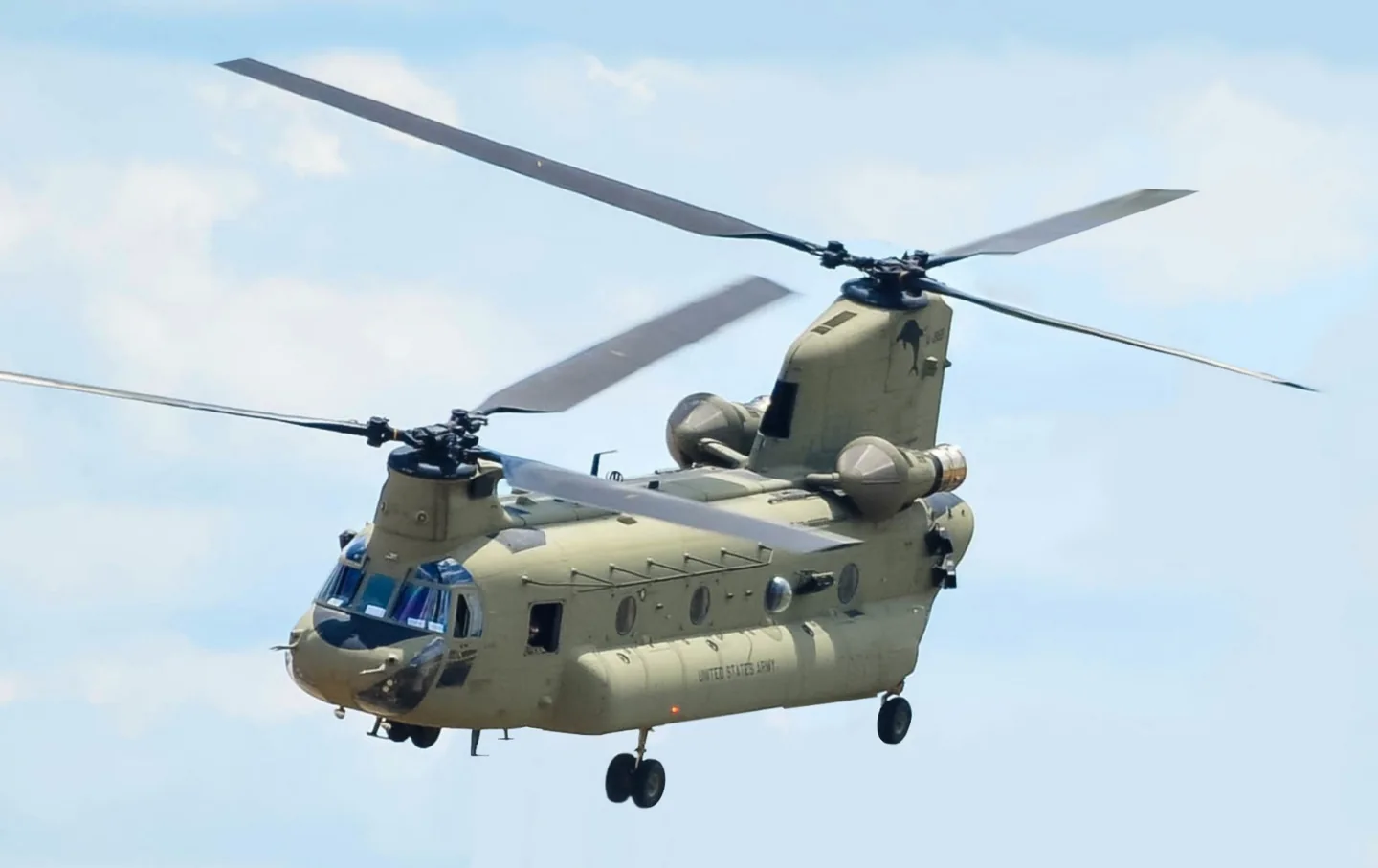
Boeing CH-47D ChinookSgt. Steven Galimore · CC0 · Boeing CH-47 Chinook pictured

Boeing CH-47D Chinook

A heavy transport helicopter whose two large rotors remove the need for a tail rotor.
Helicopter3 profielkeuzes

Ken het vliegtuig

The Chinook's tandem-rotor arrangement places one rotor above each end of a long cargo cabin. The opposing rotor systems provide the lifting configuration, leaving the rear available for a loading ramp. Vertol originated the design before it became part of Boeing.

The CH-47 family has evolved through several major versions and specialised derivatives. The simulator product represents the D model, with controls and loading arrangements for its tandem-rotor layout.

Aircraft / family

Propulsion
Twin turboshaft↗
Configuration
Tandem rotors · Rear loading ramp↗

Boeing CH-47 Chinook · Specifications (CH-47F) · real aircraft; source units retained

Length
98 ft 10.7 in (30.142 m)↗
Height
18 ft 7.8 in (5.685 m)↗
Empty weight
24,578 lb (11,148 kg)↗
Gross weight
54,000 lb (24,494 kg)↗
Powerplant
2 × Lycoming T55-GA-714A turboshaft engines, 4,733 shp (3,529 kW) each↗
Main rotor diameter
2 × 60 ft (18 m)↗
Main rotor area
5,600 sq ft (520 m² )↗
Maximum speed
170 kn (200 mph, 310 km/h)↗
Cruise speed
157 kn (181 mph, 291 km/h)↗
Range
400 nmi (460 mi, 740 km)↗

Meer over dit vliegtuig op AirframeDB

The Chinook has a civilian working branch

Columbia’s Model 234 work in Head’s account includes logging and construction. The operator also flew the smaller Model 107-II, so activities described across its whole fleet should not automatically be assigned to the Chinook.

Canada’s F model is a distinct configuration

The 2014 report describes the CH-147F’s long-range fuel installation, digital cockpit and Canadian equipment changes. These explain the setting of Townsend’s account while remaining separate from the CH-47D represented by the simulator listings on this page.

A spare part arrives with a familiar crew

Wookey remembered the Chinooks’ work bringing people from locations outside Kabul airport into the evacuation system. Keeping that operation moving meant dealing with crowded ramp space, changing security conditions and a fuel supply that could no longer be replenished normally. The flying depended on a much larger coordination effort than the journeys themselves suggested.

When one helicopter needed a component, the spare was in Kuwait and there was no dedicated flight to bring it back. Wookey contacted a Canadian colleague, and the part arrived on an evacuation aircraft. Going aboard to thank its crew, he discovered that the commander was an old classmate from military college and pilot training. That unexpected meeting became a lasting personal memory within the difficult final days of the operation.

A clipboard earns its place in the cockpit

Head joined Columbia as an employee and completed its copilot training before taking part in a Nebraska power-line reconstruction job. Studying the manuals, learning the systems and passing a check ride gave the assignment a seriousness beyond a visiting journalist’s flight. Once on site, experienced command pilots handled the precise placement of the replacement towers.

In the other seat, Head recorded weights and times, monitored fuel and instruments, watched for traffic and used the radios. She also flew between sites when the command pilots needed a break. The work could look modest beside the long-line flying outside the window, but it supported every lift.

New aircraft arrive faster than trained crews

Townsend had been the last pilot trained on Canada’s earlier CH-147C before its retirement. Returning to the Chinook programme brought him to a much more extensively equipped aircraft and the task of building a squadron around it. Deliveries were progressing well, but training the people to use the new helicopters could not happen at the same pace.

He found the CH-147F stable, including beneath its layers of automation, and valued what it could carry. Yet its sophistication also explained why the transition needed time. Pilots, loadmasters and flight engineers had to develop compatible ways of working, supported by instructors and maintainers.

Openbare bronnen 10
  1. Boeing CH-47 ChinookResearch background · Wikipedia revision 1373883548 · retrieved 2026-09-12
  2. Microsoft Flight Simulator aircraft manuals
  3. MSFS 2024 FAQ and edition aircraft inventory
  4. CH47-D ChinookOfficial developer / designated store catalogue · checked 2026-09-12
  5. A CH-47 Chinook pilot recalls final days in KabulIan Wookey · edited interview published 1 September 2026
  6. Riding ShotgunElan Head · 25 February 2011
  7. Not Your Grandfathers’ ChinookDuart Townsend interviewed by Ken Pole · 27 May 2014
  8. ICAO Doc 8643 — aircraft type designatorsPublic search data retrieved 2026-09-14; authority update 2026-09-03
  9. MSFS 2024 Sim Update 4 release notesVersion 1.6.32.0
  10. CH47D ChinookOfficial catalogue reviewed 15 September 2026

Hoe het profiel het modelleert

X-Trident CH-47D Chinook

Free + Pro
X-Plane 12X-Trident

The Chinook's tandem-rotor arrangement places one rotor above each end of a long cargo cabin. The opposing rotor systems provide the lifting configuration, leaving the rear available for a loading ramp. Vertol originated the design before it became part of Boeing.

This profile selects X-Trident CH-47D Chinook for X-Plane 12.

The cyclic spring and damping accompany the selected tandem-rotor rendition. The spring stays independent of airspeed. Directed aerodynamic loading is omitted. Cyclic damping adds resistance to hardware motion.

AFCS trim and controller-centering choices are separate from rotor-throttle regulation. Local force trim is off. Autopilot following is off.

Controls and trim

The Chinook’s tandem three-blade rotors and fixed wheels surround a heavy-lift cabin. X-Trident and MSFS products have separate AFCS and controller-centering strategies. Cyclic trim, governor-controlled rotor throttle and ground-wheel swivel serve different systems.

CH47D ChinookA-1 SkyraiderDeveloper control and trim configurationCH47-D Chinook

The selected implementation

X-Trident’s XP12 Chinook has its own four-axis AFCS and self-centering/non-centering controller options.

CH47-D Chinook

About the values

The gains are normalized profile settings. They describe the chosen effect balance; hand force depends on the device and its output limits. IAS references are tuning values rather than operating limits. Physical acceptance of this revision remains pending.

Master gain & control system

Master gain65%

De uiteindelijke totaalschaal over alles wat het model produceert, vóór de apparaatbegrenzing.

Meer: alles (veer, belastingen, effecten) wordt samen sterker.

Minder: alles wordt samen zachter.

Waarom hier: Scales overall profile strength while preserving effect balance, subject to device and output limits.

Forces

Spring strength14%

De basiscentreerkracht die de stick terug naar het midden trekt. Elke andere kracht stapelt hierop. Te laag en de stick voelt slap in normale vlucht; te hoog en hij vecht tegen je hand en maskeert de kleinere signalen erbovenop.

Meer: een steviger centreren dat de hand meer weerstaat.

Minder: een slappere stick die alleen op aerodynamische belasting leunt.

Waarom hier: The cyclic spring and damping accompany the selected tandem-rotor rendition. The baseline spring is 0.14. Low-speed spring blending is off.

CH47D ChinookA-1 SkyraiderDeveloper control and trim configurationCH47-D Chinook
Spring deadband2%

Een kleine neutrale zone rond het midden waar de veer stil blijft, zodat minieme bewegingen in rust niet ratelen. Breder is rustiger maar losser; smaller is preciezer maar kan rond het midden trillen.

Meer: een rustiger maar losser midden, met meer speling.

Minder: een strakker midden dat in rust kan trillen.

Waarom hier: Sets travel around the centre before the baseline spring resists. Smaller values engage it sooner.

Overall aerodynamic load0%

Een masterschaal over beide aangehouden asbelastingen, toegepast vóór hun onafhankelijke balans. Profielen laten dit normaal met rust en stemmen de twee asbelastingen af.

Meer: beide assen laden zwaarder.

Minder: beide assen worden samen lichter.

Waarom hier: The 0 gain omits sustained directed airspeed loading. Spring resistance remains independent.

Airspeed blendingFalse

Schakelt het lage-snelheidsvenster van de veeraangrijping in (start/vol-knopen hierboven). Uit betekent een constante veer op alle snelheden.

Waarom hier: Allows baseline spring strength to rise with indicated airspeed where the control law permits it.

Low-speed spring floor100%

Hoeveel van de veer overleeft bij stilstand, voordat luchtsnelheid aerodynamische kracht kan opbouwen. Een hoge vloer houdt de geparkeerde stick stevig; een lage geeft het losse, kabelslappe gevoel van een geparkeerd licht vliegtuig.

Meer: een stevigere stick geparkeerd en tijdens taxiën.

Minder: een slappe stick geparkeerd die pas met snelheid ontwaakt.

Waarom hier: Sets low-speed spring strength as a fraction of baseline when blending is enabled. One keeps full strength.

Spring engagement start8 kt

De snelheid waarbij de veer vanaf zijn lage-snelheidsvloer richting volle sterkte begint te klimmen: de besturing die 'tot leven komt' tijdens de startrol.

Waarom hier: Sets the IAS where the low-speed spring blend starts rising. This is a feel threshold, not a flight limit.

Spring engagement full65 kt

De snelheid waarbij de veer volle sterkte bereikt. Tussen het begin en dit punt wordt het centreren geleidelijk steviger naarmate de luchtstroom over de roeren groeit.

Waarom hier: Sets the IAS where the low-speed blend reaches baseline strength; high-speed stiffening also uses it.

Snelheid voor krachtafstemming130

De aangewezen snelheid waarbij de aerodynamische belasting haar ontworpen volle niveau bereikt. Hij verankert de hele belastingscurve aan het echte snelheidsbereik van het vliegtuig: een 172 laadt op tegen 110 knopen, een jet veel later.

Meer: belastingen komen later; de stick blijft langer licht.

Minder: belastingen komen eerder en de kruisvlucht weegt zwaarder.

Waarom hier: Sets the IAS reference for aerodynamic loading. It is an estimate, not published cruise TAS or a flight limit.

Centre firmness vs speed0%

Hoeveel het centreren zelf met snelheid verstijft, bovenop de uitslagbelastingen. Nul houdt het middengevoel constant; meer laat de stick harder centreren op kruissnelheid en losser in het circuit.

Meer: een midden dat duidelijk verhardt met snelheid.

Minder: een constant middengevoel op elke snelheid.

Waarom hier: Adds permitted spring resistance above the full-blend speed. Zero removes this high-speed increase.

Centre stiffening cap5

De bovengrens van snelheidsgedreven centreerverstijving, zodat zeer snelle vlucht de veer niet onbegrensd kan opwinden.

Meer: meer totale verstijving toegestaan op hoge snelheid.

Minder: de verstijving stopt eerder.

Waarom hier: Limits the squared airspeed ratio used for high-speed spring stiffening; it is not a device-force cap.

Aileron load72%

De aangehouden rolbelasting uit rolroeruitslag en snelheid, onafhankelijk van pitch gebalanceerd. Samen met de hoogteroerbelasting bepaalt dit de stuurharmonie waar recensenten het over hebben.

Meer: zwaardere rolkrachten.

Minder: lichtere, levendigere rolroeren.

Waarom hier: Roll and pitch aerodynamic scales are 0.72 and 1, respectively. These stored weights do not create directed aerodynamic loading while that term is inactive. No custom spring-travel curve is enabled.

Elevator load100%

De aangehouden pitchbelasting uit hoogteroeruitslag en snelheid, onafhankelijk van rol gebalanceerd. Dit is de hoofdhendel achter het pitchgewicht van een type. Hij raakt rolroer-, veer-, trim- of buffetkrachten niet.

Meer: zwaardere aangehouden pitchkrachten op snelheid.

Minder: een lichter hoogteroer, minder spierkracht om vast te houden.

Waarom hier: Scales pitch aerodynamic loading; pitch spring travel and trim responses are separate settings.

Max output force55%

Een plafond op elke gestage pitch- of rolkracht voordat die het apparaat bereikt, ter bescherming tegen beuken of verzadigen van de hardware bij stevige manoeuvres.

Meer: hogere gestage krachtpieken vóór afkapping.

Minder: een zachter plafond; harde manoeuvres vlakken eerder af.

Waarom hier: Caps directed-force output. Native spring effects and device limits remain separate.

Trim

Trim relief (elevator)0%

Hoe sterk hoogteroertrim de vastgehouden pitchkracht verlicht en verschuift waar de stick tot rust komt. Op 100 % heeft een goed getrimd vliegtuig geen vastgehouden druk nodig, de trim-de-last-weg-werkwijze van echt vliegen.

Meer: trim neemt meer vastgehouden kracht weg; op 100 % heft volle trim hem op.

Minder: je blijft kracht houden, zelfs getrimd.

Waarom hier: Scales supported pitch-trim relief and permitted centre movement. Zero removes pitch response.

Trim relief (aileron)0%

Dezelfde verlichting voor roltrim. De meeste GA-types hebben geen echte rolroertrim, dus dit blijft op nul; types met roltrim krijgen een passende waarde.

Meer: roltrim neemt meer vastgehouden kracht weg.

Minder: roltrim doet minder.

Waarom hier: Scales supported roll-trim relief and permitted centre movement. Zero removes roll response.

Effect gains · Ground

Runway rumble15%

Rollende oppervlaktetrilling uit wielsnelheid en ondergrondtype: asfalt, gras of grind onder het onderstel.

Meer: een sterkere oppervlaktetextuur in de stick.

Minder: gladder taxiën.

Waarom hier: Sets rolling texture strength, modified by speed, surface and undercarriage configuration.

Gear bumps0%

Korte losse stoten van uitzetvoegen, sporen en ruw oppervlak, die het doorlopende gerommel accentueren.

Meer: scherpere stoten van voegen en sporen.

Minder: zachtere gronddetails.

Waarom hier: Sets gear-bump texture during ground motion, separate from touchdown impact.

Effect gains · Airframe

Stall buffet0%

Casco-schudden bij het naderen van de overtrek en terwijl de overtrekwaarschuwing actief is: hoe luid deze vleugel aankondigt dat hij ontevreden is. Types met een scherpe afbreek krijgen bescheiden buffet en laten de hoorn de waarschuwing dragen.

Meer: een sterker trillen vóór de overtrek.

Minder: een discretere vleugel; de hoorn draagt de waarschuwing.

Waarom hier: Sets stall-buffet strength. Zero removes the cue without changing simulator stalls or warnings.

Mach buffet0%

Transsoon buffet bij het naderen van de Machlimiet. Betekenisvol voor jets nabij MMO, nul voor zuigers en turboprops die er nooit komen.

Meer: een sterker transsoon buffet nabij de Machlimiet.

Minder: gladder vliegen op hoge Mach.

Waarom hier: Sets high-Mach buffet strength; onset and full-strength thresholds are separate.

Flap buffet0%

Laagfrequente casco-trilling met kleppen uitgeslagen in de luchtstroom, in het snelheidsvenster waar ze de lucht echt bewerken.

Meer: ruwer vliegen met werkende kleppen.

Minder: zachtere naderingskleppen.

Waarom hier: Sets flap buffet at the configured position and speed gates. Flap movement texture is separate.

Gear buffet0%

Casco-getrommel van intrekbaar onderstel dat in de luchtstroom hangt. Nul voor types met vast onderstel, waar het casco nooit van vorm verandert.

Meer: meer getrommel met het onderstel uit.

Minder: schoner vliegen met onderstel uit.

Waarom hier: Sets gear aerodynamic buffet; movement and ground-contact cues are separate.

Stick shaker50%

De speciale stall-stickshakerzoem, geactiveerd door het eigen overtrekwaarschuwingssysteem van het vliegtuig. Alleen types met een echte shaker krijgen een waarde; de rest steunt op aerodynamisch buffet en de hoorn.

Meer: een hardere shaker.

Minder: een discretere shaker.

Waarom hier: Sets triggered shaker strength; inactive while the shaker feature is disabled.

Effect gains · Engine, mechanical & drag

Touchdown thump50%

De eenmalige dreun als de wielen de baan raken, geschaald op daalsnelheid: een zachte landing fluistert, een stevige aankomst bonkt.

Meer: een hardere dreun bij de landing.

Minder: zachtere aankomsten.

Waarom hier: Sets landing-impact strength; landing telemetry and response shape determine the pulse.

Reverse rumble0%

Uitroltrilling terwijl reverse thrust of props in beta werken. Nul voor types zonder reverse.

Meer: ruwer uitrollen onder reverse.

Minder: een discretere reverse.

Waarom hier: Sets reverse-thrust vibration with valid reverser and engine conditions. Zero removes the cue.

Engine rumble0%

Doorlopende motortrilling die het toerental volgt tussen stationair en vol vermogen, de altijd aanwezige herinnering dat er voorin iets brandstof verbrandt.

Meer: meer motor in de stick.

Minder: een discretere motor.

Waarom hier: Sets estimated engine vibration using configured telemetry and response, not measured cockpit vibration.

Flap motion0%

Doorlopende trilling alleen terwijl de sim meldt dat de klepvlakken daadwerkelijk bewegen. Volgt echte actuatorbeweging en storingen, geen geschatte timer.

Meer: meer trilling met bewegende kleppen.

Minder: discretere klepbewegingen.

Waarom hier: Sets texture from observed flap movement; a command without movement does not establish the cue.

Autopilot follow

AP follow authority5%

Hoe ver autopilootcommando's de stick fysiek mogen bewegen. Piepklein gehouden in MSFS, waar een bewogen as kan worden teruggelezen als pilooteninvoer; nul schakelt volgen volledig uit.

Meer: de autopiloot beweegt je stick zichtbaar meer.

Minder: een nauwelijks merkbaar volgen.

Waarom hier: Sets admitted AP-follow gain, not a percentage of travel. Runtime ownership and input limits still apply.

Stick feel

StickFeel · Trim feel enabledFalse

Whether this feature is active in this profile.

Waarom hier: Retained for compatibility and group membership. Trim relief, rather than this flag, controls centre movement.

StickFeel · Trim relief enabledFalse

Whether this feature is active in this profile.

Waarom hier: Allows trim relief with supported control law and valid telemetry. Axis authorities set its amount.

StickFeel · G load enabledFalse

Whether this feature is active in this profile.

Waarom hier: Allows load-factor changes to modify permitted spring laws. Passive fly-by-wire feel can suppress it.

StickFeel · Rate damping enabledFalse

Whether this feature is active in this profile.

Waarom hier: Enables rate damping with the configured coefficients and control law.

Autopilot

Autopilot · Follow enabledFalse

Whether this feature is active in this profile.

Waarom hier: Autopilot following is off; the configured spring and load retain the hardware feel.

Autopilot · Neutral hold enabledFalse

Whether this feature is active in this profile.

Waarom hier: Permits centering hold during a supported AP state, separate from following a moving target.

Autopilot · Neutral hold strength0.6

Waarom hier: Sets admitted AP neutral-hold strength; inactive while neutral hold is disabled.

Aero

Aero · EnabledTrue

Whether this feature is active in this profile.

Waarom hier: Enables aerodynamic cues; each still needs nonzero strength and its simulator conditions.

Aero · Max flap index1

Where this effect reaches full strength (or has fully faded, for washouts).

Meer: a more gradual build to a later peak.

Minder: a quicker build.

Waarom hier: Sets the final flap index for detent normalization. UP plus three detents uses maximum index3.

Aero · Min flap index1

Where this effect begins fading in.

Meer: the effect begins later.

Minder: it begins earlier.

Waarom hier: Sets the first flap detent that admits buffet; this is a handle index, not degrees.

Aero · Shaker enabledFalse

Whether this feature is active in this profile.

Waarom hier: Permits shaker at supported warning conditions; the switch does not establish aircraft equipment.

Ground

Ground · EnabledTrue

Whether this feature is active in this profile.

Waarom hier: Enables ground effects; each still needs its own strength and contact or motion telemetry.

Engine

Engine · EnabledTrue

Whether this feature is active in this profile.

Waarom hier: Enables engine cues with nonzero settings and valid running-engine telemetry.

Mechanical

Mechanical · EnabledTrue

Whether this feature is active in this profile.

Waarom hier: Enables accessory cues with configured strengths and observed accessory movement.

Mechanical · Gain0

The strength of this effect.

Meer: a stronger effect.

Minder: a weaker one.

Waarom hier: Sets texture from observed gear movement, separate from aerodynamic and touchdown effects.

Alle profielinstellingen
Geschatte profielinstellingen
ParameterWaardeWat het regelt en waarom
Spring strength0.14 The cyclic spring and damping accompany the selected tandem-rotor rendition. The baseline spring is 0.14. Low-speed spring blending is off.
Spring deadband0.02 Sets travel around the centre before the baseline spring resists. Smaller values engage it sooner.
Force gain0 The 0 gain omits sustained directed airspeed loading. Spring resistance remains independent.
Master gain0.65 Scales overall profile strength while preserving effect balance, subject to device and output limits.
Dynamic-pressure blendFalse Allows baseline spring strength to rise with indicated airspeed where the control law permits it.
Minimum spring factor1 Sets low-speed spring strength as a fraction of baseline when blending is enabled. One keeps full strength.
Spring wake-up speed8 ktSets the IAS where the low-speed spring blend starts rising. This is a feel threshold, not a flight limit.
Spring full-strength speed65 ktSets the IAS where the low-speed blend reaches baseline strength; high-speed stiffening also uses it.
Snelheid voor krachtafstemming130 ktSets the IAS reference for aerodynamic loading. It is an estimate, not published cruise TAS or a flight limit.
Airspeed spring stiffening0 Adds permitted spring resistance above the full-blend speed. Zero removes this high-speed increase.
Airspeed stiffening cap5 Limits the squared airspeed ratio used for high-speed spring stiffening; it is not a device-force cap.
Aileron force scale0.72 Roll and pitch aerodynamic scales are 0.72 and 1, respectively. These stored weights do not create directed aerodynamic loading while that term is inactive. No custom spring-travel curve is enabled.
Elevator force scale1 Scales pitch aerodynamic loading; pitch spring travel and trim responses are separate settings.
Maximum output force0.55 Caps directed-force output. Native spring effects and device limits remain separate.
StickFeel · Trim feel enabledFalse Retained for compatibility and group membership. Trim relief, rather than this flag, controls centre movement.
StickFeel · Trim relief enabledFalse Allows trim relief with supported control law and valid telemetry. Axis authorities set its amount.
StickFeel · Elevator authority0 Scales supported pitch-trim relief and permitted centre movement. Zero removes pitch response.
StickFeel · Aileron authority0 Scales supported roll-trim relief and permitted centre movement. Zero removes roll response.
StickFeel · Force trim enabledFalse AFCS trim and controller-centering choices are separate from rotor-throttle regulation. Local force trim is off. The stored latch parameters are inactive; the profile does not supply a local hold-where-left neutral.
StickFeel · G load enabledFalse Allows load-factor changes to modify permitted spring laws. Passive fly-by-wire feel can suppress it.
StickFeel · Rate damping enabledFalse Enables rate damping with the configured coefficients and control law.
Autopilot · Follow enabledFalse Autopilot following is off; the configured spring and load retain the hardware feel.
Autopilot · Follow authority0.05 Sets admitted AP-follow gain, not a percentage of travel. Runtime ownership and input limits still apply.
Autopilot · Neutral hold enabledFalse Permits centering hold during a supported AP state, separate from following a moving target.
Autopilot · Neutral hold strength0.6 Sets admitted AP neutral-hold strength; inactive while neutral hold is disabled.
Aero · EnabledTrue Enables aerodynamic cues; each still needs nonzero strength and its simulator conditions.
Aero · Gain0 Sets stall-buffet strength. Zero removes the cue without changing simulator stalls or warnings.
Aero · Gain0 Sets high-Mach buffet strength; onset and full-strength thresholds are separate.
Aero · Gain0 Sets flap buffet at the configured position and speed gates. Flap movement texture is separate.
Aero · Max flap index1 Sets the final flap index for detent normalization. UP plus three detents uses maximum index3.
Aero · Min flap index1 Sets the first flap detent that admits buffet; this is a handle index, not degrees.
Aero · Gain0 Sets gear aerodynamic buffet; movement and ground-contact cues are separate.
Aero · Shaker enabledFalse Permits shaker at supported warning conditions; the switch does not establish aircraft equipment.
Aero · Amplitude0.5 Sets triggered shaker strength; inactive while the shaker feature is disabled.
Ground · EnabledTrue Enables ground effects; each still needs its own strength and contact or motion telemetry.
Ground · Gain0.15 Sets rolling texture strength, modified by speed, surface and undercarriage configuration.
Ground · Gain0 Sets gear-bump texture during ground motion, separate from touchdown impact.
Ground · Gain0.5 Sets landing-impact strength; landing telemetry and response shape determine the pulse.
Ground · Gain0 Sets reverse-thrust vibration with valid reverser and engine conditions. Zero removes the cue.
Engine · EnabledTrue Enables engine cues with nonzero settings and valid running-engine telemetry.
Engine · Gain0 Sets estimated engine vibration using configured telemetry and response, not measured cockpit vibration.
Mechanical · EnabledTrue Enables accessory cues with configured strengths and observed accessory movement.
Mechanical · Gain0 Sets texture from observed flap movement; a command without movement does not establish the cue.
Mechanical · Gain0 Sets texture from observed gear movement, separate from aerodynamic and touchdown effects.
Openbare bronnen 12
  1. Boeing CH-47 ChinookResearch background · Wikipedia revision 1373883548 · retrieved 2026-09-12
  2. CH47D ChinookExact Miltech CH47D product platform and systemsOfficial catalogue reviewed 15 September 2026
  3. A-1 SkyraiderMiltech current product catalogue editions
  4. Developer control and trim configurationCH47D official recommended hardware configuration
  5. CH47-D ChinookExact developer-authorized product description, version and simulator requirementsOfficial developer / designated store catalogue · checked 2026-09-12
  6. Microsoft Flight Simulator aircraft manuals
  7. MSFS 2024 FAQ and edition aircraft inventory
  8. A CH-47 Chinook pilot recalls final days in KabulIan Wookey · edited interview published 1 September 2026
  9. Riding ShotgunElan Head · 25 February 2011
  10. Not Your Grandfathers’ ChinookDuart Townsend interviewed by Ken Pole · 27 May 2014
  11. ICAO Doc 8643 — aircraft type designatorsPublic search data retrieved 2026-09-14; authority update 2026-09-03
  12. MSFS 2024 Sim Update 4 release notesVersion 1.6.32.0

Community en correcties

Zegt jouw ervaring op het type dat deze pagina iets fout heeft? Corrigeer het hier.

Pilotencorrecties

Vlieg je dit toestel? Corrigeer deze pagina.

Deze pagina is gebouwd op geciteerde bronnen, en echte ervaring op het type verslaat elke bron. Citeer de foute bewering en vertel ons wat het echte toestel doet. Correcties gaan ter beoordeling naar de maintainer en voeden de volgende revisie van dit onderzoek.

Hangarpraat

Open gesprek over het vliegen en afstellen van de Boeing CH-47D Chinook, op het communityforum. Correcties hierboven gaan privé naar de maintainer; hangarpraat is openbaar.

Nog geen hangarpraat over de Boeing CH-47D Chinook. Wees de eerste.

Community

Communityprofielen voor dit toestel

Nog geen communityprofielen voor dit toestel. Op jouw manier afgesteld? Deel een profiel en het verschijnt hier.