Biblioteca de aeronavesMcDonnell Douglas MD-11
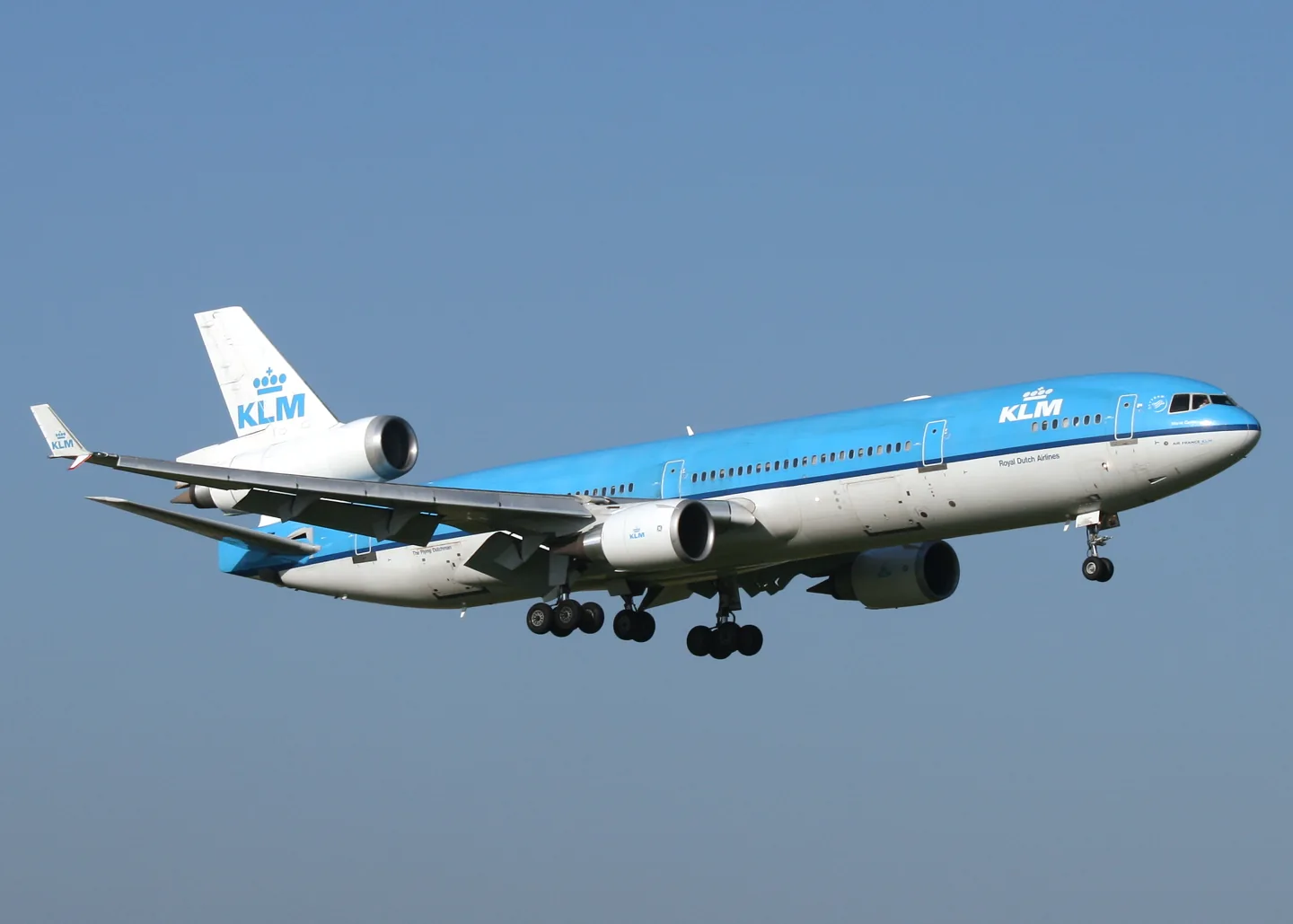
McDonnell Douglas MD-11Björn Strey · CC BY-SA 2.0 · McDonnell Douglas MD-11 pictured

McDonnell Douglas MD-11

A long-range trijet developed from the DC-10 with a stretched fuselage and revised wing and cockpit.
Airliner6 opções de perfil

Conheça o avião

The MD-11 developed the DC-10 with a longer fuselage, winglets and a two-pilot electronic flight deck. It retained the trijet arrangement, including the centre engine at the base of the fin. Passenger and freighter versions served different markets.

Automated systems and fuel management formed part of the new design. Each simulator developer documents the systems, failures and variants included in its implementation.

Aircraft / family

Propulsion
Three jets↗
Configuration
Wide-body · Winglets↗

Mais sobre esta aeronave no AirframeDB

The final scheduled passenger service had a separate farewell

KLM’s final scheduled MD-11 passenger flight arrived in Amsterdam from Montreal on 26 October 2014. Three special sightseeing flights over the Netherlands were planned for 11 November. Keeping those events separate explains why accounts of the aircraft’s passenger-service farewell give different dates.

A research aircraft lands using engine thrust for control

NASA’s history records Gordon Fullerton’s first MD-11 propulsion-controlled landing at Edwards on 29 August 1995. Special software translated commands into engine-thrust changes while the usual control surfaces remained still. It was an experimental backup-control programme, distinct from an ordinary airline flight or a real emergency.

Flying the aircraft that had been part of his childhood

Schouten had grown up around the MD-11 because his father flew it. Reaching the same aircraft after jobs in smaller island transports and the MD-80 fulfilled a long-held ambition. By the time of the interview, the freighter was taking him around the world with Western Global Airlines.

The work did not follow a predictable airline pattern. Within a normal stretch of seventeen working days, destinations and schedules could change daily. He found it demanding, but valued visiting places outside the usual scheduled network. During the pandemic, busy cargo flying brought a complicated sense of good fortune: his part of aviation still needed crews while many other pilots faced unemployment.

Putting the MD-11’s reputation in the context of experience

Asked whether the MD-11’s approach speeds made it difficult, Bokomoko drew on earlier experience flying the 737 into high-altitude La Paz. That work had already made fast ground speeds familiar. The contributor regarded the MD-11’s speed as manageable and spoke positively about its braking and reverse thrust, while noting that conditions and equipment still mattered.

Other answers stressed the planning behind what passengers saw. Fuel remaining at arrival varied with the route and airline decisions, while takeoff flap selection followed prepared performance data. The replies offered a working pilot’s context for features that could seem unusual to an enthusiast, without treating every flight or operator as identical.

A safety pilot becomes an advocate for an unusual experiment

Miller’s view of propulsion-controlled flight changed when he saw the experimental MD-11 system working in the air. On its first attempt, its steady behaviour convinced him that the engineering team had achieved something significant. He subsequently pressed management to allow the programme to progress towards actual landings and further exploration of the test envelope.

That support mattered when the team considered switching off the hydraulic systems during a later experiment. Holding control surfaces still for a test was different from allowing them to move after hydraulic power disappeared. Miller helped obtain permission to investigate that uncertainty.

Fontes públicas 12
  1. McDonnell Douglas MD-11Research background · Wikipedia revision 1372184859 · retrieved 2026-09-12
  2. X-Plane aircraft and avionics manuals
  3. MD11 v1.20 release
  4. MD-11 FreighterOfficial developer / designated store catalogue · checked 2026-09-12
  5. MD-11 PassengerOfficial developer / designated store catalogue · checked 2026-09-12
  6. Briën vliegt met een MD-11 de wereld rondBriën Schouten interview · 17 September 2020
  7. MD-11: some questionsBokomoko · 27–28 October 2003
  8. Touchdown: The Development of Propulsion Controlled Aircraft at NASA DrydenTom Tucker · 1999 · John Miller interview and MD-11 research history, PDF pp.31–34
  9. KLM operates last MD-11 passenger flight26 October 2014 · scheduled-service farewell
  10. ICAO Doc 8643 — aircraft type designatorsPublic search data retrieved 2026-09-14; authority update 2026-09-03
  11. Sky Simulations MD-11 Version 3Developer listing captured 28 September 2026; MSFS 2020
  12. MD-11 Passenger & Freighter MSFS20/24 by TFDi Design | Contrail ShopProduct listing captured 2026-09-30; edition scope from the reviewed catalogue

Como o perfil o modela

TFDi Design MD-11

Free + Pro
MSFS 2020MSFS 2024TFDi Design

The MD-11 developed the DC-10 with a longer fuselage, winglets and a two-pilot electronic flight deck. It retained the trijet arrangement, including the centre engine at the base of the fin. Passenger and freighter versions served different markets.

This profile selects TFDi Design MD-11 for MSFS 2020, MSFS 2024.

Artificial feel accompanies the hydraulically powered controls. The spring stays independent of airspeed. Directed aerodynamic loading is omitted.

Automatic pitch trim and CWS are separate from a fixed hardware-centre choice. Pitch-trim relief is off. Autopilot following is off.

Esta revisão específica ainda não está habilitada para instalação pública.

Controls and trim

The MD-11 documentation describes automatic pitch trim, CWS/RCWS and multiple hydraulic systems. Passenger/freighter and GE/PW fits retain their own configuration, while dial-a-flap and autoflight are specific cockpit mechanisms.

MD-11 FreighterMD-11 PassengerSky Simulations MD-11 version 3 productMD-11 passenger/freighter

The selected implementation

TFDi’s passenger/freighter choices have custom hydraulics, dial-a-flap and RCWS within their GE/PW fit.

MD-11 passenger/freighter

About the values

The gains are normalized profile settings. They describe the chosen effect balance; hand force depends on the device and its output limits. IAS references are tuning values rather than operating limits. Physical acceptance of this revision remains pending.

Master gain & control system

Master gain85%

A escala final de saída aplicada a tudo que o modelo produz, antes do teto do dispositivo.

Mais: tudo (mola, cargas, efeitos) fica mais forte junto.

Menos: tudo amacia junto.

Por que aqui: Scales overall profile strength while preserving effect balance, subject to device and output limits.

Forces

Spring strength80%

A força base de centragem que puxa o manche de volta ao centro. Todas as outras forças se empilham sobre ela. Baixa demais e o manche parece frouxo em voo normal; alta demais e ele briga com sua mão e mascara os sinais menores por cima.

Mais: uma centragem mais firme que resiste mais à mão.

Menos: um manche mais mole que depende só da carga aerodinâmica.

Por que aqui: Artificial feel accompanies the hydraulically powered controls. The baseline spring is 0.8. Low-speed spring blending is off.

MD-11 FreighterMD-11 PassengerSky Simulations MD-11 version 3 productMD-11 passenger/freighter
Spring deadband4%

Uma pequena zona neutra ao redor do centro onde a mola fica quieta, para que movimentos mínimos em repouso não trepidem. Mais larga é mais calma porém mais solta; mais estreita é mais precisa mas pode tremer no centro.

Mais: um centro mais calmo porém mais solto, com mais folga.

Menos: um centro mais apertado que pode tremer em repouso.

Por que aqui: Sets travel around the centre before the baseline spring resists. Smaller values engage it sooner.

Overall aerodynamic load0%

Uma escala mestra sobre as duas cargas sustentadas de eixo, aplicada antes do balanço independente delas. Os perfis normalmente a deixam quieta e ajustam as duas cargas de eixo.

Mais: os dois eixos carregam mais forte.

Menos: os dois eixos aliviam juntos.

Por que aqui: The stored 0 aerodynamic-load gain is inactive under the zero hydraulic-load factor.

Airspeed blendingFalse

Ativa a janela de engate da mola em baixa velocidade (nós de início/pleno acima). Desligado, a mola é constante em todas as velocidades.

Por que aqui: Allows baseline spring strength to rise with indicated airspeed where the control law permits it.

Low-speed spring floor55%

Quanto da mola sobrevive parado, antes que a velocidade possa gerar força aerodinâmica. Um piso alto mantém o manche estacionado firme; um piso baixo dá a sensação solta, de cabos com folga, de um avião leve estacionado.

Mais: um manche mais firme estacionado e no táxi.

Menos: um manche mole estacionado que só desperta com velocidade.

Por que aqui: Sets low-speed spring strength as a fraction of baseline when blending is enabled. One keeps full strength.

Spring engagement start8 kt

A velocidade em que a mola começa a subir do piso de baixa velocidade rumo à força plena: os comandos "ganhando vida" na corrida de decolagem.

Por que aqui: Sets the IAS where the low-speed spring blend starts rising. This is a feel threshold, not a flight limit.

Spring engagement full65 kt

A velocidade em que a mola atinge força plena. Entre o início e este ponto, a centragem endurece progressivamente à medida que o fluxo de ar cresce sobre os comandos.

Por que aqui: Sets the IAS where the low-speed blend reaches baseline strength; high-speed stiffening also uses it.

Velocidade de ajuste de força270

A velocidade indicada em que a carga aerodinâmica atinge seu nível pleno de projeto. Ela ancora toda a curva de carga à faixa real de velocidades do avião: um 172 carrega por volta de 110 nós, um jato bem depois.

Mais: as cargas chegam mais tarde; o manche fica leve até mais velocidade.

Menos: as cargas chegam antes e o cruzeiro pesa mais.

Por que aqui: Sets the IAS reference for aerodynamic loading. It is an estimate, not published cruise TAS or a flight limit.

Centre firmness vs speed0%

Quanto a própria centragem endurece com a velocidade, além das cargas de deflexão. Zero mantém a sensação de centro constante; mais faz o manche centrar mais duro em cruzeiro e mais solto no circuito.

Mais: um centro que endurece nitidamente com a velocidade.

Menos: uma sensação de centro constante em qualquer velocidade.

Por que aqui: The high-speed spring-stiffening gain is 0. No additional speed-driven stiffening is added; this does not disable independent aerodynamic loading.

Centre stiffening cap5

O limite superior do endurecimento de centro pela velocidade, para que voos muito rápidos não tensionem a mola sem freio.

Mais: mais endurecimento total permitido em alta velocidade.

Menos: o endurecimento corta antes.

Por que aqui: Limits the squared airspeed ratio used for high-speed spring stiffening; it is not a device-force cap.

Aileron load80%

A carga sustentada de rolagem da deflexão dos ailerons e da velocidade, balanceada independentemente da arfagem. Junto com a carga do profundor define a razão de harmonia de comandos de que falam as resenhas.

Mais: esforços de rolagem mais pesados.

Menos: ailerons mais leves e vivos.

Por que aqui: Roll and pitch aerodynamic scales are 0.8 and 1, respectively. These stored weights do not create directed aerodynamic loading while that term is inactive. No custom spring-travel curve is enabled.

Elevator load100%

A carga sustentada de arfagem da deflexão do profundor e da velocidade, balanceada independentemente da rolagem. É a alavanca principal por trás do peso de arfagem de um tipo. Não toca aileron, mola, compensador nem forças de buffet.

Mais: esforços sustentados de arfagem mais pesados em velocidade.

Menos: um profundor mais leve, com menos músculo para segurar.

Por que aqui: Scales pitch aerodynamic loading; pitch spring travel and trim responses are separate settings.

Max output force55%

Um teto sobre cada força estável de arfagem ou rolagem antes de chegar ao dispositivo, protegendo contra pancadas ou saturação do hardware em manobras fortes.

Mais: picos de força estável mais altos antes do corte.

Menos: um teto mais suave; manobras duras achatam antes.

Por que aqui: Caps directed-force output. Native spring effects and device limits remain separate.

Trim

Trim relief (elevator)0%

Com que força o compensador de profundor alivia o esforço de arfagem mantido e desloca onde o manche assenta. Em 100 %, um avião bem compensado não precisa de pressão mantida: o fluxo de trabalho de compensar-a-carga do voo real.

Mais: o compensador tira mais esforço mantido; em 100 %, todo compensado o anula.

Menos: você segue segurando esforço mesmo compensado.

Por que aqui: Automatic pitch trim and CWS are separate from a fixed hardware-centre choice. Pitch relief is off, with stored authority 0; roll authority is 0.

MD-11 FreighterMD-11 PassengerSky Simulations MD-11 version 3 productMD-11 passenger/freighter
Trim relief (aileron)0%

O mesmo alívio para o compensador de rolagem. A maioria dos tipos de aviação geral não tem compensador de aileron real, então isto fica em zero; tipos com compensador de rolagem recebem um valor correspondente.

Mais: o compensador de rolagem tira mais esforço mantido.

Menos: o compensador de rolagem faz menos.

Por que aqui: Scales supported roll-trim relief and permitted centre movement. Zero removes roll response.

Effect gains · Ground

Runway rumble40%

Vibração de rolagem no solo pela velocidade das rodas e tipo de superfície: asfalto, grama ou cascalho sob o trem.

Mais: uma textura de superfície mais forte no manche.

Menos: um táxi mais liso.

Por que aqui: Sets rolling texture strength, modified by speed, surface and undercarriage configuration.

Gear bumps32%

Solavancos curtos e discretos de juntas de dilatação, sulcos e superfície irregular, pontuando o ronco contínuo.

Mais: solavancos mais nítidos de juntas e sulcos.

Menos: detalhes de solo mais suaves.

Por que aqui: Sets gear-bump texture during ground motion, separate from touchdown impact.

Effect gains · Airframe

Stall buffet0%

Sacudida da célula ao se aproximar do estol e enquanto o aviso soa: quão alto esta asa anuncia que está infeliz. Tipos de quebra seca recebem buffet modesto e deixam a buzina levar o aviso.

Mais: um tremor pré-estol mais forte.

Menos: uma asa mais discreta; a buzina leva o aviso.

Por que aqui: Sets stall-buffet strength. Zero removes the cue without changing simulator stalls or warnings.

Mach buffet0%

Buffet transônico ao se aproximar do limite de Mach. Significativo para jatos perto de MMO, zero para pistões e turboélices que nunca chegam lá.

Mais: um buffet transônico mais forte perto do limite de Mach.

Menos: um voo mais liso em Mach alto.

Por que aqui: Sets high-Mach buffet strength; onset and full-strength thresholds are separate.

Flap buffet0%

Vibração de baixa frequência da célula com flapes estendidos no fluxo, na janela de velocidade em que eles realmente trabalham o ar.

Mais: um voo mais áspero com flapes trabalhando.

Menos: flapes de aproximação mais suaves.

Por que aqui: Sets flap buffet at the configured position and speed gates. Flap movement texture is separate.

Gear buffet0%

Tamborilar da célula pelo trem retrátil pendurado na corrente de ar. Zero para tipos de trem fixo, onde a célula nunca muda de forma.

Mais: mais tamborilar com o trem embaixo.

Menos: um voo com trem embaixo mais limpo.

Por que aqui: Sets gear aerodynamic buffet; movement and ground-contact cues are separate.

Stick shaker90%

O zumbido dedicado do stick shaker de estol, disparado pelo próprio sistema de aviso do avião. Só tipos com shaker real recebem valor; o resto confia no buffet aerodinâmico e na buzina.

Mais: um shaker mais duro.

Menos: um shaker mais discreto.

Por que aqui: Sets triggered shaker strength; inactive while the shaker feature is disabled.

Effect gains · Engine, mechanical & drag

Touchdown thump90%

O golpe único quando as rodas tocam a pista, escalado pela razão de descida: um pouso macio sussurra, uma chegada firme bate.

Mais: um golpe mais duro no toque.

Menos: chegadas mais suaves.

Por que aqui: Sets landing-impact strength; landing telemetry and response shape determine the pulse.

Reverse rumble0%

Vibração na corrida enquanto o reverso ou as hélices em beta trabalham. Zero para tipos sem reverso.

Mais: uma corrida mais áspera sob reverso.

Menos: um reverso mais discreto.

Por que aqui: Sets reverse-thrust vibration with valid reverser and engine conditions. Zero removes the cue.

Engine rumble6%

Vibração contínua do grupo motopropulsor seguindo a rotação entre marcha lenta e potência máxima, o lembrete sempre presente de que algo queima combustível lá na frente.

Mais: mais motor no manche.

Menos: um motor mais discreto.

Por que aqui: Sets estimated engine vibration using configured telemetry and response, not measured cockpit vibration.

Flap motion12%

Vibração contínua apenas enquanto o simulador informa as superfícies de flape realmente em movimento. Segue o movimento e as falhas reais do atuador, não um cronômetro estimado.

Mais: mais vibração com os flapes em movimento.

Menos: cursos de flape mais discretos.

Por que aqui: Sets texture from observed flap movement; a command without movement does not establish the cue.

Autopilot follow

AP follow authority10%

Quanto os comandos do piloto automático podem mover fisicamente o manche. Mantido minúsculo no MSFS, onde um eixo movido pode ser lido de volta como entrada do piloto; zero desativa o seguimento por completo.

Mais: o piloto automático move seu manche visivelmente mais.

Menos: um seguimento quase imperceptível.

Por que aqui: Sets admitted AP-follow gain, not a percentage of travel. Runtime ownership and input limits still apply.

Stick feel

StickFeel · Trim feel enabledFalse

Whether this feature is active in this profile.

Por que aqui: Retained for compatibility and group membership. Trim relief, rather than this flag, controls centre movement.

StickFeel · Trim relief enabledFalse

Whether this feature is active in this profile.

Por que aqui: Allows trim relief with supported control law and valid telemetry. Axis authorities set its amount.

StickFeel · Force trim enabledFalse

Whether this feature is active in this profile.

Por que aqui: Enables local force trim, separate from aircraft-owned trim and add-on integration qualification.

StickFeel · G load enabledTrue

Whether this feature is active in this profile.

Por que aqui: Allows load-factor changes to modify permitted spring laws. Passive fly-by-wire feel can suppress it.

StickFeel · Rate damping enabledTrue

Whether this feature is active in this profile.

Por que aqui: Enables rate damping with the configured coefficients and control law.

Autopilot

Autopilot · Follow enabledFalse

Whether this feature is active in this profile.

Por que aqui: Autopilot following is off; the configured spring and load retain the hardware feel.

Autopilot · Neutral hold enabledFalse

Whether this feature is active in this profile.

Por que aqui: Permits centering hold during a supported AP state, separate from following a moving target.

Autopilot · Neutral hold strength0.6

Por que aqui: Sets admitted AP neutral-hold strength; inactive while neutral hold is disabled.

Aero

Aero · EnabledTrue

Whether this feature is active in this profile.

Por que aqui: Enables aerodynamic cues; each still needs nonzero strength and its simulator conditions.

Aero · Max flap index5

Where this effect reaches full strength (or has fully faded, for washouts).

Mais: a more gradual build to a later peak.

Menos: a quicker build.

Por que aqui: Sets the final flap index for detent normalization. UP plus three detents uses maximum index3.

Aero · Min flap index2

Where this effect begins fading in.

Mais: the effect begins later.

Menos: it begins earlier.

Por que aqui: Sets the first flap detent that admits buffet; this is a handle index, not degrees.

Aero · Shaker enabledFalse

Whether this feature is active in this profile.

Por que aqui: Permits shaker at supported warning conditions; the switch does not establish aircraft equipment.

Ground

Ground · EnabledTrue

Whether this feature is active in this profile.

Por que aqui: Enables ground effects; each still needs its own strength and contact or motion telemetry.

Engine

Engine · EnabledTrue

Whether this feature is active in this profile.

Por que aqui: Enables engine cues with nonzero settings and valid running-engine telemetry.

Mechanical

Mechanical · EnabledTrue

Whether this feature is active in this profile.

Por que aqui: Enables accessory cues with configured strengths and observed accessory movement.

Mechanical · Gain0.12

The strength of this effect.

Mais: a stronger effect.

Menos: a weaker one.

Por que aqui: Sets texture from observed gear movement, separate from aerodynamic and touchdown effects.

Todas as configurações do perfil
Configurações estimadas do perfil
ParâmetroValorO que controla e por quê
Spring strength0.8 Artificial feel accompanies the hydraulically powered controls. The baseline spring is 0.8. Low-speed spring blending is off.
Spring deadband0.035 Sets travel around the centre before the baseline spring resists. Smaller values engage it sooner.
Force gain0 The stored 0 aerodynamic-load gain is inactive under the zero hydraulic-load factor.
Master gain0.85 Scales overall profile strength while preserving effect balance, subject to device and output limits.
Dynamic-pressure blendFalse Allows baseline spring strength to rise with indicated airspeed where the control law permits it.
Minimum spring factor0.55 Sets low-speed spring strength as a fraction of baseline when blending is enabled. One keeps full strength.
Spring wake-up speed8 ktSets the IAS where the low-speed spring blend starts rising. This is a feel threshold, not a flight limit.
Spring full-strength speed65 ktSets the IAS where the low-speed blend reaches baseline strength; high-speed stiffening also uses it.
Velocidade de ajuste de força270 ktSets the IAS reference for aerodynamic loading. It is an estimate, not published cruise TAS or a flight limit.
Airspeed spring stiffening0 The high-speed spring-stiffening gain is 0. No additional speed-driven stiffening is added; this does not disable independent aerodynamic loading.
Airspeed stiffening cap5 Limits the squared airspeed ratio used for high-speed spring stiffening; it is not a device-force cap.
Aileron force scale0.8 Roll and pitch aerodynamic scales are 0.8 and 1, respectively. These stored weights do not create directed aerodynamic loading while that term is inactive. No custom spring-travel curve is enabled.
Elevator force scale1 Scales pitch aerodynamic loading; pitch spring travel and trim responses are separate settings.
Maximum output force0.55 Caps directed-force output. Native spring effects and device limits remain separate.
StickFeel · Trim feel enabledFalse Retained for compatibility and group membership. Trim relief, rather than this flag, controls centre movement.
StickFeel · Trim relief enabledFalse Allows trim relief with supported control law and valid telemetry. Axis authorities set its amount.
StickFeel · Elevator authority0 Automatic pitch trim and CWS are separate from a fixed hardware-centre choice. Pitch relief is off, with stored authority 0; roll authority is 0.
StickFeel · Aileron authority0 Scales supported roll-trim relief and permitted centre movement. Zero removes roll response.
StickFeel · Force trim enabledFalse Enables local force trim, separate from aircraft-owned trim and add-on integration qualification.
StickFeel · G load enabledTrue Allows load-factor changes to modify permitted spring laws. Passive fly-by-wire feel can suppress it.
StickFeel · Rate damping enabledTrue Enables rate damping with the configured coefficients and control law.
Autopilot · Follow enabledFalse Autopilot following is off; the configured spring and load retain the hardware feel.
Autopilot · Follow authority0.1 Sets admitted AP-follow gain, not a percentage of travel. Runtime ownership and input limits still apply.
Autopilot · Neutral hold enabledFalse Permits centering hold during a supported AP state, separate from following a moving target.
Autopilot · Neutral hold strength0.6 Sets admitted AP neutral-hold strength; inactive while neutral hold is disabled.
Aero · EnabledTrue Enables aerodynamic cues; each still needs nonzero strength and its simulator conditions.
Aero · Gain0 Sets stall-buffet strength. Zero removes the cue without changing simulator stalls or warnings.
Aero · Gain0 Sets high-Mach buffet strength; onset and full-strength thresholds are separate.
Aero · Gain0 Sets flap buffet at the configured position and speed gates. Flap movement texture is separate.
Aero · Max flap index5 Sets the final flap index for detent normalization. UP plus three detents uses maximum index3.
Aero · Min flap index2 Sets the first flap detent that admits buffet; this is a handle index, not degrees.
Aero · Gain0 Sets gear aerodynamic buffet; movement and ground-contact cues are separate.
Aero · Shaker enabledFalse Permits shaker at supported warning conditions; the switch does not establish aircraft equipment.
Aero · Amplitude0.9 Sets triggered shaker strength; inactive while the shaker feature is disabled.
Ground · EnabledTrue Enables ground effects; each still needs its own strength and contact or motion telemetry.
Ground · Gain0.4 Sets rolling texture strength, modified by speed, surface and undercarriage configuration.
Ground · Gain0.32 Sets gear-bump texture during ground motion, separate from touchdown impact.
Ground · Gain0.9 Sets landing-impact strength; landing telemetry and response shape determine the pulse.
Ground · Gain0 Sets reverse-thrust vibration with valid reverser and engine conditions. Zero removes the cue.
Engine · EnabledTrue Enables engine cues with nonzero settings and valid running-engine telemetry.
Engine · Gain0.06 Sets estimated engine vibration using configured telemetry and response, not measured cockpit vibration.
Mechanical · EnabledTrue Enables accessory cues with configured strengths and observed accessory movement.
Mechanical · Gain0.12 Sets texture from observed flap movement; a command without movement does not establish the cue.
Mechanical · Gain0.12 Sets texture from observed gear movement, separate from aerodynamic and touchdown effects.
Fontes públicas 12
  1. McDonnell Douglas MD-11Research background · Wikipedia revision 1372184859 · retrieved 2026-09-12
  2. MD-11 FreighterRotate MD11F systems and autoflight featuresOfficial developer / designated store catalogue · checked 2026-09-12
  3. MD-11 PassengerRotate MD11 passenger systems and autoflight featuresOfficial developer / designated store catalogue · checked 2026-09-12
  4. Sky Simulations MD-11 version 3 productAircraft; Autoflight; Hydraulic System; System RequirementsDeveloper listing captured 28 September 2026; MSFS 2020
  5. MD-11 passenger/freighterTFDi MD11 licensed product systems, autoflight and engine optionsProduct listing captured 2026-09-30; edition scope from the reviewed catalogue
  6. X-Plane aircraft and avionics manuals
  7. MD11 v1.20 release
  8. Briën vliegt met een MD-11 de wereld rondBriën Schouten interview · 17 September 2020
  9. MD-11: some questionsBokomoko · 27–28 October 2003
  10. Touchdown: The Development of Propulsion Controlled Aircraft at NASA DrydenTom Tucker · 1999 · John Miller interview and MD-11 research history, PDF pp.31–34
  11. KLM operates last MD-11 passenger flight26 October 2014 · scheduled-service farewell
  12. ICAO Doc 8643 — aircraft type designatorsPublic search data retrieved 2026-09-14; authority update 2026-09-03

Comunidade e correções

Se a sua experiência no tipo diz que esta página errou, corrija aqui.

Correções de pilotos

Voa esta aeronave? Corrija esta página.

Esta página é construída com referências citadas, e experiência real no tipo vale mais que citação. Cite a afirmação errada e conte o que a aeronave real faz. As correções vão ao mantenedor para revisão e alimentam a próxima revisão desta pesquisa.

Papo de hangar

Conversa aberta sobre voar e ajustar o McDonnell Douglas MD-11, no fórum da comunidade. As correções acima vão em particular ao mantenedor; o papo de hangar é público.

Ainda não há papo de hangar sobre o McDonnell Douglas MD-11. Seja quem começa.

Comunidade

Perfis da comunidade para esta aeronave

Ainda não há perfis da comunidade para esta aeronave. Ajustou do seu jeito? Compartilhe um perfil e ele aparecerá aqui.