Biblioteca de aeronavesCessna Caravan family
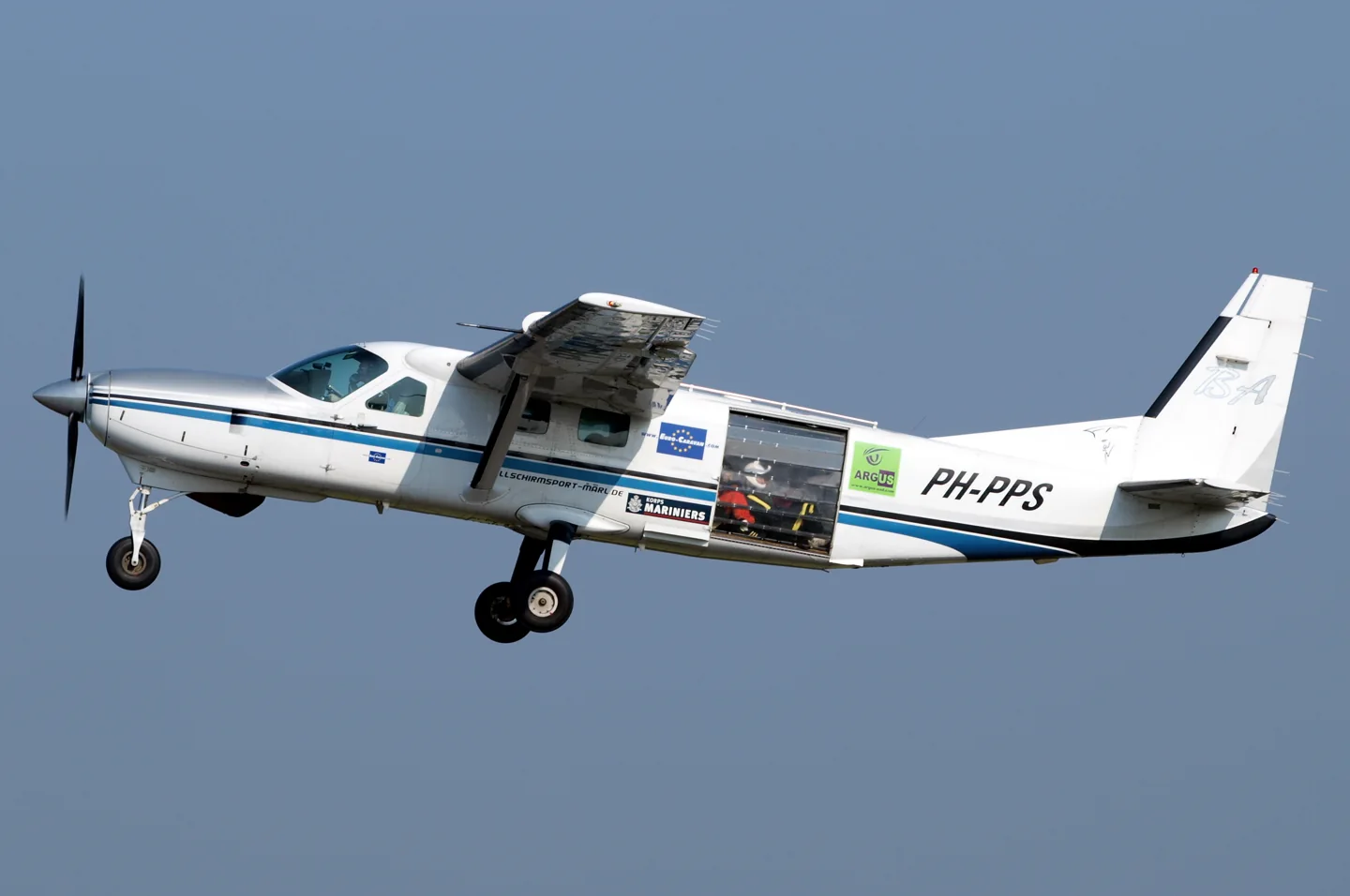
Cessna Caravan familyAlfvanBeem · CC0 · 208B Grand Caravan in the Netherlands, modified with roller door for parachuting operations; skydivers sitting on the cabin floor are visible inside the rear roller door

Cessna Caravan family

Mechanical yoke controls, roll spoilers and elevator servo tabs, with stronger roll than pitch in the cited Caravan account.
TurbopropC20819 opções de perfil

Conheça o avião

The Caravan programme began in the early 1980s, with the prototype flying in 1982. Its high wing, fixed gear and large cabin were organised around practical utility work. The longer 208B developed into the Grand Caravan as well as dedicated freight configurations.

Wheeled aircraft, cargo pods and amphibious floats give the family several recognisable forms. Simulator versions also differ sharply in cockpit philosophy, from modern glass panels to analogue conversions and new standalone aircraft. Each product has its own cockpit and systems description.

Aircraft / family

Propulsion
Single turboprop↗
Configuration
High wing · Utility cabin↗

Cessna 208 Caravan · Specifications (208 Caravan) · real aircraft; source units retained

Length
37 ft 7 in (11.46 m)↗
Wingspan
52 ft 1 in (15.87 m)↗
Height
14 ft 11 in (4.53 m)↗
Wing area
279 sq ft (25.96 m² )↗
Empty weight
4,730 lb (2,145 kg)↗
Max takeoff weight
8,000 lb (3,629 kg)↗
Powerplant
1 × Pratt & Whitney Canada PT6A -114A turboprop, 675 shp (503 kW)↗
Propellers
3-bladed McCauley constant speed, full feathering, reversible pitch↗
Cruise speed
186 kn (214 mph, 344 km/h) true air speed↗
Stall speed
61 kn (70 mph, 113 km/h) calibrated air speed↗

Mais sobre esta aeronave no AirframeDB

A utility turboprop grows into a family

Cessna launched the Caravan programme in 1981, flew the prototype in 1982 and began deliveries in 1985. The stretched, freight-focused 208B Super Cargomaster followed, with certification in 1986; the first production Grand Caravan was delivered in 1990. Passenger services, freight, government work and humanitarian flying became recurring uses for the family.

Glass cockpits and the Grand Caravan EX

The manufacturer’s timeline places standard G1000 avionics in 2008 and the start of Grand Caravan EX deliveries in 2013, with the PT6A-140 engine. G1000 NXi followed as standard equipment in 2017. These changes explain some of the differences between older Caravan accounts and later EX cockpits, alongside the choice of landplane or amphibious configuration.

From simulator preparation to the real aircraft

Horne prepared in a FlightSafety simulator before moving to the real Grand Caravan. The sessions introduced its glass cockpit and approach work, but the aircraft itself still made an impression: reaching the flight deck meant climbing a ladder, and the cockpit had the scale of a much larger working machine. The demonstration aircraft carried a cargo pod and TKS equipment.

Flying close to its maximum weight, he found that the ailerons and rudder asked for deliberate effort. Changes in configuration brought more trimming, while the stall exercises felt comparatively mild. Landing introduced the practical effect of the large propeller’s drag and the need to coordinate power carefully. His simulator preparation preceded the flight with Oliver.

A piston pilot meets the Grand Caravan EX

Hitchen approached the Grand Caravan EX with the expectations of a piston pilot and some apprehension about its size and turbine engine. Wilson took care of departure before handing over for airwork. The controls initially seemed heavy, and Hitchen repeatedly overshot headings as he adjusted to an aircraft with more momentum than his usual mount.

Familiarity softened that first impression: he came to find it responsive once he understood how much input it wanted. Wilson coached the descent, including the need to manage speed, and Hitchen made his first Caravan landing with the wind conveniently aligned with the runway. His humour about breaking his usual first-landing jinx gives the report its character. It remains an introduction under a demonstrator pilot’s guidance, with the pleasure of discovering that a large aircraft could become approachable.

Considering a Caravan after a legal career

Humphries was considering what aviation might become after retiring from legal practice. People had asked about flights to court appearances, and the Caravan suggested a possible combination of business transport and family use. Before the demonstration, he worked through a lengthy FlightSafety manual, trying to arrive with some understanding of an aircraft larger than his usual flying involved.

Allenbaugh’s guidance helped turn that preparation into an enjoyable flight. Humphries hand-flew throughout and was pleased by the roll response, the cockpit view and the comfortable ride through turbulence. Air conditioning had its own appeal in the Texas heat. Back on the ground, he was enthusiastic but still weighing the idea. He had not made a purchase decision or established a charter operation.

Fontes públicas 15
  1. Cessna 208 CaravanResearch background · Wikipedia revision 1367834803 · retrieved 2026-09-12
  2. Microsoft Flight Simulator aircraft manuals
  3. MSFS 2024 FAQ and edition aircraft inventory
  4. MSFS 2020 FAQ and edition aircraft inventory
  5. Caravan Professional manual
  6. X-Plane aircraft and avionics manuals
  7. C208 DGSOfficial developer / designated store catalogue · checked 2026-09-12
  8. Caravan Professional - Amphibian & CargoOfficial developer / designated store catalogue · checked 2026-09-12
  9. Caravan Professional - PassengerOfficial developer / designated store catalogue · checked 2026-09-12
  10. Steam Gauge Overhaul - Analog CaravanOfficial developer / designated store catalogue · checked 2026-09-12
  11. Turbine Pilot: Cessna Caravan — Sky TruckThomas A. Horne · 1 March 2009
  12. A Caravan ExperienceSteve Hitchen · 5 March 2020
  13. CaravanScott Humphries · 23 August 2021
  14. Textron Aviation delivers 3,000th Cessna Caravan family aircraft13 January 2023 · manufacturer programme chronology
  15. ICAO Doc 8643 — aircraft type designatorsPublic search data retrieved 2026-09-14; authority update 2026-09-03

Como o perfil o modela

Black Square Caravan Professional 208 Passenger

Free + Pro
MSFS 2020MSFS 2024Black Square

The Caravan programme began in the early 1980s, with the prototype flying in 1982. Its high wing, fixed gear and large cabin were organised around practical utility work. The longer 208B developed into the Grand Caravan as well as dedicated freight configurations.

This profile selects Black Square Caravan Professional 208 Passenger for MSFS 2020, MSFS 2024.

Spring resistance builds with the selected airspeed response. A separate aerodynamic term adds speed-dependent control load.

Valid trim provides the configured pressure relief. Autopilot following is off.

Esta revisão específica ainda não está habilitada para instalação pública.

Controls and trim

Cessna describes mechanical primary-control linkages, proportional roll spoilers and aileron servo tabs that reduce wheel effort. Published Caravan testing describes heavier roll than pitch in an older 208B and lighter controls after slowing from cruise in an EX. Those accounts supply qualitative family context. The information manual documents a stall-warning horn, not a mechanical stick shaker. Short-body, Grand Caravan, cargo and amphibious configurations remain distinct.

Operating ManualCarenado C208B Grand Caravan HD SeriesGrand Caravan EXCessna 208B Caravan I flight report, May 1989Cessna 208B G1000 Pilot's Operating HandbookA Caravan ExperienceCessna Caravan family reference

The selected implementation

Caravan Professional separates passenger, Cargomaster and amphibian. Mechanical fuel-control-unit operation concerns the PT6 engine rather than primary-control linkage.

Operating Manual

About the values

The gains are normalized profile settings. They describe the chosen effect balance; hand force depends on the device and its output limits. IAS references are tuning values rather than operating limits. Physical acceptance of this revision remains pending.

Master gain & control system

Master gain85%

A escala final de saída aplicada a tudo que o modelo produz, antes do teto do dispositivo.

Mais: tudo (mola, cargas, efeitos) fica mais forte junto.

Menos: tudo amacia junto.

Por que aqui: Scales overall profile strength while preserving effect balance, subject to device and output limits.

Forces

Spring strength74%

A força base de centragem que puxa o manche de volta ao centro. Todas as outras forças se empilham sobre ela. Baixa demais e o manche parece frouxo em voo normal; alta demais e ele briga com sua mão e mascara os sinais menores por cima.

Mais: uma centragem mais firme que resiste mais à mão.

Menos: um manche mais mole que depende só da carga aerodinâmica.

Por que aqui: Mechanical links and servo-tab/roll-spoiler assistance motivate the selected speed-dependent yoke response; related flight reports support a qualitative roll-heavy balance. The baseline spring is 0.74. Its low-speed blend reaches baseline strength at 62.5 KIAS.

Operating ManualCarenado C208B Grand Caravan HD SeriesGrand Caravan EXCessna 208B Caravan I flight report, May 1989Cessna 208B G1000 Pilot's Operating HandbookA Caravan ExperienceCessna Caravan family reference
Spring deadband5%

Uma pequena zona neutra ao redor do centro onde a mola fica quieta, para que movimentos mínimos em repouso não trepidem. Mais larga é mais calma porém mais solta; mais estreita é mais precisa mas pode tremer no centro.

Mais: um centro mais calmo porém mais solto, com mais folga.

Menos: um centro mais apertado que pode tremer em repouso.

Por que aqui: Sets travel around the centre before the baseline spring resists. Smaller values engage it sooner.

Overall aerodynamic load68%

Uma escala mestra sobre as duas cargas sustentadas de eixo, aplicada antes do balanço independente delas. Os perfis normalmente a deixam quieta e ajustam as duas cargas de eixo.

Mais: os dois eixos carregam mais forte.

Menos: os dois eixos aliviam juntos.

Por que aqui: The aerodynamic-load gain is 0.68 with an indicated-speed reference of 125 KIAS. This supplies speed-dependent loading alongside the spring.

Airspeed blendingTrue

Ativa a janela de engate da mola em baixa velocidade (nós de início/pleno acima). Desligado, a mola é constante em todas as velocidades.

Por que aqui: Allows baseline spring strength to rise with indicated airspeed where the control law permits it.

Low-speed spring floor55%

Quanto da mola sobrevive parado, antes que a velocidade possa gerar força aerodinâmica. Um piso alto mantém o manche estacionado firme; um piso baixo dá a sensação solta, de cabos com folga, de um avião leve estacionado.

Mais: um manche mais firme estacionado e no táxi.

Menos: um manche mole estacionado que só desperta com velocidade.

Por que aqui: Sets low-speed spring strength as a fraction of baseline when blending is enabled. One keeps full strength.

Spring engagement start8 kt

A velocidade em que a mola começa a subir do piso de baixa velocidade rumo à força plena: os comandos "ganhando vida" na corrida de decolagem.

Por que aqui: Sets the IAS where the low-speed spring blend starts rising. This is a feel threshold, not a flight limit.

Spring engagement full62.5 kt

A velocidade em que a mola atinge força plena. Entre o início e este ponto, a centragem endurece progressivamente à medida que o fluxo de ar cresce sobre os comandos.

Por que aqui: Sets the IAS where the low-speed blend reaches baseline strength; high-speed stiffening also uses it.

Velocidade de ajuste de força125

A velocidade indicada em que a carga aerodinâmica atinge seu nível pleno de projeto. Ela ancora toda a curva de carga à faixa real de velocidades do avião: um 172 carrega por volta de 110 nós, um jato bem depois.

Mais: as cargas chegam mais tarde; o manche fica leve até mais velocidade.

Menos: as cargas chegam antes e o cruzeiro pesa mais.

Por que aqui: Sets the IAS reference for aerodynamic loading. It is an estimate, not published cruise TAS or a flight limit.

Centre firmness vs speed15%

Quanto a própria centragem endurece com a velocidade, além das cargas de deflexão. Zero mantém a sensação de centro constante; mais faz o manche centrar mais duro em cruzeiro e mais solto no circuito.

Mais: um centro que endurece nitidamente com a velocidade.

Menos: uma sensação de centro constante em qualquer velocidade.

Por que aqui: The high-speed spring-stiffening gain is 0.15. It strengthens the permitted spring response above 62.5 KIAS, with the squared-speed ratio capped at 5.

Centre stiffening cap5

O limite superior do endurecimento de centro pela velocidade, para que voos muito rápidos não tensionem a mola sem freio.

Mais: mais endurecimento total permitido em alta velocidade.

Menos: o endurecimento corta antes.

Por que aqui: Limits the squared airspeed ratio used for high-speed spring stiffening; it is not a device-force cap.

Aileron load72%

A carga sustentada de rolagem da deflexão dos ailerons e da velocidade, balanceada independentemente da arfagem. Junto com a carga do profundor define a razão de harmonia de comandos de que falam as resenhas.

Mais: esforços de rolagem mais pesados.

Menos: ailerons mais leves e vivos.

Por que aqui: Roll and pitch aerodynamic scales are 0.72 and 1, respectively. They set the aerodynamic axis balance. No custom spring-travel curve is enabled.

Elevator load100%

A carga sustentada de arfagem da deflexão do profundor e da velocidade, balanceada independentemente da rolagem. É a alavanca principal por trás do peso de arfagem de um tipo. Não toca aileron, mola, compensador nem forças de buffet.

Mais: esforços sustentados de arfagem mais pesados em velocidade.

Menos: um profundor mais leve, com menos músculo para segurar.

Por que aqui: Scales pitch aerodynamic loading; pitch spring travel and trim responses are separate settings.

Max output force55%

Um teto sobre cada força estável de arfagem ou rolagem antes de chegar ao dispositivo, protegendo contra pancadas ou saturação do hardware em manobras fortes.

Mais: picos de força estável mais altos antes do corte.

Menos: um teto mais suave; manobras duras achatam antes.

Por que aqui: Caps directed-force output. Native spring effects and device limits remain separate.

Trim

Trim relief (elevator)30%

Com que força o compensador de profundor alivia o esforço de arfagem mantido e desloca onde o manche assenta. Em 100 %, um avião bem compensado não precisa de pressão mantida: o fluxo de trabalho de compensar-a-carga do voo real.

Mais: o compensador tira mais esforço mantido; em 100 %, todo compensado o anula.

Menos: você segue segurando esforço mesmo compensado.

Por que aqui: Pitch-trim relief remains a selected approximation of pressure reduction, separate from airframe length, cargo or amphibian equipment. Pitch authority 0.3 provides load relief and permitted centre movement; roll authority is 0.14.

Operating ManualCarenado C208B Grand Caravan HD SeriesGrand Caravan EXCessna 208B Caravan I flight report, May 1989Cessna 208B G1000 Pilot's Operating HandbookA Caravan ExperienceCessna Caravan family reference
Trim relief (aileron)14%

O mesmo alívio para o compensador de rolagem. A maioria dos tipos de aviação geral não tem compensador de aileron real, então isto fica em zero; tipos com compensador de rolagem recebem um valor correspondente.

Mais: o compensador de rolagem tira mais esforço mantido.

Menos: o compensador de rolagem faz menos.

Por que aqui: Scales supported roll-trim relief and permitted centre movement. Zero removes roll response.

Effect gains · Ground

Runway rumble42%

Vibração de rolagem no solo pela velocidade das rodas e tipo de superfície: asfalto, grama ou cascalho sob o trem.

Mais: uma textura de superfície mais forte no manche.

Menos: um táxi mais liso.

Por que aqui: Sets rolling texture strength, modified by speed, surface and undercarriage configuration.

Gear bumps32%

Solavancos curtos e discretos de juntas de dilatação, sulcos e superfície irregular, pontuando o ronco contínuo.

Mais: solavancos mais nítidos de juntas e sulcos.

Menos: detalhes de solo mais suaves.

Por que aqui: Sets gear-bump texture during ground motion, separate from touchdown impact.

Effect gains · Airframe

Stall buffet28%

Sacudida da célula ao se aproximar do estol e enquanto o aviso soa: quão alto esta asa anuncia que está infeliz. Tipos de quebra seca recebem buffet modesto e deixam a buzina levar o aviso.

Mais: um tremor pré-estol mais forte.

Menos: uma asa mais discreta; a buzina leva o aviso.

Por que aqui: Sets stall-buffet strength. Zero removes the cue without changing simulator stalls or warnings.

Mach buffet0%

Buffet transônico ao se aproximar do limite de Mach. Significativo para jatos perto de MMO, zero para pistões e turboélices que nunca chegam lá.

Mais: um buffet transônico mais forte perto do limite de Mach.

Menos: um voo mais liso em Mach alto.

Por que aqui: Sets high-Mach buffet strength; onset and full-strength thresholds are separate.

Flap buffet0%

Vibração de baixa frequência da célula com flapes estendidos no fluxo, na janela de velocidade em que eles realmente trabalham o ar.

Mais: um voo mais áspero com flapes trabalhando.

Menos: flapes de aproximação mais suaves.

Por que aqui: Sets flap buffet at the configured position and speed gates. Flap movement texture is separate.

Gear buffet0%

Tamborilar da célula pelo trem retrátil pendurado na corrente de ar. Zero para tipos de trem fixo, onde a célula nunca muda de forma.

Mais: mais tamborilar com o trem embaixo.

Menos: um voo com trem embaixo mais limpo.

Por que aqui: Sets gear aerodynamic buffet; movement and ground-contact cues are separate.

Stick shaker50%

O zumbido dedicado do stick shaker de estol, disparado pelo próprio sistema de aviso do avião. Só tipos com shaker real recebem valor; o resto confia no buffet aerodinâmico e na buzina.

Mais: um shaker mais duro.

Menos: um shaker mais discreto.

Por que aqui: Sets triggered shaker strength; inactive while the shaker feature is disabled.

Effect gains · Engine, mechanical & drag

Touchdown thump82%

O golpe único quando as rodas tocam a pista, escalado pela razão de descida: um pouso macio sussurra, uma chegada firme bate.

Mais: um golpe mais duro no toque.

Menos: chegadas mais suaves.

Por que aqui: Sets landing-impact strength; landing telemetry and response shape determine the pulse.

Reverse rumble0%

Vibração na corrida enquanto o reverso ou as hélices em beta trabalham. Zero para tipos sem reverso.

Mais: uma corrida mais áspera sob reverso.

Menos: um reverso mais discreto.

Por que aqui: Sets reverse-thrust vibration with valid reverser and engine conditions. Zero removes the cue.

Engine rumble6%

Vibração contínua do grupo motopropulsor seguindo a rotação entre marcha lenta e potência máxima, o lembrete sempre presente de que algo queima combustível lá na frente.

Mais: mais motor no manche.

Menos: um motor mais discreto.

Por que aqui: Sets estimated engine vibration using configured telemetry and response, not measured cockpit vibration.

Flap motion12%

Vibração contínua apenas enquanto o simulador informa as superfícies de flape realmente em movimento. Segue o movimento e as falhas reais do atuador, não um cronômetro estimado.

Mais: mais vibração com os flapes em movimento.

Menos: cursos de flape mais discretos.

Por que aqui: Sets texture from observed flap movement; a command without movement does not establish the cue.

Autopilot follow

AP follow authority10%

Quanto os comandos do piloto automático podem mover fisicamente o manche. Mantido minúsculo no MSFS, onde um eixo movido pode ser lido de volta como entrada do piloto; zero desativa o seguimento por completo.

Mais: o piloto automático move seu manche visivelmente mais.

Menos: um seguimento quase imperceptível.

Por que aqui: Sets admitted AP-follow gain, not a percentage of travel. Runtime ownership and input limits still apply.

Stick feel

StickFeel · Trim feel enabledFalse

Whether this feature is active in this profile.

Por que aqui: Retained for compatibility and group membership. Trim relief, rather than this flag, controls centre movement.

StickFeel · Trim relief enabledTrue

Whether this feature is active in this profile.

Por que aqui: Allows trim relief with supported control law and valid telemetry. Axis authorities set its amount.

StickFeel · Force trim enabledFalse

Whether this feature is active in this profile.

Por que aqui: Enables local force trim, separate from aircraft-owned trim and add-on integration qualification.

StickFeel · G load enabledTrue

Whether this feature is active in this profile.

Por que aqui: Allows load-factor changes to modify permitted spring laws. Passive fly-by-wire feel can suppress it.

StickFeel · Rate damping enabledTrue

Whether this feature is active in this profile.

Por que aqui: Enables rate damping with the configured coefficients and control law.

Autopilot

Autopilot · Follow enabledFalse

Whether this feature is active in this profile.

Por que aqui: Autopilot following is off; the configured spring and load retain the hardware feel.

Autopilot · Neutral hold enabledFalse

Whether this feature is active in this profile.

Por que aqui: Permits centering hold during a supported AP state, separate from following a moving target.

Autopilot · Neutral hold strength0.6

Por que aqui: Sets admitted AP neutral-hold strength; inactive while neutral hold is disabled.

Aero

Aero · EnabledTrue

Whether this feature is active in this profile.

Por que aqui: Enables aerodynamic cues; each still needs nonzero strength and its simulator conditions.

Aero · Max flap index3

Where this effect reaches full strength (or has fully faded, for washouts).

Mais: a more gradual build to a later peak.

Menos: a quicker build.

Por que aqui: Sets the final flap index for detent normalization. UP plus three detents uses maximum index3.

Aero · Min flap index2

Where this effect begins fading in.

Mais: the effect begins later.

Menos: it begins earlier.

Por que aqui: Sets the first flap detent that admits buffet; this is a handle index, not degrees.

Aero · Shaker enabledFalse

Whether this feature is active in this profile.

Por que aqui: Permits shaker at supported warning conditions; the switch does not establish aircraft equipment.

Ground

Ground · EnabledTrue

Whether this feature is active in this profile.

Por que aqui: Enables ground effects; each still needs its own strength and contact or motion telemetry.

Engine

Engine · EnabledTrue

Whether this feature is active in this profile.

Por que aqui: Enables engine cues with nonzero settings and valid running-engine telemetry.

Mechanical

Mechanical · EnabledTrue

Whether this feature is active in this profile.

Por que aqui: Enables accessory cues with configured strengths and observed accessory movement.

Mechanical · Gain0

The strength of this effect.

Mais: a stronger effect.

Menos: a weaker one.

Por que aqui: Sets texture from observed gear movement, separate from aerodynamic and touchdown effects.

Todas as configurações do perfil
Configurações estimadas do perfil
ParâmetroValorO que controla e por quê
Spring strength0.74 Mechanical links and servo-tab/roll-spoiler assistance motivate the selected speed-dependent yoke response; related flight reports support a qualitative roll-heavy balance. The baseline spring is 0.74. Its low-speed blend reaches baseline strength at 62.5 KIAS.
Spring deadband0.05 Sets travel around the centre before the baseline spring resists. Smaller values engage it sooner.
Force gain0.68 The aerodynamic-load gain is 0.68 with an indicated-speed reference of 125 KIAS. This supplies speed-dependent loading alongside the spring.
Master gain0.85 Scales overall profile strength while preserving effect balance, subject to device and output limits.
Dynamic-pressure blendTrue Allows baseline spring strength to rise with indicated airspeed where the control law permits it.
Minimum spring factor0.55 Sets low-speed spring strength as a fraction of baseline when blending is enabled. One keeps full strength.
Spring wake-up speed8 ktSets the IAS where the low-speed spring blend starts rising. This is a feel threshold, not a flight limit.
Spring full-strength speed62.5 ktSets the IAS where the low-speed blend reaches baseline strength; high-speed stiffening also uses it.
Velocidade de ajuste de força125 ktSets the IAS reference for aerodynamic loading. It is an estimate, not published cruise TAS or a flight limit.
Airspeed spring stiffening0.15 The high-speed spring-stiffening gain is 0.15. It strengthens the permitted spring response above 62.5 KIAS, with the squared-speed ratio capped at 5.
Airspeed stiffening cap5 Limits the squared airspeed ratio used for high-speed spring stiffening; it is not a device-force cap.
Aileron force scale0.72 Roll and pitch aerodynamic scales are 0.72 and 1, respectively. They set the aerodynamic axis balance. No custom spring-travel curve is enabled.
Elevator force scale1 Scales pitch aerodynamic loading; pitch spring travel and trim responses are separate settings.
Maximum output force0.55 Caps directed-force output. Native spring effects and device limits remain separate.
StickFeel · Trim feel enabledFalse Retained for compatibility and group membership. Trim relief, rather than this flag, controls centre movement.
StickFeel · Trim relief enabledTrue Allows trim relief with supported control law and valid telemetry. Axis authorities set its amount.
StickFeel · Elevator authority0.3 Pitch-trim relief remains a selected approximation of pressure reduction, separate from airframe length, cargo or amphibian equipment. Pitch authority 0.3 provides load relief and permitted centre movement; roll authority is 0.14.
StickFeel · Aileron authority0.14 Scales supported roll-trim relief and permitted centre movement. Zero removes roll response.
StickFeel · Force trim enabledFalse Enables local force trim, separate from aircraft-owned trim and add-on integration qualification.
StickFeel · G load enabledTrue Allows load-factor changes to modify permitted spring laws. Passive fly-by-wire feel can suppress it.
StickFeel · Rate damping enabledTrue Enables rate damping with the configured coefficients and control law.
Autopilot · Follow enabledFalse Autopilot following is off; the configured spring and load retain the hardware feel.
Autopilot · Follow authority0.1 Sets admitted AP-follow gain, not a percentage of travel. Runtime ownership and input limits still apply.
Autopilot · Neutral hold enabledFalse Permits centering hold during a supported AP state, separate from following a moving target.
Autopilot · Neutral hold strength0.6 Sets admitted AP neutral-hold strength; inactive while neutral hold is disabled.
Aero · EnabledTrue Enables aerodynamic cues; each still needs nonzero strength and its simulator conditions.
Aero · Gain0.28 Sets stall-buffet strength. Zero removes the cue without changing simulator stalls or warnings.
Aero · Gain0 Sets high-Mach buffet strength; onset and full-strength thresholds are separate.
Aero · Gain0 Sets flap buffet at the configured position and speed gates. Flap movement texture is separate.
Aero · Max flap index3 Sets the final flap index for detent normalization. UP plus three detents uses maximum index3.
Aero · Min flap index2 Sets the first flap detent that admits buffet; this is a handle index, not degrees.
Aero · Gain0 Sets gear aerodynamic buffet; movement and ground-contact cues are separate.
Aero · Shaker enabledFalse Permits shaker at supported warning conditions; the switch does not establish aircraft equipment.
Aero · Amplitude0.5 Sets triggered shaker strength; inactive while the shaker feature is disabled.
Ground · EnabledTrue Enables ground effects; each still needs its own strength and contact or motion telemetry.
Ground · Gain0.42 Sets rolling texture strength, modified by speed, surface and undercarriage configuration.
Ground · Gain0.32 Sets gear-bump texture during ground motion, separate from touchdown impact.
Ground · Gain0.82 Sets landing-impact strength; landing telemetry and response shape determine the pulse.
Ground · Gain0 Sets reverse-thrust vibration with valid reverser and engine conditions. Zero removes the cue.
Engine · EnabledTrue Enables engine cues with nonzero settings and valid running-engine telemetry.
Engine · Gain0.06 Sets estimated engine vibration using configured telemetry and response, not measured cockpit vibration.
Mechanical · EnabledTrue Enables accessory cues with configured strengths and observed accessory movement.
Mechanical · Gain0.12 Sets texture from observed flap movement; a command without movement does not establish the cue.
Mechanical · Gain0 Sets texture from observed gear movement, separate from aerodynamic and touchdown effects.
Fontes públicas 21
  1. Cessna 208 CaravanResearch background · Wikipedia revision 1367834803 · retrieved 2026-09-12
  2. Operating ManualCaravan Professional manual introduction, aircraft specifications, controls and hardware sections
  3. Carenado C208B Grand Caravan HD SeriesCessna Caravan family
  4. Grand Caravan EXCessna Caravan family
  5. Cessna 208B Caravan I flight report, May 1989Cessna Caravan family
  6. Cessna 208B G1000 Pilot's Operating HandbookCessna Caravan family
  7. A Caravan ExperienceSteve Hitchen · 5 March 2020
  8. Cessna Caravan family referenceCessna Caravan family
  9. Microsoft Flight Simulator aircraft manuals
  10. MSFS 2024 FAQ and edition aircraft inventory
  11. MSFS 2020 FAQ and edition aircraft inventory
  12. Caravan Professional manual
  13. X-Plane aircraft and avionics manuals
  14. C208 DGSOfficial developer / designated store catalogue · checked 2026-09-12
  15. Caravan Professional - Amphibian & CargoOfficial developer / designated store catalogue · checked 2026-09-12
  16. Caravan Professional - PassengerOfficial developer / designated store catalogue · checked 2026-09-12
  17. Steam Gauge Overhaul - Analog CaravanOfficial developer / designated store catalogue · checked 2026-09-12
  18. Turbine Pilot: Cessna Caravan — Sky TruckThomas A. Horne · 1 March 2009
  19. CaravanScott Humphries · 23 August 2021
  20. Textron Aviation delivers 3,000th Cessna Caravan family aircraft13 January 2023 · manufacturer programme chronology
  21. ICAO Doc 8643 — aircraft type designatorsPublic search data retrieved 2026-09-14; authority update 2026-09-03

Comunidade e correções

Se a sua experiência no tipo diz que esta página errou, corrija aqui.

Correções de pilotos

Voa esta aeronave? Corrija esta página.

Esta página é construída com referências citadas, e experiência real no tipo vale mais que citação. Cite a afirmação errada e conte o que a aeronave real faz. As correções vão ao mantenedor para revisão e alimentam a próxima revisão desta pesquisa.

Papo de hangar

Conversa aberta sobre voar e ajustar o Cessna Caravan family, no fórum da comunidade. As correções acima vão em particular ao mantenedor; o papo de hangar é público.

0 respostas · última atividade

FFB-Bridge
Hangar talk for the Cessna 208B Grand Caravan. How does the real one feel, and how close does the built-in profile get? Compare cockpit time, tuning tweaks, and community profiles here. Research page: Cessna 208B Grand C…
Participe da conversa
Comunidade

Perfis da comunidade para esta aeronave

Ver os 1 na biblioteca
Aeronave Perfil Simulador Hardware Added ReviewsDiscussionDownloads Open profile
Cessna Grand CaravanC208 Black Square Caravan Professional by Jasper_83 MSFS Moza AY210 Sem avaliaçõesStart discussion262