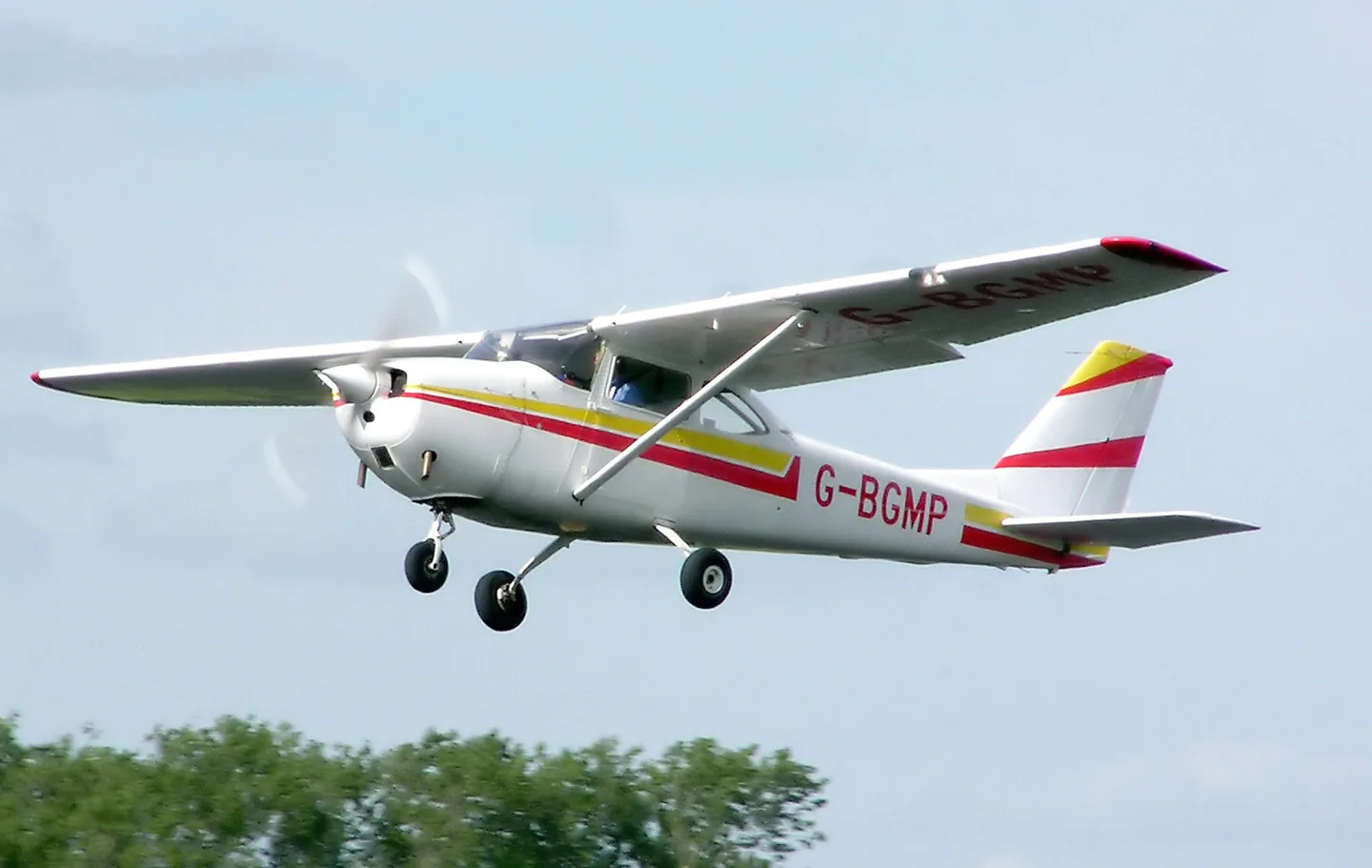
VliegtuigbibliotheekCessna 172 Skyhawk
Cessna 172 SkyhawkAdrian Pingstone · Public domain · 1966 Reims F172G

Cessna 172 Skyhawk

Cable-operated yoke controls with airspeed-dependent resistance, pitch-trim relief and a stall-warning horn.
General aviationC17227 profielkeuzes

Ken het vliegtuig

The Skyhawk developed from the tailwheel Cessna 170, adopting tricycle landing gear. The first 172 flew in 1955. Its combination of a practical cabin, fixed undercarriage and straightforward layout helped make it a familiar aircraft for personal flying and instruction.

The 172's long history includes different engines, panels and equipment. That variety is especially visible in simulation: a conventional-instrument aircraft, a G1000-equipped version and an add-on with persistent maintenance systems offer different experiences despite sharing the same basic silhouette.

Cessna 172 Skyhawk (G1000)

Powerplant
Lycoming IO-360-L2A, 180 hp↗
Seats
4↗
Max takeoff weight
2,550 lb (1,157 kg)↗
Wingspan
36 ft 1 in (11.0 m)↗
Length
27 ft 2 in (8.28 m)↗
Never exceed (Vne)
163 KIAS↗
Max structural cruise (Vno)
129 KIAS↗
Maneuvering (Va)
105 KIAS at 2,550 lb↗
Stall, landing config (Vs0)
40 KCAS↗
Cruise
≈124 KTAS at 75% power↗
Service ceiling
14,000 ft↗
Usable fuel
53 US gal↗

Meer over dit vliegtuig op AirframeDB

A familiar shape that evolved

The 172 began with the tailwheel Cessna 170. Moving the third wheel to the nose helped create the aircraft that became familiar to generations of students. Its outline changed along the way: early examples had a straight fin, the swept fin arrived with the 172A, and the lowered rear fuselage and rear window followed with the 172D. A photograph of an early Skyhawk can therefore look surprisingly different from the training aircraft on a modern ramp.

Familiar controls, a different engine experience

Flying factory JT-A N688CS from San Marcos, Texas, Goyer immediately noticed how different the turbodiesel sounded. Its quieter whirr accompanied a climb that felt convincingly stronger than the earlier diesel Skyhawk the writer had evaluated. The cockpit also changed the pilot's relationship with the engine: one power lever requested output while electronic controls managed fuel and propeller settings. The report describes the Continental-powered JT-A and its Garmin NXi installation, rather than the conventional Lycoming-powered training aircraft that shares its silhouette.

Despite those changes, Goyer found the flight-control feel and most of the familiar Skyhawk flying manners intact. One difference appeared in landing: the demonstrator seemed inclined to float more when approach speed was not closely controlled. The writer suggested residual thrust as a possible explanation, explicitly as an interpretation.

Living with an early straight-tail 172

Davisson's account of Jim Landers's restored 1957 aircraft explains why an early 172 can feel different before it even leaves the ground. The low instrument panel and more upright seating create an unusually open view over the nose. He describes the six-cylinder Continental as smoother than the later Lycomings and finds the aircraft's familiar, approachable character already present in this early version. Landers had moved up from a Cessna 150 chiefly to gain useful space for travelling with his wife and their baggage.

That extra space did not mean treating every seat as routinely available. Operating in Arizona, Landers generally used the aircraft as a two-person tourer and took high density altitude seriously when deciding on a load. His account also includes the less glamorous side of ownership: an engine failure inside the crankcase led to a rebuild, and the polished finish required considerable labour.

A student’s view of the glass-panel Skyhawk

For Cox's 2009 review, student pilot Peggy Herrera offered a perspective quite different from a veteran test pilot's. She had been able to try a varied group of aircraft and was training in a recent, air-conditioned Skyhawk with Garmin G1000 instruments. What she appreciated most was the aircraft's unhurried response: gentle control behaviour, effective flaps and low speeds in the circuit left her time to understand what was happening. That mattered particularly while she was learning to land.

Her principal difficulty lay in the panel rather than the airframe. The G1000 initially felt overwhelming until its organisation began to make sense, and the tall instrument panel could restrict the view for a shorter pilot despite the adjustable seat. Cox set those observations alongside his own experience in numerous Skyhawks, including long trips, and described the model's appeal as a balance of useful qualities.

Openbare bronnen 34
  1. Cessna 172Research background · Wikipedia revision 1374422697 · retrieved 2026-09-12
  2. Microsoft Flight Simulator aircraft manuals
  3. MSFS 2024 FAQ and edition aircraft inventory
  4. MSFS 2020 FAQ and edition aircraft inventory
  5. Cessna 172 SP POH
  6. X-Plane 12 Desktop Manual
  7. X-Plane aircraft and avionics manuals
  8. X-Plane 11 Desktop Manual
  9. C172 DigitalOfficial developer / designated store catalogue · checked 2026-09-12
  10. Cessna 172: Everyman’s AirplaneAOPA Pilot, May 1992: a retrospective on the real Skyhawk.
  11. Cessna 172M DGS series XP12Official developer / designated store catalogue · checked 2026-09-12
  12. C172 NG AnalogOfficial developer / designated store catalogue · checked 2026-09-12
  13. Reality Expansion Pack · Default XP11/12 Cessna 172SPOfficial developer / designated store catalogue · checked 2026-09-12
  14. Turbodiesel Cessna 172 JT-AIsabel Goyer · 12 March 2018. Continental CD-155-powered factory JT-A, N688CS. Byline as currently published.
  15. Cessna C172 (1957) pilot report: Straight Tail TaleBudd Davisson, with owner Jim Landers · Undated hosted article about Jim Landers’s 1957 Cessna 172. Historical owner and writer observations; not current operating advice.
  16. 2009 Cessna 172S: Skyhawk in Year 53Peggy Herrera, interviewed by Bill Cox · 24 March 2009. Herrera’s training in a 2008 G1000-equipped Skyhawk, interviewed within Cox’s 172S review.
  17. C172 NG DIGITAL-airfoillabs-C172NGOfficial developer / designated-store reference · checked 2026-09-14
  18. C172 NG ANALOG XP12-airfoillabs-C172NGAOfficial developer / designated-store reference · checked 2026-09-14
  19. Cessna 172SP Skyhawk XP11-airfoillabs-C172SPOfficial developer / designated-store reference · checked 2026-09-14
  20. ICAO Doc 8643 — aircraft type designatorsPublic search data retrieved 2026-09-14; authority update 2026-09-03
  21. FAA JO 7360.1K — aircraft type designatorsActive FAA order; checked 2026-09-14
  22. C172 Amphibian current productProduct listing captured 2026-09-24; edition scope from the reviewed catalogue
  23. C172 Bushkit current productProduct listing captured 2026-09-24; edition scope from the reviewed catalogue
  24. C172 Taildragger current productProduct listing captured 2026-09-24; edition scope from the reviewed catalogue
  25. C172M current productProduct listing captured 2026-09-24; edition scope from the reviewed catalogue
  26. C172SP AS1000 improvement current productProduct listing captured 2026-09-24; edition scope from the reviewed catalogue
  27. FR172 Reims Rocket / R172 Hawk XP II current productProduct listing captured 2026-09-24; edition scope from the reviewed catalogue
  28. C172 MSFS2020 – CarenadoProduct listing captured 2026-09-23; edition scope from the reviewed catalogue
  29. C172 MSFS2024 – CarenadoProduct listing captured 2026-09-23; edition scope from the reviewed catalogue
  30. WBSim C172SP current changes and interface documentation scopeProduct listing captured 2026-09-24; edition scope from the reviewed catalogue
  31. C-172S, C-172R, C-172M/N Enhanced Flight ModelsProduct listing captured 2026-09-24; edition scope from the reviewed catalogue
  32. Cessna 172S POH; FAA TCDS 3A12Gedrukte of gearchiveerde bron; geen openbare link
  33. Cessna 172S POHGedrukte of gearchiveerde bron; geen openbare link
  34. FAA TCDS 3A12Gedrukte of gearchiveerde bron; geen openbare link

Hoe het profiel het modelleert

Bagolu C172 Taildragger

Free + Pro
MSFS 2020MSFS 2024Bagolu

The Skyhawk developed from the tailwheel Cessna 170, adopting tricycle landing gear. The first 172 flew in 1955. Its combination of a practical cabin, fixed undercarriage and straightforward layout helped make it a familiar aircraft for personal flying and instruction.

This profile selects Bagolu C172 Taildragger for MSFS 2020, MSFS 2024.

Spring resistance builds with the selected airspeed response. A separate aerodynamic term adds speed-dependent control load.

Valid trim provides the configured pressure relief. Autopilot following is off.

Deze exacte revisie is nog niet beschikbaar voor openbare installatie.

Controls and trim

C172 manuals describe mechanical cables and linkages operating the primary controls and an elevator trim tab operated from the cockpit wheel. Published handling accounts describe greater elevator effort than aileron effort and hands-off stability after trimming. These are qualitative accounts, not one fixed ratio for every Skyhawk or loading condition. Engine upgrades, float kits, taildragger conversions and analog or glass panels retain their own simulator scope.

Cessna-authored 172S POH preserved by aircraft operator; verify avionics and revisionCessna 172M manufacturer POHCessna 172 SkyhawkCessna 172 Skyhawk

The selected implementation

Bagolu v4.2.0 uses a 210-hp conversion, continuous manual 0–40-degree flaps, fixed tailwheel/bush tyres and enhanced brakes, with analog and optional GPS/G5 equipment.

Cessna-authored 172S POH preserved by aircraft operator; verify avionics and revisionC172 Taildragger

About the values

The gains are normalized profile settings. They describe the chosen effect balance; hand force depends on the device and its output limits. IAS references are tuning values rather than operating limits. Physical acceptance of this revision remains pending.

Master gain & control system

Master gain85%

De uiteindelijke totaalschaal over alles wat het model produceert, vóór de apparaatbegrenzing.

Meer: alles (veer, belastingen, effecten) wordt samen sterker.

Minder: alles wordt samen zachter.

Waarom hier: Scales overall profile strength while preserving effect balance, subject to device and output limits.

Forces

Spring strength74%

De basiscentreerkracht die de stick terug naar het midden trekt. Elke andere kracht stapelt hierop. Te laag en de stick voelt slap in normale vlucht; te hoog en hij vecht tegen je hand en maskeert de kleinere signalen erbovenop.

Meer: een steviger centreren dat de hand meer weerstaat.

Minder: een slappere stick die alleen op aerodynamische belasting leunt.

Waarom hier: Mechanical controls and published pitch-heavy handling motivate speed-dependent yoke resistance and a separately selected roll balance. The baseline spring is 0.74. Its low-speed blend reaches baseline strength at 50 KIAS.

Cessna-authored 172S POH preserved by aircraft operator; verify avionics and revisionCessna 172M manufacturer POHCessna 172 SkyhawkCessna 172 Skyhawk
Spring deadband4%

Een kleine neutrale zone rond het midden waar de veer stil blijft, zodat minieme bewegingen in rust niet ratelen. Breder is rustiger maar losser; smaller is preciezer maar kan rond het midden trillen.

Meer: een rustiger maar losser midden, met meer speling.

Minder: een strakker midden dat in rust kan trillen.

Waarom hier: Sets travel around the centre before the baseline spring resists. Smaller values engage it sooner.

Overall aerodynamic load80%

Een masterschaal over beide aangehouden asbelastingen, toegepast vóór hun onafhankelijke balans. Profielen laten dit normaal met rust en stemmen de twee asbelastingen af.

Meer: beide assen laden zwaarder.

Minder: beide assen worden samen lichter.

Waarom hier: The aerodynamic-load gain is 0.8 with an indicated-speed reference of 100 KIAS. This supplies speed-dependent loading alongside the spring.

Airspeed blendingTrue

Schakelt het lage-snelheidsvenster van de veeraangrijping in (start/vol-knopen hierboven). Uit betekent een constante veer op alle snelheden.

Waarom hier: Allows baseline spring strength to rise with indicated airspeed where the control law permits it.

Low-speed spring floor55%

Hoeveel van de veer overleeft bij stilstand, voordat luchtsnelheid aerodynamische kracht kan opbouwen. Een hoge vloer houdt de geparkeerde stick stevig; een lage geeft het losse, kabelslappe gevoel van een geparkeerd licht vliegtuig.

Meer: een stevigere stick geparkeerd en tijdens taxiën.

Minder: een slappe stick geparkeerd die pas met snelheid ontwaakt.

Waarom hier: Sets low-speed spring strength as a fraction of baseline when blending is enabled. One keeps full strength.

Spring engagement start8 kt

De snelheid waarbij de veer vanaf zijn lage-snelheidsvloer richting volle sterkte begint te klimmen: de besturing die 'tot leven komt' tijdens de startrol.

Waarom hier: Sets the IAS where the low-speed spring blend starts rising. This is a feel threshold, not a flight limit.

Spring engagement full50 kt

De snelheid waarbij de veer volle sterkte bereikt. Tussen het begin en dit punt wordt het centreren geleidelijk steviger naarmate de luchtstroom over de roeren groeit.

Waarom hier: Sets the IAS where the low-speed blend reaches baseline strength; high-speed stiffening also uses it.

Snelheid voor krachtafstemming100

De aangewezen snelheid waarbij de aerodynamische belasting haar ontworpen volle niveau bereikt. Hij verankert de hele belastingscurve aan het echte snelheidsbereik van het vliegtuig: een 172 laadt op tegen 110 knopen, een jet veel later.

Meer: belastingen komen later; de stick blijft langer licht.

Minder: belastingen komen eerder en de kruisvlucht weegt zwaarder.

Waarom hier: Sets the IAS reference for aerodynamic loading. It is an estimate, not published cruise TAS or a flight limit.

Centre firmness vs speed15%

Hoeveel het centreren zelf met snelheid verstijft, bovenop de uitslagbelastingen. Nul houdt het middengevoel constant; meer laat de stick harder centreren op kruissnelheid en losser in het circuit.

Meer: een midden dat duidelijk verhardt met snelheid.

Minder: een constant middengevoel op elke snelheid.

Waarom hier: The high-speed spring-stiffening gain is 0.15. It strengthens the permitted spring response above 50 KIAS, with the squared-speed ratio capped at 5.

Centre stiffening cap5

De bovengrens van snelheidsgedreven centreerverstijving, zodat zeer snelle vlucht de veer niet onbegrensd kan opwinden.

Meer: meer totale verstijving toegestaan op hoge snelheid.

Minder: de verstijving stopt eerder.

Waarom hier: Limits the squared airspeed ratio used for high-speed spring stiffening; it is not a device-force cap.

Aileron load72%

De aangehouden rolbelasting uit rolroeruitslag en snelheid, onafhankelijk van pitch gebalanceerd. Samen met de hoogteroerbelasting bepaalt dit de stuurharmonie waar recensenten het over hebben.

Meer: zwaardere rolkrachten.

Minder: lichtere, levendigere rolroeren.

Waarom hier: Roll and pitch aerodynamic scales are 0.72 and 1, respectively. They set the aerodynamic axis balance. No custom spring-travel curve is enabled.

Elevator load100%

De aangehouden pitchbelasting uit hoogteroeruitslag en snelheid, onafhankelijk van rol gebalanceerd. Dit is de hoofdhendel achter het pitchgewicht van een type. Hij raakt rolroer-, veer-, trim- of buffetkrachten niet.

Meer: zwaardere aangehouden pitchkrachten op snelheid.

Minder: een lichter hoogteroer, minder spierkracht om vast te houden.

Waarom hier: Scales pitch aerodynamic loading; pitch spring travel and trim responses are separate settings.

Max output force55%

Een plafond op elke gestage pitch- of rolkracht voordat die het apparaat bereikt, ter bescherming tegen beuken of verzadigen van de hardware bij stevige manoeuvres.

Meer: hogere gestage krachtpieken vóór afkapping.

Minder: een zachter plafond; harde manoeuvres vlakken eerder af.

Waarom hier: Caps directed-force output. Native spring effects and device limits remain separate.

Trim

Trim relief (elevator)30%

Hoe sterk hoogteroertrim de vastgehouden pitchkracht verlicht en verschuift waar de stick tot rust komt. Op 100 % heeft een goed getrimd vliegtuig geen vastgehouden druk nodig, de trim-de-last-weg-werkwijze van echt vliegen.

Meer: trim neemt meer vastgehouden kracht weg; op 100 % heft volle trim hem op.

Minder: je blijft kracht houden, zelfs getrimd.

Waarom hier: The elevator trim tab supports pitch-load relief. A ground-adjustable rudder tab is not a pilot-operated aileron-trim signal. Pitch authority 0.3 provides load relief and permitted centre movement; roll authority is 0.

Cessna-authored 172S POH preserved by aircraft operator; verify avionics and revisionCessna 172M manufacturer POHCessna 172 SkyhawkCessna 172 Skyhawk
Trim relief (aileron)0%

Dezelfde verlichting voor roltrim. De meeste GA-types hebben geen echte rolroertrim, dus dit blijft op nul; types met roltrim krijgen een passende waarde.

Meer: roltrim neemt meer vastgehouden kracht weg.

Minder: roltrim doet minder.

Waarom hier: Scales supported roll-trim relief and permitted centre movement. Zero removes roll response.

Effect gains · Ground

Runway rumble40%

Rollende oppervlaktetrilling uit wielsnelheid en ondergrondtype: asfalt, gras of grind onder het onderstel.

Meer: een sterkere oppervlaktetextuur in de stick.

Minder: gladder taxiën.

Waarom hier: Sets rolling texture strength, modified by speed, surface and undercarriage configuration.

Gear bumps25%

Korte losse stoten van uitzetvoegen, sporen en ruw oppervlak, die het doorlopende gerommel accentueren.

Meer: scherpere stoten van voegen en sporen.

Minder: zachtere gronddetails.

Waarom hier: Sets gear-bump texture during ground motion, separate from touchdown impact.

Effect gains · Airframe

Stall buffet35%

Casco-schudden bij het naderen van de overtrek en terwijl de overtrekwaarschuwing actief is: hoe luid deze vleugel aankondigt dat hij ontevreden is. Types met een scherpe afbreek krijgen bescheiden buffet en laten de hoorn de waarschuwing dragen.

Meer: een sterker trillen vóór de overtrek.

Minder: een discretere vleugel; de hoorn draagt de waarschuwing.

Waarom hier: Sets stall-buffet strength. Zero removes the cue without changing simulator stalls or warnings.

Mach buffet0%

Transsoon buffet bij het naderen van de Machlimiet. Betekenisvol voor jets nabij MMO, nul voor zuigers en turboprops die er nooit komen.

Meer: een sterker transsoon buffet nabij de Machlimiet.

Minder: gladder vliegen op hoge Mach.

Waarom hier: Sets high-Mach buffet strength; onset and full-strength thresholds are separate.

Flap buffet0%

Laagfrequente casco-trilling met kleppen uitgeslagen in de luchtstroom, in het snelheidsvenster waar ze de lucht echt bewerken.

Meer: ruwer vliegen met werkende kleppen.

Minder: zachtere naderingskleppen.

Waarom hier: Sets flap buffet at the configured position and speed gates. Flap movement texture is separate.

Gear buffet0%

Casco-getrommel van intrekbaar onderstel dat in de luchtstroom hangt. Nul voor types met vast onderstel, waar het casco nooit van vorm verandert.

Meer: meer getrommel met het onderstel uit.

Minder: schoner vliegen met onderstel uit.

Waarom hier: Sets gear aerodynamic buffet; movement and ground-contact cues are separate.

Stick shaker50%

De speciale stall-stickshakerzoem, geactiveerd door het eigen overtrekwaarschuwingssysteem van het vliegtuig. Alleen types met een echte shaker krijgen een waarde; de rest steunt op aerodynamisch buffet en de hoorn.

Meer: een hardere shaker.

Minder: een discretere shaker.

Waarom hier: Sets triggered shaker strength; inactive while the shaker feature is disabled.

Effect gains · Engine, mechanical & drag

Touchdown thump65%

De eenmalige dreun als de wielen de baan raken, geschaald op daalsnelheid: een zachte landing fluistert, een stevige aankomst bonkt.

Meer: een hardere dreun bij de landing.

Minder: zachtere aankomsten.

Waarom hier: Sets landing-impact strength; landing telemetry and response shape determine the pulse.

Reverse rumble0%

Uitroltrilling terwijl reverse thrust of props in beta werken. Nul voor types zonder reverse.

Meer: ruwer uitrollen onder reverse.

Minder: een discretere reverse.

Waarom hier: Sets reverse-thrust vibration with valid reverser and engine conditions. Zero removes the cue.

Engine rumble12%

Doorlopende motortrilling die het toerental volgt tussen stationair en vol vermogen, de altijd aanwezige herinnering dat er voorin iets brandstof verbrandt.

Meer: meer motor in de stick.

Minder: een discretere motor.

Waarom hier: Sets estimated engine vibration using configured telemetry and response, not measured cockpit vibration.

Flap motion12%

Doorlopende trilling alleen terwijl de sim meldt dat de klepvlakken daadwerkelijk bewegen. Volgt echte actuatorbeweging en storingen, geen geschatte timer.

Meer: meer trilling met bewegende kleppen.

Minder: discretere klepbewegingen.

Waarom hier: Sets texture from observed flap movement; a command without movement does not establish the cue.

Autopilot follow

AP follow authority10%

Hoe ver autopilootcommando's de stick fysiek mogen bewegen. Piepklein gehouden in MSFS, waar een bewogen as kan worden teruggelezen als pilooteninvoer; nul schakelt volgen volledig uit.

Meer: de autopiloot beweegt je stick zichtbaar meer.

Minder: een nauwelijks merkbaar volgen.

Waarom hier: Sets admitted AP-follow gain, not a percentage of travel. Runtime ownership and input limits still apply.

Stick feel

StickFeel · Trim feel enabledFalse

Whether this feature is active in this profile.

Waarom hier: Retained for compatibility and group membership. Trim relief, rather than this flag, controls centre movement.

StickFeel · Trim relief enabledTrue

Whether this feature is active in this profile.

Waarom hier: Allows trim relief with supported control law and valid telemetry. Axis authorities set its amount.

StickFeel · Force trim enabledFalse

Whether this feature is active in this profile.

Waarom hier: Enables local force trim, separate from aircraft-owned trim and add-on integration qualification.

StickFeel · G load enabledTrue

Whether this feature is active in this profile.

Waarom hier: Allows load-factor changes to modify permitted spring laws. Passive fly-by-wire feel can suppress it.

StickFeel · Rate damping enabledTrue

Whether this feature is active in this profile.

Waarom hier: Enables rate damping with the configured coefficients and control law.

Autopilot

Autopilot · Follow enabledFalse

Whether this feature is active in this profile.

Waarom hier: Autopilot following is off; the configured spring and load retain the hardware feel.

Autopilot · Neutral hold enabledFalse

Whether this feature is active in this profile.

Waarom hier: Permits centering hold during a supported AP state, separate from following a moving target.

Autopilot · Neutral hold strength0.6

Waarom hier: Sets admitted AP neutral-hold strength; inactive while neutral hold is disabled.

Aero

Aero · EnabledTrue

Whether this feature is active in this profile.

Waarom hier: Enables aerodynamic cues; each still needs nonzero strength and its simulator conditions.

Aero · Max flap index3

Where this effect reaches full strength (or has fully faded, for washouts).

Meer: a more gradual build to a later peak.

Minder: a quicker build.

Waarom hier: Sets the final flap index for detent normalization. UP plus three detents uses maximum index3.

Aero · Min flap index2

Where this effect begins fading in.

Meer: the effect begins later.

Minder: it begins earlier.

Waarom hier: Sets the first flap detent that admits buffet; this is a handle index, not degrees.

Aero · Shaker enabledFalse

Whether this feature is active in this profile.

Waarom hier: Permits shaker at supported warning conditions; the switch does not establish aircraft equipment.

Ground

Ground · EnabledTrue

Whether this feature is active in this profile.

Waarom hier: Enables ground effects; each still needs its own strength and contact or motion telemetry.

Engine

Engine · EnabledTrue

Whether this feature is active in this profile.

Waarom hier: Enables engine cues with nonzero settings and valid running-engine telemetry.

Mechanical

Mechanical · EnabledTrue

Whether this feature is active in this profile.

Waarom hier: Enables accessory cues with configured strengths and observed accessory movement.

Mechanical · Gain0

The strength of this effect.

Meer: a stronger effect.

Minder: a weaker one.

Waarom hier: Sets texture from observed gear movement, separate from aerodynamic and touchdown effects.

Alle profielinstellingen
Geschatte profielinstellingen
ParameterWaardeWat het regelt en waarom
Spring strength0.74 Mechanical controls and published pitch-heavy handling motivate speed-dependent yoke resistance and a separately selected roll balance. The baseline spring is 0.74. Its low-speed blend reaches baseline strength at 50 KIAS.
Spring deadband0.04 Sets travel around the centre before the baseline spring resists. Smaller values engage it sooner.
Force gain0.8 The aerodynamic-load gain is 0.8 with an indicated-speed reference of 100 KIAS. This supplies speed-dependent loading alongside the spring.
Master gain0.85 Scales overall profile strength while preserving effect balance, subject to device and output limits.
Dynamic-pressure blendTrue Allows baseline spring strength to rise with indicated airspeed where the control law permits it.
Minimum spring factor0.55 Sets low-speed spring strength as a fraction of baseline when blending is enabled. One keeps full strength.
Spring wake-up speed8 ktSets the IAS where the low-speed spring blend starts rising. This is a feel threshold, not a flight limit.
Spring full-strength speed50 ktSets the IAS where the low-speed blend reaches baseline strength; high-speed stiffening also uses it.
Snelheid voor krachtafstemming100 ktSets the IAS reference for aerodynamic loading. It is an estimate, not published cruise TAS or a flight limit.
Airspeed spring stiffening0.15 The high-speed spring-stiffening gain is 0.15. It strengthens the permitted spring response above 50 KIAS, with the squared-speed ratio capped at 5.
Airspeed stiffening cap5 Limits the squared airspeed ratio used for high-speed spring stiffening; it is not a device-force cap.
Aileron force scale0.72 Roll and pitch aerodynamic scales are 0.72 and 1, respectively. They set the aerodynamic axis balance. No custom spring-travel curve is enabled.
Elevator force scale1.0 Scales pitch aerodynamic loading; pitch spring travel and trim responses are separate settings.
Maximum output force0.55 Caps directed-force output. Native spring effects and device limits remain separate.
StickFeel · Trim feel enabledFalse Retained for compatibility and group membership. Trim relief, rather than this flag, controls centre movement.
StickFeel · Trim relief enabledTrue Allows trim relief with supported control law and valid telemetry. Axis authorities set its amount.
StickFeel · Elevator authority0.3 The elevator trim tab supports pitch-load relief. A ground-adjustable rudder tab is not a pilot-operated aileron-trim signal. Pitch authority 0.3 provides load relief and permitted centre movement; roll authority is 0.
StickFeel · Aileron authority0 Scales supported roll-trim relief and permitted centre movement. Zero removes roll response.
StickFeel · Force trim enabledFalse Enables local force trim, separate from aircraft-owned trim and add-on integration qualification.
StickFeel · G load enabledTrue Allows load-factor changes to modify permitted spring laws. Passive fly-by-wire feel can suppress it.
StickFeel · Rate damping enabledTrue Enables rate damping with the configured coefficients and control law.
Autopilot · Follow enabledFalse Autopilot following is off; the configured spring and load retain the hardware feel.
Autopilot · Follow authority0.1 Sets admitted AP-follow gain, not a percentage of travel. Runtime ownership and input limits still apply.
Autopilot · Neutral hold enabledFalse Permits centering hold during a supported AP state, separate from following a moving target.
Autopilot · Neutral hold strength0.6 Sets admitted AP neutral-hold strength; inactive while neutral hold is disabled.
Aero · EnabledTrue Enables aerodynamic cues; each still needs nonzero strength and its simulator conditions.
Aero · Gain0.35 Sets stall-buffet strength. Zero removes the cue without changing simulator stalls or warnings.
Aero · Gain0 Sets high-Mach buffet strength; onset and full-strength thresholds are separate.
Aero · Gain0 Sets flap buffet at the configured position and speed gates. Flap movement texture is separate.
Aero · Max flap index3 Sets the final flap index for detent normalization. UP plus three detents uses maximum index3.
Aero · Min flap index2 Sets the first flap detent that admits buffet; this is a handle index, not degrees.
Aero · Gain0 Sets gear aerodynamic buffet; movement and ground-contact cues are separate.
Aero · Shaker enabledFalse Permits shaker at supported warning conditions; the switch does not establish aircraft equipment.
Aero · Amplitude0.5 Sets triggered shaker strength; inactive while the shaker feature is disabled.
Ground · EnabledTrue Enables ground effects; each still needs its own strength and contact or motion telemetry.
Ground · Gain0.4 Sets rolling texture strength, modified by speed, surface and undercarriage configuration.
Ground · Gain0.25 Sets gear-bump texture during ground motion, separate from touchdown impact.
Ground · Gain0.65 Sets landing-impact strength; landing telemetry and response shape determine the pulse.
Ground · Gain0 Sets reverse-thrust vibration with valid reverser and engine conditions. Zero removes the cue.
Engine · EnabledTrue Enables engine cues with nonzero settings and valid running-engine telemetry.
Engine · Gain0.12 Sets estimated engine vibration using configured telemetry and response, not measured cockpit vibration.
Mechanical · EnabledTrue Enables accessory cues with configured strengths and observed accessory movement.
Mechanical · Gain0.12 Sets texture from observed flap movement; a command without movement does not establish the cue.
Mechanical · Gain0 Sets texture from observed gear movement, separate from aerodynamic and touchdown effects.
Openbare bronnen 38
  1. Cessna 172Research background · Wikipedia revision 1374422697 · retrieved 2026-09-12
  2. Cessna-authored 172S POH preserved by aircraft operator; verify avionics and revisionCessna172S POH PDF p168(section7-6),p175(7-13),p40(2-4), table ; Cessna 172S POH PDF168 / printed7-6
  3. Cessna 172M manufacturer POHCessna172M POH PDF98/100/104, printed7-3/7-5/7-9,
  4. Cessna 172 SkyhawkCessna 172 Skyhawk
  5. Cessna 172 SkyhawkCessna 172 Skyhawk
  6. C172 TaildraggerCurrent product: compatibility, cockpit, model and flight-model changesProduct listing captured 2026-09-24; edition scope from the reviewed catalogue
  7. Microsoft Flight Simulator aircraft manuals
  8. MSFS 2024 FAQ and edition aircraft inventory
  9. MSFS 2020 FAQ and edition aircraft inventory
  10. Cessna 172 SP POH
  11. X-Plane 12 Desktop Manual
  12. X-Plane aircraft and avionics manuals
  13. X-Plane 11 Desktop Manual
  14. C172 DigitalOfficial developer / designated store catalogue · checked 2026-09-12
  15. Cessna 172: Everyman’s AirplaneAOPA Pilot, May 1992: a retrospective on the real Skyhawk.
  16. Cessna 172M DGS series XP12Official developer / designated store catalogue · checked 2026-09-12
  17. C172 NG AnalogOfficial developer / designated store catalogue · checked 2026-09-12
  18. Reality Expansion Pack · Default XP11/12 Cessna 172SPOfficial developer / designated store catalogue · checked 2026-09-12
  19. Turbodiesel Cessna 172 JT-AIsabel Goyer · 12 March 2018. Continental CD-155-powered factory JT-A, N688CS. Byline as currently published.
  20. Cessna C172 (1957) pilot report: Straight Tail TaleBudd Davisson, with owner Jim Landers · Undated hosted article about Jim Landers’s 1957 Cessna 172. Historical owner and writer observations; not current operating advice.
  21. 2009 Cessna 172S: Skyhawk in Year 53Peggy Herrera, interviewed by Bill Cox · 24 March 2009. Herrera’s training in a 2008 G1000-equipped Skyhawk, interviewed within Cox’s 172S review.
  22. C172 NG DIGITAL-airfoillabs-C172NGOfficial developer / designated-store reference · checked 2026-09-14
  23. C172 NG ANALOG XP12-airfoillabs-C172NGAOfficial developer / designated-store reference · checked 2026-09-14
  24. Cessna 172SP Skyhawk XP11-airfoillabs-C172SPOfficial developer / designated-store reference · checked 2026-09-14
  25. ICAO Doc 8643 — aircraft type designatorsPublic search data retrieved 2026-09-14; authority update 2026-09-03
  26. FAA JO 7360.1K — aircraft type designatorsActive FAA order; checked 2026-09-14
  27. C172 Amphibian current productProduct listing captured 2026-09-24; edition scope from the reviewed catalogue
  28. C172 Bushkit current productProduct listing captured 2026-09-24; edition scope from the reviewed catalogue
  29. C172M current productProduct listing captured 2026-09-24; edition scope from the reviewed catalogue
  30. C172SP AS1000 improvement current productProduct listing captured 2026-09-24; edition scope from the reviewed catalogue
  31. FR172 Reims Rocket / R172 Hawk XP II current productProduct listing captured 2026-09-24; edition scope from the reviewed catalogue
  32. C172 MSFS2020 – CarenadoProduct listing captured 2026-09-23; edition scope from the reviewed catalogue
  33. C172 MSFS2024 – CarenadoProduct listing captured 2026-09-23; edition scope from the reviewed catalogue
  34. WBSim C172SP current changes and interface documentation scopeProduct listing captured 2026-09-24; edition scope from the reviewed catalogue
  35. C-172S, C-172R, C-172M/N Enhanced Flight ModelsProduct listing captured 2026-09-24; edition scope from the reviewed catalogue
  36. Cessna 172S POH; FAA TCDS 3A12Gedrukte of gearchiveerde bron; geen openbare link
  37. Cessna 172S POHGedrukte of gearchiveerde bron; geen openbare link
  38. FAA TCDS 3A12Gedrukte of gearchiveerde bron; geen openbare link

Community en correcties

Zegt jouw ervaring op het type dat deze pagina iets fout heeft? Corrigeer het hier.

Pilotencorrecties

Vlieg je dit toestel? Corrigeer deze pagina.

Deze pagina is gebouwd op geciteerde bronnen, en echte ervaring op het type verslaat elke bron. Citeer de foute bewering en vertel ons wat het echte toestel doet. Correcties gaan ter beoordeling naar de maintainer en voeden de volgende revisie van dit onderzoek.

Hangarpraat

Open gesprek over het vliegen en afstellen van de Cessna 172 Skyhawk, op het communityforum. Correcties hierboven gaan privé naar de maintainer; hangarpraat is openbaar.

Nog geen hangarpraat over de Cessna 172 Skyhawk. Wees de eerste.

Community

Communityprofielen voor dit toestel

Nog geen communityprofielen voor dit toestel. Op jouw manier afgesteld? Deel een profiel en het verschijnt hier.