Development milestones
First flight: September 26, 1981 ( 1981-09-26 )
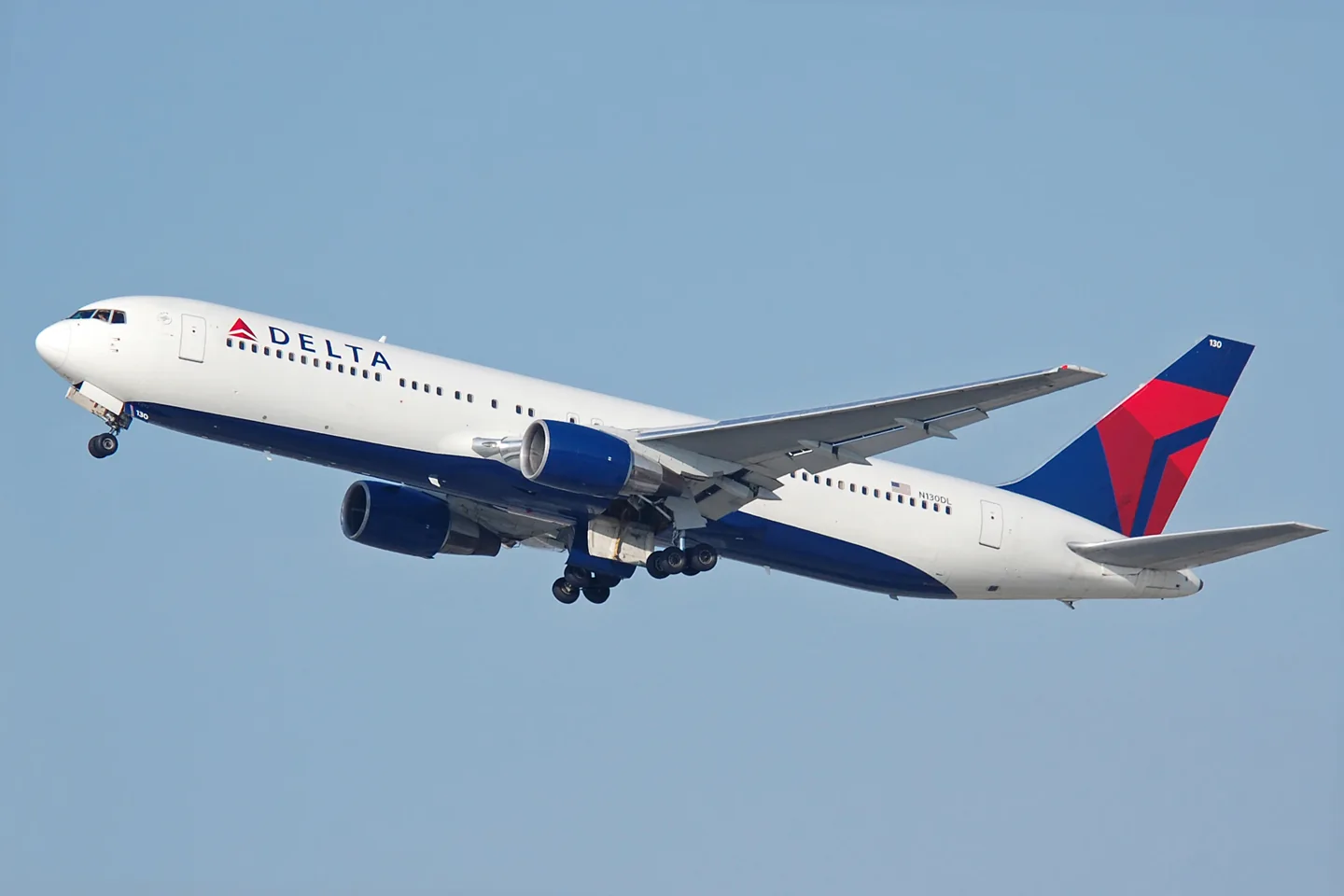 Richard Snyder; derivative by Altair78 · CC BY-SA 2.0 · Delta Air Lines Boeing 767-300
The 767 first flew in 1981 and entered service in 1982. Its twin-engine wide-body layout served routes between smaller narrow-bodies and the largest long-haul aircraft. Stretched, extended-range and freight versions broadened the programme.
The -200, -300 and -400 are different airframes, and the -400 also brought substantial cockpit changes. Simulator products cover different parts of that range, identified by variant and developer.
Boeing 767 · Specifications (Boeing 767-300ER with PW4060 engines) · real aircraft; source units retained
Meer over dit vliegtuig op AirframeDB
First flight: September 26, 1981 ( 1981-09-26 )
After joining Ansett Express on the Fokker 50, Ferguson moved to the 767 as his first jet. He was surprised by how quickly he became comfortable in it, helped by a training captain and his existing knowledge of the company’s operation. He particularly remembers the feedback through the controls and the way the flight guidance reduced workload, while domestic and international sectors gave him different kinds of experience.
Captain Joe Wilson left a lasting impression through both handling skill and the atmosphere he created for the whole crew. Ferguson studied his flying and kept copies of his notes. Yet achieving a childhood ambition did not end his restlessness. A period flying the 767 for Air Mauritius brought European weather and routes across Africa, Asia and the Indian Ocean, refreshing his interest before he returned to Ansett.
Showing a reporter around a UPS 767 at Louisville, Hoke describes cargo that could range from family parcels to electronics and seafood. His usual trip took him through Anchorage to Tokyo, followed by roughly a week and a half of flying within Asia. Away from home, much of the time between sectors went into resting, preparing for the next flight and keeping himself ready for the schedule.
After about two weeks abroad, another two weeks at home gave him a chance to share responsibilities his wife had carried while he was away. The interview connects the large aircraft and international network with ordinary family life. Hoke’s interest in flying had become a career after lessons during an airport-management course; decades later, the work still meant balancing the pleasure of aviation with long stretches of absence from home.
Borja’s camera became a way to share the atmospheric scenes he encountered from the 767. Carrying it regularly allowed him to combine flying with a growing interest in landscape photography. A storm over the Pacific south of Panama attracted particular attention, but he also valued sunrises, unusual clouds and the changing coastline on the aircraft’s routes between North and South America.
He explains that the opportunities came during commuting flights or breaks on long-haul sectors with an augmented crew, while other pilots operated the aircraft. Good conditions were far from guaranteed: clouds could hide the most interesting formations, and a clear view might appear only briefly. His recollection of the Pacific storm emphasises the contrast between the cloud’s visible power and the still air around the aircraft, a moment whose scale he wanted the photograph to convey.
The 767 first flew in 1981 and entered service in 1982. Its twin-engine wide-body layout served routes between smaller narrow-bodies and the largest long-haul aircraft. Stretched, extended-range and freight versions broadened the programme.
This profile selects FlightFactor 767-300ER for X-Plane 12.
The spring stays independent of airspeed. Directed aerodynamic loading is omitted.
Pitch-trim relief is off. Autopilot following is off.
FlightFactor's 767 family includes 200ER, 300ER, 200SF, 300F and 400ER configurations. The -400ER has a modern six-screen EFIS and its own three-channel autopilot and system scope. Its 777-like display arrangement does not make its controls a 777 installation. Passenger and freighter identities and engine choices remain separate from a shared family force starting point.
FlightFactor's Global family separates 200ER/300ER/200SF/300F/400ER. The -400ER's updated EFIS is not a 777 control system; the selected cargo/passenger model stays explicit.
The gains are normalized profile settings. They describe the chosen effect balance; hand force depends on the device and its output limits. IAS references are tuning values rather than operating limits. Physical acceptance of this revision remains pending.
De uiteindelijke totaalschaal over alles wat het model produceert, vóór de apparaatbegrenzing.
Meer: alles (veer, belastingen, effecten) wordt samen sterker.
Minder: alles wordt samen zachter.
Waarom hier: Scales overall profile strength while preserving effect balance, subject to device and output limits.
De basiscentreerkracht die de stick terug naar het midden trekt. Elke andere kracht stapelt hierop. Te laag en de stick voelt slap in normale vlucht; te hoog en hij vecht tegen je hand en maskeert de kleinere signalen erbovenop.
Meer: een steviger centreren dat de hand meer weerstaat.
Minder: een slappere stick die alleen op aerodynamische belasting leunt.
Waarom hier: The selected powered-control feel remains nominal; the -400ER's display and autopilot architecture does not calibrate hand force for other 767s. The baseline spring is 0.8. Low-speed spring blending is off.
767-400ER ProfessionalEen kleine neutrale zone rond het midden waar de veer stil blijft, zodat minieme bewegingen in rust niet ratelen. Breder is rustiger maar losser; smaller is preciezer maar kan rond het midden trillen.
Meer: een rustiger maar losser midden, met meer speling.
Minder: een strakker midden dat in rust kan trillen.
Waarom hier: Sets travel around the centre before the baseline spring resists. Smaller values engage it sooner.
Een masterschaal over beide aangehouden asbelastingen, toegepast vóór hun onafhankelijke balans. Profielen laten dit normaal met rust en stemmen de twee asbelastingen af.
Meer: beide assen laden zwaarder.
Minder: beide assen worden samen lichter.
Waarom hier: The stored 0 aerodynamic-load gain is inactive under the zero hydraulic-load factor.
Schakelt het lage-snelheidsvenster van de veeraangrijping in (start/vol-knopen hierboven). Uit betekent een constante veer op alle snelheden.
Waarom hier: Allows baseline spring strength to rise with indicated airspeed where the control law permits it.
Hoeveel van de veer overleeft bij stilstand, voordat luchtsnelheid aerodynamische kracht kan opbouwen. Een hoge vloer houdt de geparkeerde stick stevig; een lage geeft het losse, kabelslappe gevoel van een geparkeerd licht vliegtuig.
Meer: een stevigere stick geparkeerd en tijdens taxiën.
Minder: een slappe stick geparkeerd die pas met snelheid ontwaakt.
Waarom hier: Sets low-speed spring strength as a fraction of baseline when blending is enabled. One keeps full strength.
De snelheid waarbij de veer vanaf zijn lage-snelheidsvloer richting volle sterkte begint te klimmen: de besturing die 'tot leven komt' tijdens de startrol.
Waarom hier: Sets the IAS where the low-speed spring blend starts rising. This is a feel threshold, not a flight limit.
De snelheid waarbij de veer volle sterkte bereikt. Tussen het begin en dit punt wordt het centreren geleidelijk steviger naarmate de luchtstroom over de roeren groeit.
Waarom hier: Sets the IAS where the low-speed blend reaches baseline strength; high-speed stiffening also uses it.
De aangewezen snelheid waarbij de aerodynamische belasting haar ontworpen volle niveau bereikt. Hij verankert de hele belastingscurve aan het echte snelheidsbereik van het vliegtuig: een 172 laadt op tegen 110 knopen, een jet veel later.
Meer: belastingen komen later; de stick blijft langer licht.
Minder: belastingen komen eerder en de kruisvlucht weegt zwaarder.
Waarom hier: Sets the IAS reference for aerodynamic loading. It is an estimate, not published cruise TAS or a flight limit.
Hoeveel het centreren zelf met snelheid verstijft, bovenop de uitslagbelastingen. Nul houdt het middengevoel constant; meer laat de stick harder centreren op kruissnelheid en losser in het circuit.
Meer: een midden dat duidelijk verhardt met snelheid.
Minder: een constant middengevoel op elke snelheid.
Waarom hier: The high-speed spring-stiffening gain is 0. No additional speed-driven stiffening is added; this does not disable independent aerodynamic loading.
De bovengrens van snelheidsgedreven centreerverstijving, zodat zeer snelle vlucht de veer niet onbegrensd kan opwinden.
Meer: meer totale verstijving toegestaan op hoge snelheid.
Minder: de verstijving stopt eerder.
Waarom hier: Limits the squared airspeed ratio used for high-speed spring stiffening; it is not a device-force cap.
De aangehouden rolbelasting uit rolroeruitslag en snelheid, onafhankelijk van pitch gebalanceerd. Samen met de hoogteroerbelasting bepaalt dit de stuurharmonie waar recensenten het over hebben.
Meer: zwaardere rolkrachten.
Minder: lichtere, levendigere rolroeren.
Waarom hier: Roll and pitch aerodynamic scales are 0.8 and 1, respectively. These stored weights do not create directed aerodynamic loading while that term is inactive. No custom spring-travel curve is enabled.
De aangehouden pitchbelasting uit hoogteroeruitslag en snelheid, onafhankelijk van rol gebalanceerd. Dit is de hoofdhendel achter het pitchgewicht van een type. Hij raakt rolroer-, veer-, trim- of buffetkrachten niet.
Meer: zwaardere aangehouden pitchkrachten op snelheid.
Minder: een lichter hoogteroer, minder spierkracht om vast te houden.
Waarom hier: Scales pitch aerodynamic loading; pitch spring travel and trim responses are separate settings.
Een plafond op elke gestage pitch- of rolkracht voordat die het apparaat bereikt, ter bescherming tegen beuken of verzadigen van de hardware bij stevige manoeuvres.
Meer: hogere gestage krachtpieken vóór afkapping.
Minder: een zachter plafond; harde manoeuvres vlakken eerder af.
Waarom hier: Caps directed-force output. Native spring effects and device limits remain separate.
Hoe sterk hoogteroertrim de vastgehouden pitchkracht verlicht en verschuift waar de stick tot rust komt. Op 100 % heeft een goed getrimd vliegtuig geen vastgehouden druk nodig, de trim-de-last-weg-werkwijze van echt vliegen.
Meer: trim neemt meer vastgehouden kracht weg; op 100 % heft volle trim hem op.
Minder: je blijft kracht houden, zelfs getrimd.
Waarom hier: Pitch-trim response remains the profile's approximation and does not imply a documented force-output contract from the three-channel autopilot. Pitch relief is off, with stored authority 0; roll authority is 0.
767-400ER ProfessionalDezelfde verlichting voor roltrim. De meeste GA-types hebben geen echte rolroertrim, dus dit blijft op nul; types met roltrim krijgen een passende waarde.
Meer: roltrim neemt meer vastgehouden kracht weg.
Minder: roltrim doet minder.
Waarom hier: Scales supported roll-trim relief and permitted centre movement. Zero removes roll response.
Rollende oppervlaktetrilling uit wielsnelheid en ondergrondtype: asfalt, gras of grind onder het onderstel.
Meer: een sterkere oppervlaktetextuur in de stick.
Minder: gladder taxiën.
Waarom hier: Sets rolling texture strength, modified by speed, surface and undercarriage configuration.
Korte losse stoten van uitzetvoegen, sporen en ruw oppervlak, die het doorlopende gerommel accentueren.
Meer: scherpere stoten van voegen en sporen.
Minder: zachtere gronddetails.
Waarom hier: Sets gear-bump texture during ground motion, separate from touchdown impact.
Casco-schudden bij het naderen van de overtrek en terwijl de overtrekwaarschuwing actief is: hoe luid deze vleugel aankondigt dat hij ontevreden is. Types met een scherpe afbreek krijgen bescheiden buffet en laten de hoorn de waarschuwing dragen.
Meer: een sterker trillen vóór de overtrek.
Minder: een discretere vleugel; de hoorn draagt de waarschuwing.
Waarom hier: Sets stall-buffet strength. Zero removes the cue without changing simulator stalls or warnings.
Transsoon buffet bij het naderen van de Machlimiet. Betekenisvol voor jets nabij MMO, nul voor zuigers en turboprops die er nooit komen.
Meer: een sterker transsoon buffet nabij de Machlimiet.
Minder: gladder vliegen op hoge Mach.
Waarom hier: Sets high-Mach buffet strength; onset and full-strength thresholds are separate.
Laagfrequente casco-trilling met kleppen uitgeslagen in de luchtstroom, in het snelheidsvenster waar ze de lucht echt bewerken.
Meer: ruwer vliegen met werkende kleppen.
Minder: zachtere naderingskleppen.
Waarom hier: Sets flap buffet at the configured position and speed gates. Flap movement texture is separate.
Casco-getrommel van intrekbaar onderstel dat in de luchtstroom hangt. Nul voor types met vast onderstel, waar het casco nooit van vorm verandert.
Meer: meer getrommel met het onderstel uit.
Minder: schoner vliegen met onderstel uit.
Waarom hier: Sets gear aerodynamic buffet; movement and ground-contact cues are separate.
De speciale stall-stickshakerzoem, geactiveerd door het eigen overtrekwaarschuwingssysteem van het vliegtuig. Alleen types met een echte shaker krijgen een waarde; de rest steunt op aerodynamisch buffet en de hoorn.
Meer: een hardere shaker.
Minder: een discretere shaker.
Waarom hier: Sets triggered shaker strength; inactive while the shaker feature is disabled.
De eenmalige dreun als de wielen de baan raken, geschaald op daalsnelheid: een zachte landing fluistert, een stevige aankomst bonkt.
Meer: een hardere dreun bij de landing.
Minder: zachtere aankomsten.
Waarom hier: Sets landing-impact strength; landing telemetry and response shape determine the pulse.
Uitroltrilling terwijl reverse thrust of props in beta werken. Nul voor types zonder reverse.
Meer: ruwer uitrollen onder reverse.
Minder: een discretere reverse.
Waarom hier: Sets reverse-thrust vibration with valid reverser and engine conditions. Zero removes the cue.
Doorlopende motortrilling die het toerental volgt tussen stationair en vol vermogen, de altijd aanwezige herinnering dat er voorin iets brandstof verbrandt.
Meer: meer motor in de stick.
Minder: een discretere motor.
Waarom hier: Sets estimated engine vibration using configured telemetry and response, not measured cockpit vibration.
Doorlopende trilling alleen terwijl de sim meldt dat de klepvlakken daadwerkelijk bewegen. Volgt echte actuatorbeweging en storingen, geen geschatte timer.
Meer: meer trilling met bewegende kleppen.
Minder: discretere klepbewegingen.
Waarom hier: Sets texture from observed flap movement; a command without movement does not establish the cue.
Hoe ver autopilootcommando's de stick fysiek mogen bewegen. Piepklein gehouden in MSFS, waar een bewogen as kan worden teruggelezen als pilooteninvoer; nul schakelt volgen volledig uit.
Meer: de autopiloot beweegt je stick zichtbaar meer.
Minder: een nauwelijks merkbaar volgen.
Waarom hier: Sets admitted AP-follow gain, not a percentage of travel. Runtime ownership and input limits still apply.
Whether this feature is active in this profile.
Waarom hier: Retained for compatibility and group membership. Trim relief, rather than this flag, controls centre movement.
Whether this feature is active in this profile.
Waarom hier: Allows trim relief with supported control law and valid telemetry. Axis authorities set its amount.
Whether this feature is active in this profile.
Waarom hier: Enables local force trim, separate from aircraft-owned trim and add-on integration qualification.
Whether this feature is active in this profile.
Waarom hier: Allows load-factor changes to modify permitted spring laws. Passive fly-by-wire feel can suppress it.
Whether this feature is active in this profile.
Waarom hier: Enables rate damping with the configured coefficients and control law.
Whether this feature is active in this profile.
Waarom hier: Autopilot following is off; the configured spring and load retain the hardware feel.
Whether this feature is active in this profile.
Waarom hier: Permits centering hold during a supported AP state, separate from following a moving target.
Waarom hier: Sets admitted AP neutral-hold strength; inactive while neutral hold is disabled.
Whether this feature is active in this profile.
Waarom hier: Enables aerodynamic cues; each still needs nonzero strength and its simulator conditions.
Where this effect reaches full strength (or has fully faded, for washouts).
Meer: a more gradual build to a later peak.
Minder: a quicker build.
Waarom hier: Sets the final flap index for detent normalization. UP plus three detents uses maximum index3.
Where this effect begins fading in.
Meer: the effect begins later.
Minder: it begins earlier.
Waarom hier: Sets the first flap detent that admits buffet; this is a handle index, not degrees.
Whether this feature is active in this profile.
Waarom hier: Permits shaker at supported warning conditions; the switch does not establish aircraft equipment.
Whether this feature is active in this profile.
Waarom hier: Enables ground effects; each still needs its own strength and contact or motion telemetry.
Whether this feature is active in this profile.
Waarom hier: Enables engine cues with nonzero settings and valid running-engine telemetry.
Whether this feature is active in this profile.
Waarom hier: Enables accessory cues with configured strengths and observed accessory movement.
The strength of this effect.
Meer: a stronger effect.
Minder: a weaker one.
Waarom hier: Sets texture from observed gear movement, separate from aerodynamic and touchdown effects.
| Parameter | Waarde | Wat het regelt en waarom |
|---|---|---|
| Spring strength | 0.8 | The selected powered-control feel remains nominal; the -400ER's display and autopilot architecture does not calibrate hand force for other 767s. The baseline spring is 0.8. Low-speed spring blending is off. |
| Spring deadband | 0.035 | Sets travel around the centre before the baseline spring resists. Smaller values engage it sooner. |
| Force gain | 0 | The stored 0 aerodynamic-load gain is inactive under the zero hydraulic-load factor. |
| Master gain | 0.85 | Scales overall profile strength while preserving effect balance, subject to device and output limits. |
| Dynamic-pressure blend | False | Allows baseline spring strength to rise with indicated airspeed where the control law permits it. |
| Minimum spring factor | 0.55 | Sets low-speed spring strength as a fraction of baseline when blending is enabled. One keeps full strength. |
| Spring wake-up speed | 8 kt | Sets the IAS where the low-speed spring blend starts rising. This is a feel threshold, not a flight limit. |
| Spring full-strength speed | 65 kt | Sets the IAS where the low-speed blend reaches baseline strength; high-speed stiffening also uses it. |
| Snelheid voor krachtafstemming | 265 kt | Sets the IAS reference for aerodynamic loading. It is an estimate, not published cruise TAS or a flight limit. |
| Airspeed spring stiffening | 0 | The high-speed spring-stiffening gain is 0. No additional speed-driven stiffening is added; this does not disable independent aerodynamic loading. |
| Airspeed stiffening cap | 5 | Limits the squared airspeed ratio used for high-speed spring stiffening; it is not a device-force cap. |
| Aileron force scale | 0.8 | Roll and pitch aerodynamic scales are 0.8 and 1, respectively. These stored weights do not create directed aerodynamic loading while that term is inactive. No custom spring-travel curve is enabled. |
| Elevator force scale | 1 | Scales pitch aerodynamic loading; pitch spring travel and trim responses are separate settings. |
| Maximum output force | 0.55 | Caps directed-force output. Native spring effects and device limits remain separate. |
| StickFeel · Trim feel enabled | False | Retained for compatibility and group membership. Trim relief, rather than this flag, controls centre movement. |
| StickFeel · Trim relief enabled | False | Allows trim relief with supported control law and valid telemetry. Axis authorities set its amount. |
| StickFeel · Elevator authority | 0 | Pitch-trim response remains the profile's approximation and does not imply a documented force-output contract from the three-channel autopilot. Pitch relief is off, with stored authority 0; roll authority is 0. |
| StickFeel · Aileron authority | 0 | Scales supported roll-trim relief and permitted centre movement. Zero removes roll response. |
| StickFeel · Force trim enabled | False | Enables local force trim, separate from aircraft-owned trim and add-on integration qualification. |
| StickFeel · G load enabled | True | Allows load-factor changes to modify permitted spring laws. Passive fly-by-wire feel can suppress it. |
| StickFeel · Rate damping enabled | True | Enables rate damping with the configured coefficients and control law. |
| Autopilot · Follow enabled | False | Autopilot following is off; the configured spring and load retain the hardware feel. |
| Autopilot · Follow authority | 0.1 | Sets admitted AP-follow gain, not a percentage of travel. Runtime ownership and input limits still apply. |
| Autopilot · Neutral hold enabled | False | Permits centering hold during a supported AP state, separate from following a moving target. |
| Autopilot · Neutral hold strength | 0.6 | Sets admitted AP neutral-hold strength; inactive while neutral hold is disabled. |
| Aero · Enabled | True | Enables aerodynamic cues; each still needs nonzero strength and its simulator conditions. |
| Aero · Gain | 0 | Sets stall-buffet strength. Zero removes the cue without changing simulator stalls or warnings. |
| Aero · Gain | 0 | Sets high-Mach buffet strength; onset and full-strength thresholds are separate. |
| Aero · Gain | 0 | Sets flap buffet at the configured position and speed gates. Flap movement texture is separate. |
| Aero · Max flap index | 6 | Sets the final flap index for detent normalization. UP plus three detents uses maximum index3. |
| Aero · Min flap index | 2 | Sets the first flap detent that admits buffet; this is a handle index, not degrees. |
| Aero · Gain | 0 | Sets gear aerodynamic buffet; movement and ground-contact cues are separate. |
| Aero · Shaker enabled | False | Permits shaker at supported warning conditions; the switch does not establish aircraft equipment. |
| Aero · Amplitude | 0.9 | Sets triggered shaker strength; inactive while the shaker feature is disabled. |
| Ground · Enabled | True | Enables ground effects; each still needs its own strength and contact or motion telemetry. |
| Ground · Gain | 0.4 | Sets rolling texture strength, modified by speed, surface and undercarriage configuration. |
| Ground · Gain | 0.32 | Sets gear-bump texture during ground motion, separate from touchdown impact. |
| Ground · Gain | 0.9 | Sets landing-impact strength; landing telemetry and response shape determine the pulse. |
| Ground · Gain | 0 | Sets reverse-thrust vibration with valid reverser and engine conditions. Zero removes the cue. |
| Engine · Enabled | True | Enables engine cues with nonzero settings and valid running-engine telemetry. |
| Engine · Gain | 0.06 | Sets estimated engine vibration using configured telemetry and response, not measured cockpit vibration. |
| Mechanical · Enabled | True | Enables accessory cues with configured strengths and observed accessory movement. |
| Mechanical · Gain | 0.12 | Sets texture from observed flap movement; a command without movement does not establish the cue. |
| Mechanical · Gain | 0.12 | Sets texture from observed gear movement, separate from aerodynamic and touchdown effects. |
Zegt jouw ervaring op het type dat deze pagina iets fout heeft? Corrigeer het hier.
Deze pagina is gebouwd op geciteerde bronnen, en echte ervaring op het type verslaat elke bron. Citeer de foute bewering en vertel ons wat het echte toestel doet. Correcties gaan ter beoordeling naar de maintainer en voeden de volgende revisie van dit onderzoek.
Open gesprek over het vliegen en afstellen van de Boeing 767, op het communityforum. Correcties hierboven gaan privé naar de maintainer; hangarpraat is openbaar.