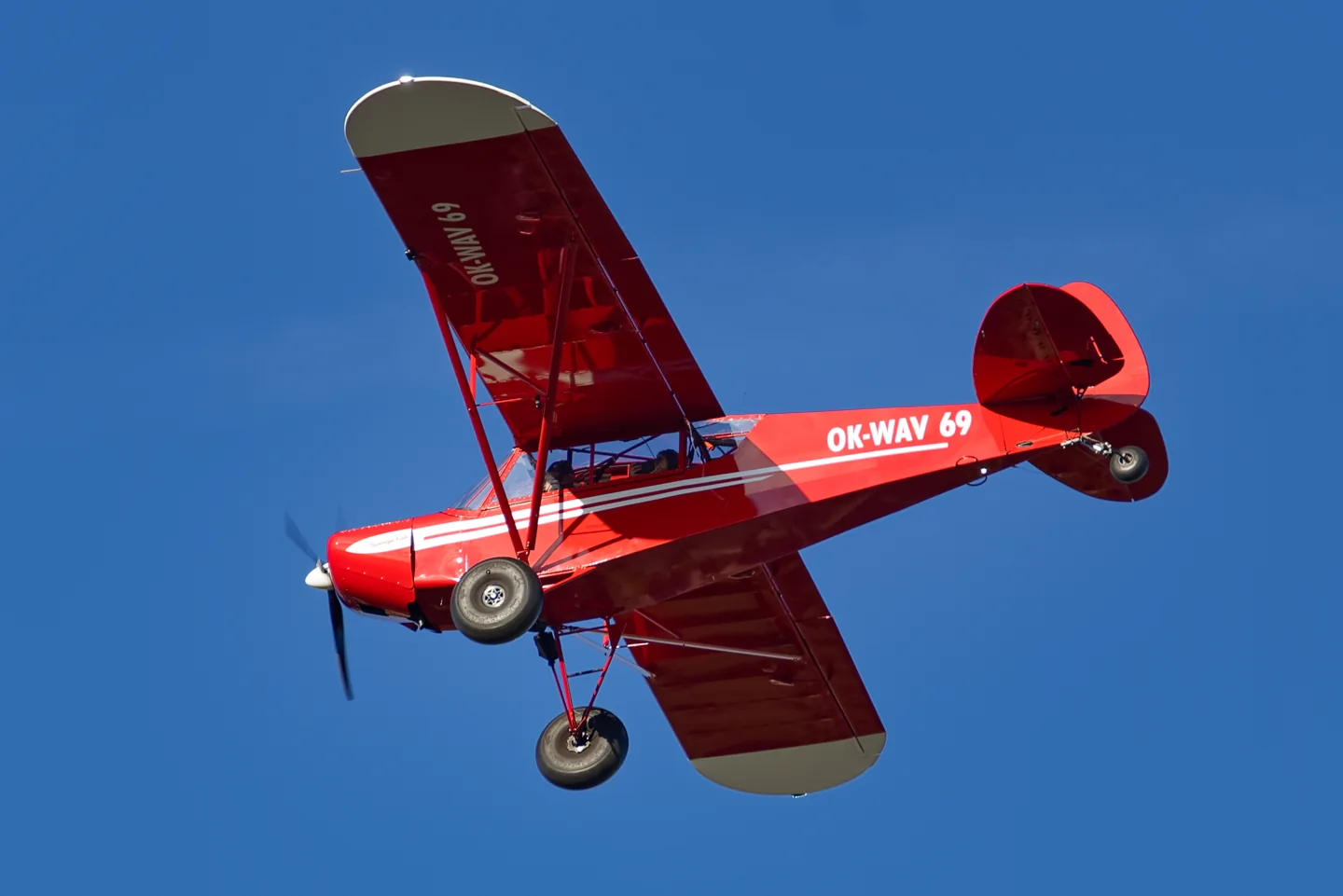
VliegtuigbibliotheekZlin Aviation Savage Cub
Zlin Aviation Savage CubJakub Hałun · CC BY 4.0 · Zlin Savage Cub, registration OK-WAV69

Zlin Aviation Savage Cub

Zlin Aviation's tandem-seat recreational taildragger with a braced high wing.
Light sport3 profielkeuzes

Ken het vliegtuig

Zlin Aviation's Savage Cub uses a lightweight braced high-wing airframe, tandem cabin and tailwheel landing gear for recreational flying. Its layout follows the familiar Cub pattern.

The later Norden and specialised Shock Ultra share the family outline, with different wing, engine and landing-gear developments.

Aircraft / family

Propulsion
Single piston↗
Configuration
High wing · Tandem seats · Tailwheel↗

Zlin Savage · Specifications (Zlin Savage) · real aircraft; source units retained

Length
6.39 m (21 ft 0 in)↗
Wingspan
9.31 m (30 ft 7 in)↗
Height
2.03 m (6 ft 8 in)↗
Wing area
14.2 m² (153 sq ft)↗
Empty weight
288 kg (635 lb)↗
Gross weight
560 kg (1,235 lb)↗
Powerplant
1 × Rotax 912UL Four cylinder horizontally opposed piston, 60 kW (80 hp)↗
Maximum speed
188 km/h (117 mph, 102 kn)↗
Cruise speed
170 km/h (110 mph, 92 kn)↗
Stall speed
62 km/h (39 mph, 33 kn)↗

Meer over dit vliegtuig op AirframeDB

An Italian design built in the Czech Republic

The Savage began production in Italy in 1997-98. Production moved to the Czech Republic in 1999 under Zlin Aviation, using a welded-tube fuselage and fabric covering intended to remain repairable in bush-flying service. The family subsequently expanded, with the Norden introduced in 2020. The Savage Cub and later specialist derivatives share a lineage, but their equipment and high-lift systems should not be treated as interchangeable.

A first tailwheel lesson brings both encouragement and awkward moments

The Savage gave this new tailwheel pilot plenty to think about before leaving the ground. Taxiing demanded unfamiliar coordination, and reaching the flap handle from the chosen seat position proved awkward. Once airborne, the low nose attitude also took some adjustment, even as the aircraft’s direct feedback made the flying enjoyable.

The first landing went surprisingly well with encouragement from the instructor behind. Later attempts were less tidy, as judging height and the tailwheel sight picture remained new skills. The post keeps those successes and mistakes together instead of turning an introductory lesson into an effortless conversion.

An Italian flying lesson continues around lunch and rain

Benny travelled to Brescia hoping to develop the skills needed for bush flying. The first step was learning the yellow Savage Cub with instructor Fabio Guerra. Repeated taxi practice led into an initial flight, where the aircraft’s feedback began to make sense through time at the controls.

Lunch at a local trattoria divided the day’s lessons. In the afternoon, worsening rain reduced visibility and prompted a go-around before a better attempt helped Benny make more use of peripheral vision. He and the instructor eventually stopped as the weather deteriorated further. The account ends with a tired but pleased student, with rough-field adventures still dependent on first becoming competent in the aircraft.

An Italian purchase becomes a New Zealand building and test project

Retired commercial pilot Tony Baker’s plans for a Savage began with a visit to the Italian factory and a flight in its test aircraft. He ordered a quick-build kit with the intention of enjoying the aircraft in retirement around New Zealand’s Bay of Plenty. Delays and changing circumstances eventually led him to commission Malcolm Savill to complete the project.

Savill’s work at Classic Aviation Designs took ZK-LAP through construction, certification and test flying. The finished Cub used a Rotax 912 ULS and an Italian wooden propeller, and the report relays his favourable handling assessment. By publication it was offered for sale. The story records both the owner’s original ambition and the builder-pilot’s work, without assuming those retirement flights took place.

Openbare bronnen 11
  1. Zlin SavageResearch background · Wikipedia revision 1322580419 · retrieved 2026-09-12
  2. Microsoft Flight Simulator aircraft manuals
  3. MSFS 2024 FAQ and edition aircraft inventory
  4. MSFS 2020 FAQ and edition aircraft inventory
  5. Zlin Savage Cub: first impressionsPersonal blog · 13 July 2009
  6. Learning to bush fly (1)Benny · 27 September 2017, updated 5 November 2017
  7. ZK Review: Zlin Aviation Savage Cub ZK-LAPIssue 70, 2020 #4 · printed pages 76–77
  8. ICAO Doc 8643 — aircraft type designatorsPublic search data retrieved 2026-09-14; authority update 2026-09-03
  9. Savage Carbon – Got FriendsProduct listing captured 2026-09-30; edition scope from the reviewed catalogue
  10. Savage Grravel – Got FriendsProduct listing captured 2026-09-30; edition scope from the reviewed catalogue
  11. Savage family historyZlin Aviation manufacturer history; model chronology and construction.

Hoe het profiel het modelleert

Got Friends Savage Carbon

Free + Pro
MSFS 2020MSFS 2024Got Friends

Zlin Aviation's Savage Cub uses a lightweight braced high-wing airframe, tandem cabin and tailwheel landing gear for recreational flying. Its layout follows the familiar Cub pattern.

This profile selects Got Friends Savage Carbon for MSFS 2020, MSFS 2024.

The selected resistance accompanies the modified utility-aircraft configuration. Spring resistance builds with the selected airspeed response. A separate aerodynamic term adds speed-dependent control load.

Pitch relief is separate from tyre, engine and flap-fit selection. Valid trim provides the configured pressure relief. Autopilot following is off.

Deze exacte revisie is nog niet beschikbaar voor openbare installatie.

Controls and trim

The Savage-derived Carbon and Grravel products alter engines, bush tyres, propellers and extended flaps. Hidden automatic-flight conveniences and trim hotkeys have versioned implementation scope, separate from those short-field modifications.

GotGravel Savage Carbon official developer detailsDeveloper legacy compatibility updateGotGravel original Grravel development and controlsSavage Cub manufacturer specification

The selected implementation

Carbon uses a 165-hp engine, bush tyres and extended flaps with separately versioned trim/automatic-flight conveniences.

GotGravel Savage Carbon official developer detailsDeveloper legacy compatibility updateSavage Carbon – Got FriendsCurrent Got Friends avionics enhancement prerequisites

About the values

The gains are normalized profile settings. They describe the chosen effect balance; hand force depends on the device and its output limits. IAS references are tuning values rather than operating limits. Physical acceptance of this revision remains pending.

Master gain & control system

Master gain85%

De uiteindelijke totaalschaal over alles wat het model produceert, vóór de apparaatbegrenzing.

Meer: alles (veer, belastingen, effecten) wordt samen sterker.

Minder: alles wordt samen zachter.

Waarom hier: Scales overall profile strength while preserving effect balance, subject to device and output limits.

Forces

Spring strength74%

De basiscentreerkracht die de stick terug naar het midden trekt. Elke andere kracht stapelt hierop. Te laag en de stick voelt slap in normale vlucht; te hoog en hij vecht tegen je hand en maskeert de kleinere signalen erbovenop.

Meer: een steviger centreren dat de hand meer weerstaat.

Minder: een slappere stick die alleen op aerodynamische belasting leunt.

Waarom hier: The selected resistance accompanies the modified utility-aircraft configuration. The baseline spring is 0.74. Its low-speed blend reaches baseline strength at 55 KIAS.

GotGravel Savage Carbon official developer detailsDeveloper legacy compatibility updateGotGravel original Grravel development and controlsSavage Cub manufacturer specification
Spring deadband4%

Een kleine neutrale zone rond het midden waar de veer stil blijft, zodat minieme bewegingen in rust niet ratelen. Breder is rustiger maar losser; smaller is preciezer maar kan rond het midden trillen.

Meer: een rustiger maar losser midden, met meer speling.

Minder: een strakker midden dat in rust kan trillen.

Waarom hier: Sets travel around the centre before the baseline spring resists. Smaller values engage it sooner.

Overall aerodynamic load80%

Een masterschaal over beide aangehouden asbelastingen, toegepast vóór hun onafhankelijke balans. Profielen laten dit normaal met rust en stemmen de twee asbelastingen af.

Meer: beide assen laden zwaarder.

Minder: beide assen worden samen lichter.

Waarom hier: The aerodynamic-load gain is 0.8 with an indicated-speed reference of 95 KIAS. This supplies speed-dependent loading alongside the spring.

Airspeed blendingTrue

Schakelt het lage-snelheidsvenster van de veeraangrijping in (start/vol-knopen hierboven). Uit betekent een constante veer op alle snelheden.

Waarom hier: Allows baseline spring strength to rise with indicated airspeed where the control law permits it.

Low-speed spring floor55%

Hoeveel van de veer overleeft bij stilstand, voordat luchtsnelheid aerodynamische kracht kan opbouwen. Een hoge vloer houdt de geparkeerde stick stevig; een lage geeft het losse, kabelslappe gevoel van een geparkeerd licht vliegtuig.

Meer: een stevigere stick geparkeerd en tijdens taxiën.

Minder: een slappe stick geparkeerd die pas met snelheid ontwaakt.

Waarom hier: Sets low-speed spring strength as a fraction of baseline when blending is enabled. One keeps full strength.

Spring engagement start20 kt

De snelheid waarbij de veer vanaf zijn lage-snelheidsvloer richting volle sterkte begint te klimmen: de besturing die 'tot leven komt' tijdens de startrol.

Waarom hier: Sets the IAS where the low-speed spring blend starts rising. This is a feel threshold, not a flight limit.

Spring engagement full55 kt

De snelheid waarbij de veer volle sterkte bereikt. Tussen het begin en dit punt wordt het centreren geleidelijk steviger naarmate de luchtstroom over de roeren groeit.

Waarom hier: Sets the IAS where the low-speed blend reaches baseline strength; high-speed stiffening also uses it.

Snelheid voor krachtafstemming95

De aangewezen snelheid waarbij de aerodynamische belasting haar ontworpen volle niveau bereikt. Hij verankert de hele belastingscurve aan het echte snelheidsbereik van het vliegtuig: een 172 laadt op tegen 110 knopen, een jet veel later.

Meer: belastingen komen later; de stick blijft langer licht.

Minder: belastingen komen eerder en de kruisvlucht weegt zwaarder.

Waarom hier: Sets the IAS reference for aerodynamic loading. It is an estimate, not published cruise TAS or a flight limit.

Centre firmness vs speed15%

Hoeveel het centreren zelf met snelheid verstijft, bovenop de uitslagbelastingen. Nul houdt het middengevoel constant; meer laat de stick harder centreren op kruissnelheid en losser in het circuit.

Meer: een midden dat duidelijk verhardt met snelheid.

Minder: een constant middengevoel op elke snelheid.

Waarom hier: The high-speed spring-stiffening gain is 0.15. It strengthens the permitted spring response above 55 KIAS, with the squared-speed ratio capped at 5.

Centre stiffening cap5

De bovengrens van snelheidsgedreven centreerverstijving, zodat zeer snelle vlucht de veer niet onbegrensd kan opwinden.

Meer: meer totale verstijving toegestaan op hoge snelheid.

Minder: de verstijving stopt eerder.

Waarom hier: Limits the squared airspeed ratio used for high-speed spring stiffening; it is not a device-force cap.

Aileron load80%

De aangehouden rolbelasting uit rolroeruitslag en snelheid, onafhankelijk van pitch gebalanceerd. Samen met de hoogteroerbelasting bepaalt dit de stuurharmonie waar recensenten het over hebben.

Meer: zwaardere rolkrachten.

Minder: lichtere, levendigere rolroeren.

Waarom hier: Roll and pitch aerodynamic scales are 0.8 and 1, respectively. They set the aerodynamic axis balance. No custom spring-travel curve is enabled.

Elevator load100%

De aangehouden pitchbelasting uit hoogteroeruitslag en snelheid, onafhankelijk van rol gebalanceerd. Dit is de hoofdhendel achter het pitchgewicht van een type. Hij raakt rolroer-, veer-, trim- of buffetkrachten niet.

Meer: zwaardere aangehouden pitchkrachten op snelheid.

Minder: een lichter hoogteroer, minder spierkracht om vast te houden.

Waarom hier: Scales pitch aerodynamic loading; pitch spring travel and trim responses are separate settings.

Max output force55%

Een plafond op elke gestage pitch- of rolkracht voordat die het apparaat bereikt, ter bescherming tegen beuken of verzadigen van de hardware bij stevige manoeuvres.

Meer: hogere gestage krachtpieken vóór afkapping.

Minder: een zachter plafond; harde manoeuvres vlakken eerder af.

Waarom hier: Caps directed-force output. Native spring effects and device limits remain separate.

Trim

Trim relief (elevator)30%

Hoe sterk hoogteroertrim de vastgehouden pitchkracht verlicht en verschuift waar de stick tot rust komt. Op 100 % heeft een goed getrimd vliegtuig geen vastgehouden druk nodig, de trim-de-last-weg-werkwijze van echt vliegen.

Meer: trim neemt meer vastgehouden kracht weg; op 100 % heft volle trim hem op.

Minder: je blijft kracht houden, zelfs getrimd.

Waarom hier: Pitch relief is separate from tyre, engine and flap-fit selection. Pitch authority 0.3 provides load relief and permitted centre movement; roll authority is 0.

GotGravel Savage Carbon official developer detailsDeveloper legacy compatibility updateGotGravel original Grravel development and controlsSavage Cub manufacturer specification
Trim relief (aileron)0%

Dezelfde verlichting voor roltrim. De meeste GA-types hebben geen echte rolroertrim, dus dit blijft op nul; types met roltrim krijgen een passende waarde.

Meer: roltrim neemt meer vastgehouden kracht weg.

Minder: roltrim doet minder.

Waarom hier: Scales supported roll-trim relief and permitted centre movement. Zero removes roll response.

Effect gains · Ground

Runway rumble40%

Rollende oppervlaktetrilling uit wielsnelheid en ondergrondtype: asfalt, gras of grind onder het onderstel.

Meer: een sterkere oppervlaktetextuur in de stick.

Minder: gladder taxiën.

Waarom hier: Sets rolling texture strength, modified by speed, surface and undercarriage configuration.

Gear bumps25%

Korte losse stoten van uitzetvoegen, sporen en ruw oppervlak, die het doorlopende gerommel accentueren.

Meer: scherpere stoten van voegen en sporen.

Minder: zachtere gronddetails.

Waarom hier: Sets gear-bump texture during ground motion, separate from touchdown impact.

Effect gains · Airframe

Stall buffet35%

Casco-schudden bij het naderen van de overtrek en terwijl de overtrekwaarschuwing actief is: hoe luid deze vleugel aankondigt dat hij ontevreden is. Types met een scherpe afbreek krijgen bescheiden buffet en laten de hoorn de waarschuwing dragen.

Meer: een sterker trillen vóór de overtrek.

Minder: een discretere vleugel; de hoorn draagt de waarschuwing.

Waarom hier: Sets stall-buffet strength. Zero removes the cue without changing simulator stalls or warnings.

Mach buffet0%

Transsoon buffet bij het naderen van de Machlimiet. Betekenisvol voor jets nabij MMO, nul voor zuigers en turboprops die er nooit komen.

Meer: een sterker transsoon buffet nabij de Machlimiet.

Minder: gladder vliegen op hoge Mach.

Waarom hier: Sets high-Mach buffet strength; onset and full-strength thresholds are separate.

Flap buffet0%

Laagfrequente casco-trilling met kleppen uitgeslagen in de luchtstroom, in het snelheidsvenster waar ze de lucht echt bewerken.

Meer: ruwer vliegen met werkende kleppen.

Minder: zachtere naderingskleppen.

Waarom hier: Sets flap buffet at the configured position and speed gates. Flap movement texture is separate.

Gear buffet0%

Casco-getrommel van intrekbaar onderstel dat in de luchtstroom hangt. Nul voor types met vast onderstel, waar het casco nooit van vorm verandert.

Meer: meer getrommel met het onderstel uit.

Minder: schoner vliegen met onderstel uit.

Waarom hier: Sets gear aerodynamic buffet; movement and ground-contact cues are separate.

Stick shaker50%

De speciale stall-stickshakerzoem, geactiveerd door het eigen overtrekwaarschuwingssysteem van het vliegtuig. Alleen types met een echte shaker krijgen een waarde; de rest steunt op aerodynamisch buffet en de hoorn.

Meer: een hardere shaker.

Minder: een discretere shaker.

Waarom hier: Sets triggered shaker strength; inactive while the shaker feature is disabled.

Effect gains · Engine, mechanical & drag

Touchdown thump65%

De eenmalige dreun als de wielen de baan raken, geschaald op daalsnelheid: een zachte landing fluistert, een stevige aankomst bonkt.

Meer: een hardere dreun bij de landing.

Minder: zachtere aankomsten.

Waarom hier: Sets landing-impact strength; landing telemetry and response shape determine the pulse.

Reverse rumble0%

Uitroltrilling terwijl reverse thrust of props in beta werken. Nul voor types zonder reverse.

Meer: ruwer uitrollen onder reverse.

Minder: een discretere reverse.

Waarom hier: Sets reverse-thrust vibration with valid reverser and engine conditions. Zero removes the cue.

Engine rumble12%

Doorlopende motortrilling die het toerental volgt tussen stationair en vol vermogen, de altijd aanwezige herinnering dat er voorin iets brandstof verbrandt.

Meer: meer motor in de stick.

Minder: een discretere motor.

Waarom hier: Sets estimated engine vibration using configured telemetry and response, not measured cockpit vibration.

Flap motion12%

Doorlopende trilling alleen terwijl de sim meldt dat de klepvlakken daadwerkelijk bewegen. Volgt echte actuatorbeweging en storingen, geen geschatte timer.

Meer: meer trilling met bewegende kleppen.

Minder: discretere klepbewegingen.

Waarom hier: Sets texture from observed flap movement; a command without movement does not establish the cue.

Autopilot follow

AP follow authority10%

Hoe ver autopilootcommando's de stick fysiek mogen bewegen. Piepklein gehouden in MSFS, waar een bewogen as kan worden teruggelezen als pilooteninvoer; nul schakelt volgen volledig uit.

Meer: de autopiloot beweegt je stick zichtbaar meer.

Minder: een nauwelijks merkbaar volgen.

Waarom hier: Sets admitted AP-follow gain, not a percentage of travel. Runtime ownership and input limits still apply.

Stick feel

StickFeel · Trim feel enabledFalse

Whether this feature is active in this profile.

Waarom hier: Retained for compatibility and group membership. Trim relief, rather than this flag, controls centre movement.

StickFeel · Trim relief enabledTrue

Whether this feature is active in this profile.

Waarom hier: Allows trim relief with supported control law and valid telemetry. Axis authorities set its amount.

StickFeel · Force trim enabledFalse

Whether this feature is active in this profile.

Waarom hier: Enables local force trim, separate from aircraft-owned trim and add-on integration qualification.

StickFeel · G load enabledTrue

Whether this feature is active in this profile.

Waarom hier: Allows load-factor changes to modify permitted spring laws. Passive fly-by-wire feel can suppress it.

StickFeel · Rate damping enabledTrue

Whether this feature is active in this profile.

Waarom hier: Enables rate damping with the configured coefficients and control law.

Autopilot

Autopilot · Follow enabledFalse

Whether this feature is active in this profile.

Waarom hier: Autopilot following is off; the configured spring and load retain the hardware feel.

Autopilot · Neutral hold enabledFalse

Whether this feature is active in this profile.

Waarom hier: Permits centering hold during a supported AP state, separate from following a moving target.

Autopilot · Neutral hold strength0.6

Waarom hier: Sets admitted AP neutral-hold strength; inactive while neutral hold is disabled.

Aero

Aero · EnabledTrue

Whether this feature is active in this profile.

Waarom hier: Enables aerodynamic cues; each still needs nonzero strength and its simulator conditions.

Aero · Max flap index2

Where this effect reaches full strength (or has fully faded, for washouts).

Meer: a more gradual build to a later peak.

Minder: a quicker build.

Waarom hier: Sets the final flap index for detent normalization. UP plus three detents uses maximum index3.

Aero · Min flap index2

Where this effect begins fading in.

Meer: the effect begins later.

Minder: it begins earlier.

Waarom hier: Sets the first flap detent that admits buffet; this is a handle index, not degrees.

Aero · Shaker enabledFalse

Whether this feature is active in this profile.

Waarom hier: Permits shaker at supported warning conditions; the switch does not establish aircraft equipment.

Ground

Ground · EnabledTrue

Whether this feature is active in this profile.

Waarom hier: Enables ground effects; each still needs its own strength and contact or motion telemetry.

Engine

Engine · EnabledTrue

Whether this feature is active in this profile.

Waarom hier: Enables engine cues with nonzero settings and valid running-engine telemetry.

Mechanical

Mechanical · EnabledTrue

Whether this feature is active in this profile.

Waarom hier: Enables accessory cues with configured strengths and observed accessory movement.

Mechanical · Gain0

The strength of this effect.

Meer: a stronger effect.

Minder: a weaker one.

Waarom hier: Sets texture from observed gear movement, separate from aerodynamic and touchdown effects.

Alle profielinstellingen
Geschatte profielinstellingen
ParameterWaardeWat het regelt en waarom
Spring strength0.74 The selected resistance accompanies the modified utility-aircraft configuration. The baseline spring is 0.74. Its low-speed blend reaches baseline strength at 55 KIAS.
Spring deadband0.04 Sets travel around the centre before the baseline spring resists. Smaller values engage it sooner.
Force gain0.8 The aerodynamic-load gain is 0.8 with an indicated-speed reference of 95 KIAS. This supplies speed-dependent loading alongside the spring.
Master gain0.85 Scales overall profile strength while preserving effect balance, subject to device and output limits.
Dynamic-pressure blendTrue Allows baseline spring strength to rise with indicated airspeed where the control law permits it.
Minimum spring factor0.55 Sets low-speed spring strength as a fraction of baseline when blending is enabled. One keeps full strength.
Spring wake-up speed20 ktSets the IAS where the low-speed spring blend starts rising. This is a feel threshold, not a flight limit.
Spring full-strength speed55 ktSets the IAS where the low-speed blend reaches baseline strength; high-speed stiffening also uses it.
Snelheid voor krachtafstemming95 ktSets the IAS reference for aerodynamic loading. It is an estimate, not published cruise TAS or a flight limit.
Airspeed spring stiffening0.15 The high-speed spring-stiffening gain is 0.15. It strengthens the permitted spring response above 55 KIAS, with the squared-speed ratio capped at 5.
Airspeed stiffening cap5 Limits the squared airspeed ratio used for high-speed spring stiffening; it is not a device-force cap.
Aileron force scale0.8 Roll and pitch aerodynamic scales are 0.8 and 1, respectively. They set the aerodynamic axis balance. No custom spring-travel curve is enabled.
Elevator force scale1 Scales pitch aerodynamic loading; pitch spring travel and trim responses are separate settings.
Maximum output force0.55 Caps directed-force output. Native spring effects and device limits remain separate.
StickFeel · Trim feel enabledFalse Retained for compatibility and group membership. Trim relief, rather than this flag, controls centre movement.
StickFeel · Trim relief enabledTrue Allows trim relief with supported control law and valid telemetry. Axis authorities set its amount.
StickFeel · Elevator authority0.3 Pitch relief is separate from tyre, engine and flap-fit selection. Pitch authority 0.3 provides load relief and permitted centre movement; roll authority is 0.
StickFeel · Aileron authority0 Scales supported roll-trim relief and permitted centre movement. Zero removes roll response.
StickFeel · Force trim enabledFalse Enables local force trim, separate from aircraft-owned trim and add-on integration qualification.
StickFeel · G load enabledTrue Allows load-factor changes to modify permitted spring laws. Passive fly-by-wire feel can suppress it.
StickFeel · Rate damping enabledTrue Enables rate damping with the configured coefficients and control law.
Autopilot · Follow enabledFalse Autopilot following is off; the configured spring and load retain the hardware feel.
Autopilot · Follow authority0.1 Sets admitted AP-follow gain, not a percentage of travel. Runtime ownership and input limits still apply.
Autopilot · Neutral hold enabledFalse Permits centering hold during a supported AP state, separate from following a moving target.
Autopilot · Neutral hold strength0.6 Sets admitted AP neutral-hold strength; inactive while neutral hold is disabled.
Aero · EnabledTrue Enables aerodynamic cues; each still needs nonzero strength and its simulator conditions.
Aero · Gain0.35 Sets stall-buffet strength. Zero removes the cue without changing simulator stalls or warnings.
Aero · Gain0 Sets high-Mach buffet strength; onset and full-strength thresholds are separate.
Aero · Gain0 Sets flap buffet at the configured position and speed gates. Flap movement texture is separate.
Aero · Max flap index2 Sets the final flap index for detent normalization. UP plus three detents uses maximum index3.
Aero · Min flap index2 Sets the first flap detent that admits buffet; this is a handle index, not degrees.
Aero · Gain0 Sets gear aerodynamic buffet; movement and ground-contact cues are separate.
Aero · Shaker enabledFalse Permits shaker at supported warning conditions; the switch does not establish aircraft equipment.
Aero · Amplitude0.5 Sets triggered shaker strength; inactive while the shaker feature is disabled.
Ground · EnabledTrue Enables ground effects; each still needs its own strength and contact or motion telemetry.
Ground · Gain0.4 Sets rolling texture strength, modified by speed, surface and undercarriage configuration.
Ground · Gain0.25 Sets gear-bump texture during ground motion, separate from touchdown impact.
Ground · Gain0.65 Sets landing-impact strength; landing telemetry and response shape determine the pulse.
Ground · Gain0 Sets reverse-thrust vibration with valid reverser and engine conditions. Zero removes the cue.
Engine · EnabledTrue Enables engine cues with nonzero settings and valid running-engine telemetry.
Engine · Gain0.12 Sets estimated engine vibration using configured telemetry and response, not measured cockpit vibration.
Mechanical · EnabledTrue Enables accessory cues with configured strengths and observed accessory movement.
Mechanical · Gain0.12 Sets texture from observed flap movement; a command without movement does not establish the cue.
Mechanical · Gain0 Sets texture from observed gear movement, separate from aerodynamic and touchdown effects.
Openbare bronnen 17
  1. Zlin SavageResearch background · Wikipedia revision 1322580419 · retrieved 2026-09-12
  2. GotGravel Savage Carbon official developer detailsOriginal developer first post and changelog
  3. Developer legacy compatibility updateDiscus v2.1.5 paragraph; AS33 v1.0.6 paragraph; DoubleEnder v1.0.6; F4F4 v1.0.3; Wilga v1.1.4; Savage Carbon v1.0.5 paragraph; Savage Grravel v1.0.5 paragraph; MonsterNX Cub v1.0.5 paragraph; Vertigo v1.0.5 paragraph; Mini500 v1.0.9
  4. GotGravel original Grravel development and controlsOriginal developer first post and changelog
  5. Savage Cub manufacturer specificationZlin Aviation Savage Cub
  6. Savage Carbon – Got FriendsZlin Aviation Savage Cub
  7. Current Got Friends avionics enhancement prerequisitesPMS and TDS aircraft lists
  8. Microsoft Flight Simulator aircraft manuals
  9. MSFS 2024 FAQ and edition aircraft inventory
  10. MSFS 2020 FAQ and edition aircraft inventory
  11. Zlin Savage Cub: first impressionsPersonal blog · 13 July 2009
  12. Learning to bush fly (1)Benny · 27 September 2017, updated 5 November 2017
  13. ZK Review: Zlin Aviation Savage Cub ZK-LAPIssue 70, 2020 #4 · printed pages 76–77
  14. ICAO Doc 8643 — aircraft type designatorsPublic search data retrieved 2026-09-14; authority update 2026-09-03
  15. Savage Carbon – Got FriendsProduct listing captured 2026-09-30; edition scope from the reviewed catalogue
  16. Savage Grravel – Got FriendsProduct listing captured 2026-09-30; edition scope from the reviewed catalogue
  17. Savage family historyZlin Aviation manufacturer history; model chronology and construction.

Community en correcties

Zegt jouw ervaring op het type dat deze pagina iets fout heeft? Corrigeer het hier.

Pilotencorrecties

Vlieg je dit toestel? Corrigeer deze pagina.

Deze pagina is gebouwd op geciteerde bronnen, en echte ervaring op het type verslaat elke bron. Citeer de foute bewering en vertel ons wat het echte toestel doet. Correcties gaan ter beoordeling naar de maintainer en voeden de volgende revisie van dit onderzoek.

Hangarpraat

Open gesprek over het vliegen en afstellen van de Zlin Aviation Savage Cub, op het communityforum. Correcties hierboven gaan privé naar de maintainer; hangarpraat is openbaar.

Nog geen hangarpraat over de Zlin Aviation Savage Cub. Wees de eerste.

Community

Communityprofielen voor dit toestel

Nog geen communityprofielen voor dit toestel. Op jouw manier afgesteld? Deel een profiel en het verschijnt hier.