Development milestones
First flight: May 24, 1956
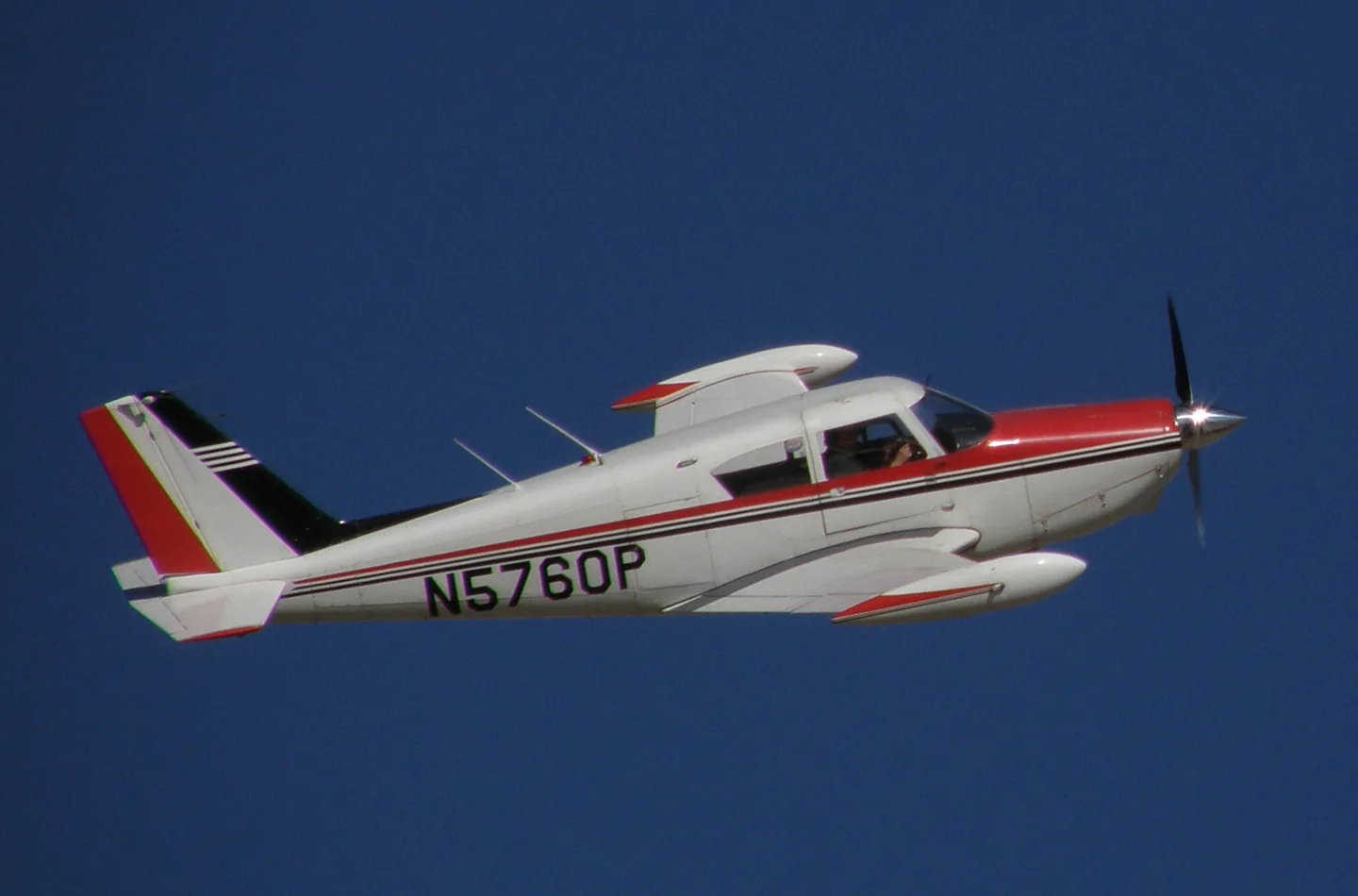 Alan Radecki Akradecki · CC BY-SA 4.0 · Piper PA-24 Comanche pictured
Piper's Comanche first flew in 1956 with an all-metal low-wing airframe, enclosed cabin and retractable tricycle gear. Later versions changed engine power and seating, alongside the separate Twin Comanche line.
Production ended after the 1972 flood at Piper's Lock Haven plant. A2A models a particular Comanche with persistent engine and airframe condition; its manual describes the loading, maintenance and mechanical systems included in the simulation.
Piper PA-24 Comanche · Specifications (PA-24-260C) · real aircraft; source units retained
Scopri di più su questo aeromobile su AirframeDB
First flight: May 24, 1956
The Comanche 250’s pitch control uses a stabilator: the horizontal tail moves as a unit instead of carrying a separate hinged elevator. Its anti-servo tab also provides longitudinal trim. A2A’s aircraft description pairs that arrangement with manually operated flaps and conventional yoke-and-pedal controls. This combination gives the cockpit several distinct mechanical controls, even before the separate engine and propeller levers are considered.
An electric motor and reduction mechanism beneath the floor move the three landing-gear units through push-pull cables. The nosewheel steering disconnects as the gear retracts, reducing the steering mechanism’s contribution to airborne rudder-pedal loads. The manual also describes a ground anti-retraction switch and separate indications for gear position. The selector operates the documented electrical and mechanical landing-gear system.
The list supplies trim-required lights and AP controls, and identifies the elevator trim handle with a standard SimVar requested in percent.
Unwin flew Mark Bonsall's refurbished 1963 Comanche 250 from Netherthorpe with instructor Nick Riddin. This particular aircraft had fuel injection and a three-blade propeller, so it was not an untouched factory example. With two aboard and partial fuel, it accelerated briskly from the grass strip. Unwin liked the harmonisation of the primary controls and their low initial resistance, although he found the older instrument and engine-control layout less intuitive than a modern cockpit. In airwork, his stalls gave clear warning and little inclination to drop a wing.
The landing and photo flights exposed different demands. He could feel the aircraft entering ground effect and thought excess approach speed would produce a long float; careful speed control rewarded him with successive satisfactory landings. Flying close formation for the photographer required more work, partly because the view from his chosen seat was restrictive. His overall appreciation was for a capable touring aircraft, with handling observations tied to the loading and modifications of the example he actually flew.
Wall's attachment to the Comanche began with a flying-club comparison in 1958. Interviewed by Bill Cox, he recalled flying a loaded Comanche 250 and a contemporary Bonanza between Burbank and Phoenix. He considered the Comanche the stronger performer in that particular comparison, while acknowledging the appeal of the Beechcraft's handling. Decades later, after a professional flying career, that experience helped draw him back to a 1958 Comanche of his own.
By the 2005 article, Wall had accumulated more than a thousand hours in the type and restored his aircraft extensively. He distinguished brochure claims from his experience: the advertised climb figure seemed optimistic to him, while maximum cruise was closer to what he observed. His usual choice was an economical high-altitude cruise rather than maximum speed. As an owner and mechanic, he also valued access for maintenance and familiarity with the systems he had rebuilt. These are the preferences and reported results of one experienced owner, rather than a controlled comparison of all Comanches and Bonanzas.
Looking back on his test-flying years, Kershner remembered the Comanche 400 as one of the aircraft that stood out. He identified the two final test aircraft and explained Pug Piper's interest in obtaining high-altitude performance without turbocharging. The extra power gave him an impression reminiscent of a fighter, but he also recalled substantial fuel consumption and troublesome hot starts during the flight-test period. His account concerns the eight-cylinder 400, a different proposition from the familiar 180 and 250.
One flight supplied the story's human detail. Over Lock Haven, he overtook a conventional Comanche and made further passes that prompted its pilot to ask what version he was flying. Kershner gave an evasive answer over the radio, then returned to a reprimand for drawing attention to an aircraft Piper had not yet announced. He also remembered watching the fuel indication move towards empty.
In the manual's developer notes, Gentile explains why A2A chose his own Comanche 250, N6229P, for its new Accu-Sim system. He had owned and operated the aeroplane for more than a decade. That familiarity gave the team continuing access to an aircraft they could examine and fly while investigating questions raised during development. His account describes the connection between an owner's long experience and the choice of a simulation subject.
Gentile's affection is equally explicit. He values the Comanche's combination of speed, load-carrying ability, cabin room and manageable handling, and says the aircraft has become part of the family. The appeal began with its appearance and deepened over years of operation. This is an enthusiastic owner's introduction, written by the developer selling the simulation, rather than an independent comparison flight.
Piper's Comanche first flew in 1956 with an all-metal low-wing airframe, enclosed cabin and retractable tricycle gear. Later versions changed engine power and seating, alongside the separate Twin Comanche line.
This profile selects A2A Comanche 250 for MSFS 2020, MSFS 2024.
The stabilator/anti-servo arrangement motivates reversible yoke loading. Spring resistance builds with the selected airspeed response. A separate aerodynamic term adds speed-dependent control load.
The anti-servo tab supplies pitch relief; ALT-mode trim lamps request manual action. Valid trim provides the configured pressure relief. Autopilot following is enabled for supported control references.
The Comanche’s manually controlled stabilator uses an anti-servo tab for longitudinal trim. A2A’s S-TEC30 altitude hold has an elevator servo and lamps requesting pilot trim, without automatic pitch trim. Native 2024 GPSS supplies lateral steering as a separate addition.
A2A’s native 2024 Comanche removes the earlier Elevator Force tablet input option and adds ST901 GPSS lateral guidance; S-TEC30 ALT still requests manual trimming.
The gains are normalized profile settings. They describe the chosen effect balance; hand force depends on the device and its output limits. IAS references are tuning values rather than operating limits. Physical acceptance of this revision remains pending.
La scala finale complessiva applicata a tutto ciò che il modello produce, prima del limite del dispositivo.
Più: tutto (molla, carichi, effetti) si rafforza insieme.
Meno: tutto si ammorbidisce insieme.
Perché qui: Scales overall profile strength while preserving effect balance, subject to device and output limits.
La forza di centraggio di base che riporta la barra al centro. Ogni altra forza si somma a questa. Troppo bassa e la barra sembra molle in volo normale; troppo alta e combatte la mano, mascherando i segnali più piccoli sovrapposti.
Più: un centraggio più fermo che resiste di più alla mano.
Meno: una barra più molle che conta solo sul carico aerodinamico.
Perché qui: The stabilator/anti-servo arrangement motivates reversible yoke loading. The baseline spring is 0.74. Its low-speed blend reaches baseline strength at 75 KIAS.
Comanche Pilot ManualComanche variables listExact product and documentation researchNative ComancheUna piccola zona neutra attorno al centro dove la molla resta silenziosa, così i micro-movimenti a riposo non vibrano. Più larga è più tranquilla ma più lasca; più stretta è più precisa ma può fremere attorno al centro.
Più: un centro più calmo ma più lasco, con più gioco.
Meno: un centro più serrato che può fremere a riposo.
Perché qui: Sets travel around the centre before the baseline spring resists. Smaller values engage it sooner.
Una scala maestra su entrambi i carichi d'asse sostenuti, applicata prima del loro bilanciamento indipendente. Di norma i profili la lasciano stare e regolano i due carichi d'asse.
Più: entrambi gli assi caricano più forte.
Meno: entrambi gli assi si alleggeriscono insieme.
Perché qui: The aerodynamic-load gain is 0.8 with an indicated-speed reference of 150 KIAS. This supplies speed-dependent loading alongside the spring.
Attiva la finestra di innesto della molla a bassa velocità (nodi di inizio/pieno qui sopra). Spento, la molla è costante a ogni velocità.
Perché qui: Allows baseline spring strength to rise with indicated airspeed where the control law permits it.
Quanta molla sopravvive da fermo, prima che la velocità possa generare forza aerodinamica. Un pavimento alto tiene salda la barra parcheggiata; uno basso dà la sensazione lasca, da cavi allentati, di un aereo leggero in sosta.
Più: una barra più salda in sosta e al rullaggio.
Meno: una barra molle da fermo che si sveglia solo con la velocità.
Perché qui: Sets low-speed spring strength as a fraction of baseline when blending is enabled. One keeps full strength.
La velocità a cui la molla comincia a salire dal suo pavimento di bassa velocità verso la piena forza: i comandi che «prendono vita» in corsa di decollo.
Perché qui: Sets the IAS where the low-speed spring blend starts rising. This is a feel threshold, not a flight limit.
La velocità a cui la molla raggiunge la piena forza. Tra l'inizio e questo punto il centraggio si irrigidisce progressivamente man mano che il flusso cresce sui comandi.
Perché qui: Sets the IAS where the low-speed blend reaches baseline strength; high-speed stiffening also uses it.
La velocità indicata a cui il carico aerodinamico raggiunge il livello pieno di progetto. Ancora l'intera curva di carico al reale intervallo di velocità dell'aereo: un 172 carica verso 110 nodi, un jet molto più tardi.
Più: i carichi arrivano più tardi; la barra resta leggera fino a velocità più alte.
Meno: i carichi arrivano prima e la crociera pesa di più.
Perché qui: Sets the IAS reference for aerodynamic loading. It is an estimate, not published cruise TAS or a flight limit.
Quanto il centraggio stesso si irrigidisce con la velocità, oltre ai carichi da deflessione. Zero mantiene costante la sensazione del centro; di più fa centrare la barra più dura in crociera e più lasca in circuito.
Più: un centro che si indurisce nettamente con la velocità.
Meno: una sensazione di centro costante a ogni velocità.
Perché qui: The high-speed spring-stiffening gain is 0.15. It strengthens the permitted spring response above 75 KIAS, with the squared-speed ratio capped at 5.
Il limite superiore all'irrigidimento del centro dovuto alla velocità, così il volo molto veloce non può caricare la molla senza limite.
Più: più irrigidimento totale concesso ad alta velocità.
Meno: l'irrigidimento si ferma prima.
Perché qui: Limits the squared airspeed ratio used for high-speed spring stiffening; it is not a device-force cap.
Il carico sostenuto di rollio da deflessione degli alettoni e velocità, bilanciato indipendentemente dal beccheggio. Insieme al carico dell'equilibratore fissa il rapporto di armonia dei comandi di cui parlano le recensioni.
Più: sforzi di rollio più pesanti.
Meno: alettoni più leggeri e scattanti.
Perché qui: Roll and pitch aerodynamic scales are 0.72 and 1, respectively. They set the aerodynamic axis balance. No custom spring-travel curve is enabled.
Il carico sostenuto di beccheggio da deflessione dell'equilibratore e velocità, bilanciato indipendentemente dal rollio. È la leva principale dietro il peso di beccheggio di un tipo. Non tocca alettoni, molla, trim né forze di buffet.
Più: sforzi di beccheggio sostenuti più pesanti in velocità.
Meno: una profondità più leggera, meno muscolosa da tenere.
Perché qui: Scales pitch aerodynamic loading; pitch spring travel and trim responses are separate settings.
Un tetto su ogni forza stabile di beccheggio o rollio prima che raggiunga il dispositivo, a protezione da colpi o saturazioni dell'hardware nelle manovre energiche.
Più: picchi di forza stabile più alti prima del taglio.
Meno: un tetto più morbido; le manovre dure si appiattiscono prima.
Perché qui: Caps directed-force output. Native spring effects and device limits remain separate.
Quanto il trim di profondità allevia lo sforzo di beccheggio mantenuto e sposta dove la barra si assesta. Al 100 %, un aereo trimmato bene non richiede pressione mantenuta: il flusso di lavoro trimma-via-il-carico del volo reale.
Più: il trim toglie più sforzo mantenuto; al 100 %, trim pieno lo annulla.
Meno: continui a tenere sforzo anche trimmato.
Perché qui: The anti-servo tab supplies pitch relief; ALT-mode trim lamps request manual action. Pitch authority 0.3 provides load relief and permitted centre movement; roll authority is 0.
Comanche Pilot ManualComanche variables listExact product and documentation researchNative ComancheLo stesso sollievo per il trim di rollio. La maggior parte dei tipi di aviazione generale non ha un vero trim degli alettoni, quindi resta a zero; i tipi con trim di rollio ricevono un valore corrispondente.
Più: il trim di rollio toglie più sforzo mantenuto.
Meno: il trim di rollio fa meno.
Perché qui: Scales supported roll-trim relief and permitted centre movement. Zero removes roll response.
Vibrazione di rotolamento da velocità delle ruote e tipo di superficie: asfalto, erba o ghiaia sotto il carrello.
Più: una texture di superficie più forte nella barra.
Meno: un rullaggio più liscio.
Perché qui: Sets rolling texture strength, modified by speed, surface and undercarriage configuration.
Colpi brevi e discreti da giunti di dilatazione, solchi e superficie irregolare, che punteggiano il rombo continuo.
Più: colpi più netti da giunti e solchi.
Meno: dettagli del suolo più morbidi.
Perché qui: Sets gear-bump texture during ground motion, separate from touchdown impact.
Scuotimento della cellula in avvicinamento allo stallo e con l'avviso attivo: quanto forte quest'ala annuncia di essere scontenta. I tipi con distacco netto ricevono buffet modesto e lasciano l'avviso alla sirena.
Più: un tremito pre-stallo più forte.
Meno: un'ala più discreta; la sirena porta l'avviso.
Perché qui: Sets stall-buffet strength. Zero removes the cue without changing simulator stalls or warnings.
Buffet transonico in avvicinamento al limite di Mach. Significativo per i jet vicino a MMO, zero per pistoni e turboelica che non ci arrivano mai.
Più: un buffet transonico più forte vicino al limite di Mach.
Meno: un volo più liscio ad alto Mach.
Perché qui: Sets high-Mach buffet strength; onset and full-strength thresholds are separate.
Vibrazione a bassa frequenza della cellula con i flap estesi nel flusso, nella finestra di velocità in cui lavorano davvero l'aria.
Più: un volo più ruvido con i flap al lavoro.
Meno: flap d'avvicinamento più morbidi.
Perché qui: Sets flap buffet at the configured position and speed gates. Flap movement texture is separate.
Il tambureggiare della cellula per il carrello retrattile appeso nel flusso. Zero per i tipi a carrello fisso, dove la cellula non cambia mai forma.
Più: più tambureggiare col carrello fuori.
Meno: un volo col carrello fuori più pulito.
Perché qui: Sets gear aerodynamic buffet; movement and ground-contact cues are separate.
Il ronzio dedicato dello stick shaker di stallo, attivato dal sistema di avviso dell'aereo stesso. Solo i tipi con un vero shaker ricevono un valore; tutti gli altri si affidano al buffet aerodinamico e alla sirena.
Più: uno shaker più duro.
Meno: uno shaker più discreto.
Perché qui: Sets triggered shaker strength; inactive while the shaker feature is disabled.
Il colpo singolo quando le ruote toccano la pista, scalato dal rateo di discesa: un atterraggio di velluto sussurra, un arrivo deciso batte.
Più: un colpo più duro al contatto.
Meno: arrivi più morbidi.
Perché qui: Sets landing-impact strength; landing telemetry and response shape determine the pulse.
Vibrazione in corsa mentre lavorano l'inversione di spinta o le eliche in beta. Zero per i tipi senza reverse.
Più: una corsa più ruvida in reverse.
Meno: una reverse più discreta.
Perché qui: Sets reverse-thrust vibration with valid reverser and engine conditions. Zero removes the cue.
Vibrazione continua del propulsore che segue i giri tra minimo e piena potenza, il promemoria sempre presente che qualcosa brucia carburante davanti.
Più: più motore nella barra.
Meno: un motore più discreto.
Perché qui: Sets estimated engine vibration using configured telemetry and response, not measured cockpit vibration.
Vibrazione continua solo mentre il simulatore riporta le superfici dei flap davvero in movimento. Segue il moto reale dell'attuatore e i guasti, non un timer stimato.
Più: più vibrazione coi flap in movimento.
Meno: corse dei flap più discrete.
Perché qui: Sets texture from observed flap movement; a command without movement does not establish the cue.
Quanto i comandi dell'autopilota possono muovere fisicamente la barra. Tenuto minuscolo in MSFS, dove un asse mosso può essere riletto come ingresso del pilota; zero disattiva del tutto il seguito.
Più: l'autopilota muove visibilmente di più la tua barra.
Meno: un seguito appena percettibile.
Perché qui: Sets admitted AP-follow gain, not a percentage of travel. Runtime ownership and input limits still apply.
Whether this feature is active in this profile.
Perché qui: Retained for compatibility and group membership. Trim relief, rather than this flag, controls centre movement.
Whether this feature is active in this profile.
Perché qui: Allows trim relief with supported control law and valid telemetry. Axis authorities set its amount.
Whether this feature is active in this profile.
Perché qui: Enables local force trim, separate from aircraft-owned trim and add-on integration qualification.
Whether this feature is active in this profile.
Perché qui: Allows load-factor changes to modify permitted spring laws. Passive fly-by-wire feel can suppress it.
Whether this feature is active in this profile.
Perché qui: Enables rate damping with the configured coefficients and control law.
Whether this feature is active in this profile.
Perché qui: Following is on at 1 authority when a supported, valid autopilot control reference is available.
Whether this feature is active in this profile.
Perché qui: Permits centering hold during a supported AP state, separate from following a moving target.
Perché qui: Sets admitted AP neutral-hold strength; inactive while neutral hold is disabled.
Whether this feature is active in this profile.
Perché qui: Enables aerodynamic cues; each still needs nonzero strength and its simulator conditions.
Where this effect reaches full strength (or has fully faded, for washouts).
Più: a more gradual build to a later peak.
Meno: a quicker build.
Perché qui: Sets the final flap index for detent normalization. UP plus three detents uses maximum index3.
Where this effect begins fading in.
Più: the effect begins later.
Meno: it begins earlier.
Perché qui: Sets the first flap detent that admits buffet; this is a handle index, not degrees.
Whether this feature is active in this profile.
Perché qui: Permits shaker at supported warning conditions; the switch does not establish aircraft equipment.
Whether this feature is active in this profile.
Perché qui: Enables ground effects; each still needs its own strength and contact or motion telemetry.
Whether this feature is active in this profile.
Perché qui: Enables engine cues with nonzero settings and valid running-engine telemetry.
Whether this feature is active in this profile.
Perché qui: Enables accessory cues with configured strengths and observed accessory movement.
The strength of this effect.
Più: a stronger effect.
Meno: a weaker one.
Perché qui: Sets texture from observed gear movement, separate from aerodynamic and touchdown effects.
| Parametro | Valore | Cosa controlla e perché |
|---|---|---|
| Spring strength | 0.74 | The stabilator/anti-servo arrangement motivates reversible yoke loading. The baseline spring is 0.74. Its low-speed blend reaches baseline strength at 75 KIAS. |
| Spring deadband | 0.045 | Sets travel around the centre before the baseline spring resists. Smaller values engage it sooner. |
| Force gain | 0.8 | The aerodynamic-load gain is 0.8 with an indicated-speed reference of 150 KIAS. This supplies speed-dependent loading alongside the spring. |
| Master gain | 0.85 | Scales overall profile strength while preserving effect balance, subject to device and output limits. |
| Dynamic-pressure blend | True | Allows baseline spring strength to rise with indicated airspeed where the control law permits it. |
| Minimum spring factor | 0.5 | Sets low-speed spring strength as a fraction of baseline when blending is enabled. One keeps full strength. |
| Spring wake-up speed | 20 kt | Sets the IAS where the low-speed spring blend starts rising. This is a feel threshold, not a flight limit. |
| Spring full-strength speed | 75.0 kt | Sets the IAS where the low-speed blend reaches baseline strength; high-speed stiffening also uses it. |
| Velocità di regolazione della forza | 150.0 kt | Sets the IAS reference for aerodynamic loading. It is an estimate, not published cruise TAS or a flight limit. |
| Airspeed spring stiffening | 0.15 | The high-speed spring-stiffening gain is 0.15. It strengthens the permitted spring response above 75 KIAS, with the squared-speed ratio capped at 5. |
| Airspeed stiffening cap | 5 | Limits the squared airspeed ratio used for high-speed spring stiffening; it is not a device-force cap. |
| Aileron force scale | 0.72 | Roll and pitch aerodynamic scales are 0.72 and 1, respectively. They set the aerodynamic axis balance. No custom spring-travel curve is enabled. |
| Elevator force scale | 1.0 | Scales pitch aerodynamic loading; pitch spring travel and trim responses are separate settings. |
| Maximum output force | 0.55 | Caps directed-force output. Native spring effects and device limits remain separate. |
| StickFeel · Trim feel enabled | True | Retained for compatibility and group membership. Trim relief, rather than this flag, controls centre movement. |
| StickFeel · Trim relief enabled | True | Allows trim relief with supported control law and valid telemetry. Axis authorities set its amount. |
| StickFeel · Elevator authority | 0.3 | The anti-servo tab supplies pitch relief; ALT-mode trim lamps request manual action. Pitch authority 0.3 provides load relief and permitted centre movement; roll authority is 0. |
| StickFeel · Aileron authority | 0 | Scales supported roll-trim relief and permitted centre movement. Zero removes roll response. |
| StickFeel · Force trim enabled | False | Enables local force trim, separate from aircraft-owned trim and add-on integration qualification. |
| StickFeel · G load enabled | True | Allows load-factor changes to modify permitted spring laws. Passive fly-by-wire feel can suppress it. |
| StickFeel · Rate damping enabled | True | Enables rate damping with the configured coefficients and control law. |
| Autopilot · Follow enabled | True | Following is on at 1 authority when a supported, valid autopilot control reference is available. |
| Autopilot · Follow authority | 1.0 | Sets admitted AP-follow gain, not a percentage of travel. Runtime ownership and input limits still apply. |
| Autopilot · Neutral hold enabled | False | Permits centering hold during a supported AP state, separate from following a moving target. |
| Autopilot · Neutral hold strength | 0.6 | Sets admitted AP neutral-hold strength; inactive while neutral hold is disabled. |
| Aero · Enabled | True | Enables aerodynamic cues; each still needs nonzero strength and its simulator conditions. |
| Aero · Gain | 0.35 | Sets stall-buffet strength. Zero removes the cue without changing simulator stalls or warnings. |
| Aero · Gain | 0 | Sets high-Mach buffet strength; onset and full-strength thresholds are separate. |
| Aero · Gain | 0.14 | Sets flap buffet at the configured position and speed gates. Flap movement texture is separate. |
| Aero · Max flap index | 3 | Sets the final flap index for detent normalization. UP plus three detents uses maximum index3. |
| Aero · Min flap index | 2 | Sets the first flap detent that admits buffet; this is a handle index, not degrees. |
| Aero · Gain | 0.1 | Sets gear aerodynamic buffet; movement and ground-contact cues are separate. |
| Aero · Shaker enabled | False | Permits shaker at supported warning conditions; the switch does not establish aircraft equipment. |
| Aero · Amplitude | 0.5 | Sets triggered shaker strength; inactive while the shaker feature is disabled. |
| Ground · Enabled | True | Enables ground effects; each still needs its own strength and contact or motion telemetry. |
| Ground · Gain | 0.4 | Sets rolling texture strength, modified by speed, surface and undercarriage configuration. |
| Ground · Gain | 0.25 | Sets gear-bump texture during ground motion, separate from touchdown impact. |
| Ground · Gain | 0.65 | Sets landing-impact strength; landing telemetry and response shape determine the pulse. |
| Ground · Gain | 0 | Sets reverse-thrust vibration with valid reverser and engine conditions. Zero removes the cue. |
| Engine · Enabled | True | Enables engine cues with nonzero settings and valid running-engine telemetry. |
| Engine · Gain | 0.12 | Sets estimated engine vibration using configured telemetry and response, not measured cockpit vibration. |
| Mechanical · Enabled | True | Enables accessory cues with configured strengths and observed accessory movement. |
| Mechanical · Gain | 0.12 | Sets texture from observed flap movement; a command without movement does not establish the cue. |
| Mechanical · Gain | 0.12 | Sets texture from observed gear movement, separate from aerodynamic and touchdown effects. |
Se la tua esperienza sul tipo dice che questa pagina sbaglia, correggila qui.
Questa pagina nasce da riferimenti citati, e l'esperienza reale sul tipo vale più di una citazione. Cita l'affermazione errata e dicci cosa fa il velivolo reale. Le correzioni vanno al maintainer per revisione e alimentano la prossima revisione di questa ricerca.
Conversazione aperta su come si vola e si regola il Piper Comanche, nel forum della comunità. Le correzioni sopra vanno in privato al maintainer; le chiacchiere da hangar sono pubbliche.