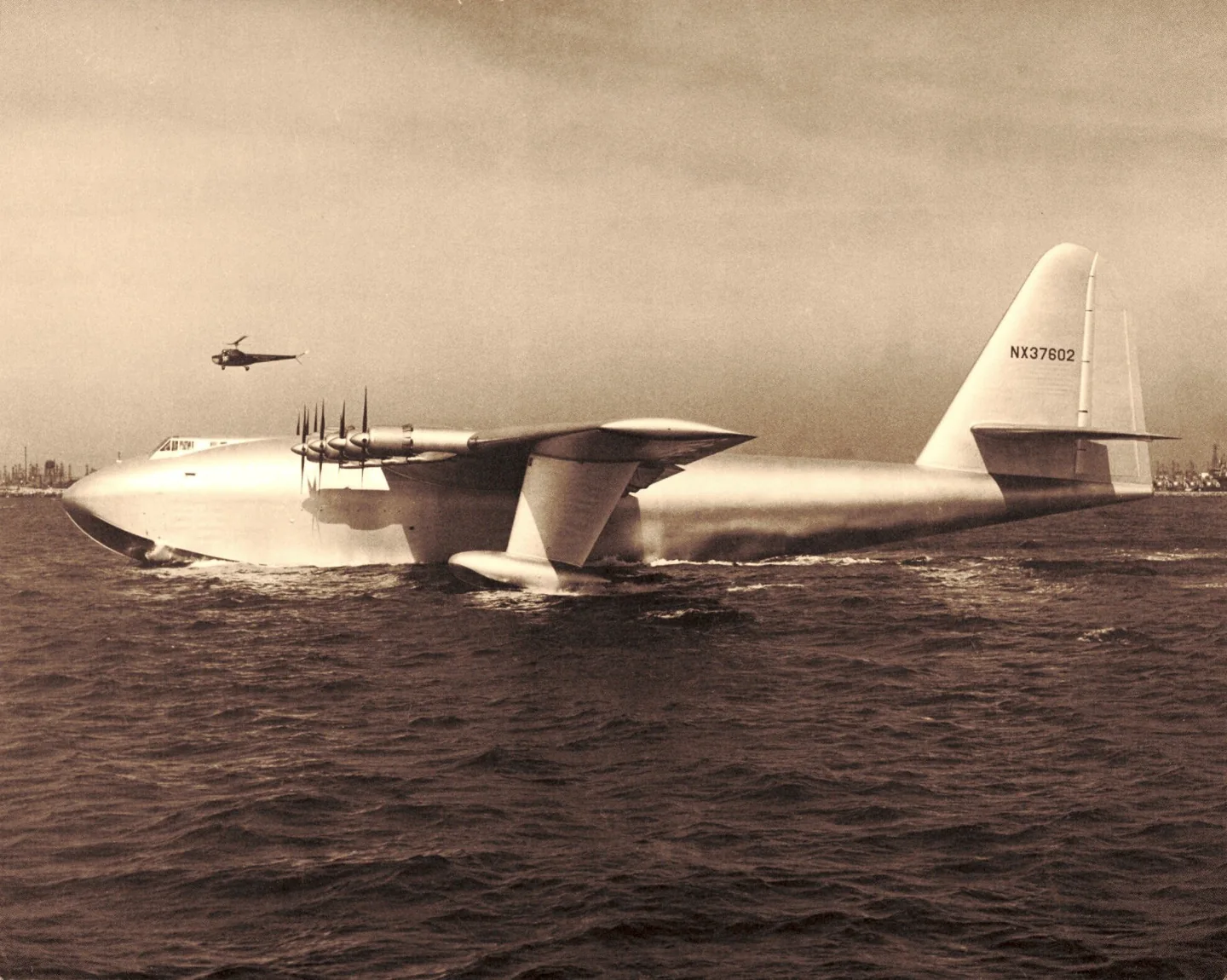
Hughes H-4 HerculesSDASM Archives · Public domain · Hughes H-4 Hercules pictured

Hughes H-4 Hercules

An eight-engine wooden flying-boat prototype that made one brief flight in 1947.
SeaplaneLiczba opcji profilu: 1

Poznaj maszynę

The H-4 Hercules was conceived as a wartime transatlantic transport and completed after the war. Eight engines and an immense wing surrounded its flying-boat hull. The prototype made one brief flight on 2 November 1947 and never entered operational transport service.

The familiar Spruce Goose nickname conceals a construction detail: birch was a major material in the wooden airframe. The simulator represents this single experimental aircraft.

Aircraft / family

Propulsion
Eight piston engines↗
Configuration
Prototype flying boat↗

Hughes H-4 Hercules · reported specifications; performance figures are estimates, not demonstrated operational capability

Length
218 ft 8 in (66.65 m)↗
Wingspan
319 ft 11 in (97.51 m)↗
Height
79 ft 4 in (24.18 m)↗
Empty weight
250,000 lb (113,398 kg)↗
Powerplant
8 × Pratt & Whitney R-4360 Wasp Major 28-cylinder air-cooled radial piston engines, 3,000 hp (2,200 kW) each↗
Propellers
4-bladed Hamilton Standard , 17 ft 2 in (5.23 m) diameter constant-speed propellers↗

Reported estimate; not demonstrated by the brief 1947 flight

Cruise speed
250 mph (400 km/h, 220 kn)↗
Range
3,000 mi (4,800 km, 2,600 nmi)↗
Service ceiling
20,900 ft (6,400 m)↗

Więcej o tym statku powietrznym w AirframeDB

Different memories of the decision to take off

In AOPA’s 2000 article, Jack Real relays a different explanation he said Hughes had given him privately: the aircraft became airborne while Hughes was exploring the effect of additional flap. Marsh also discusses recollections suggesting deliberate intent. These later versions conflict with one another and with parts of the immediate reporting; the article does not establish a single uncontested account.

The person in the copilot’s seat was an engineer

Norman Polmar identifies Dave Grant as the project’s chief hydraulic engineer and explicitly says he was not a pilot. Accounts that call Grant the copilot describe his position aboard the aircraft. His presence does not provide evidence of another person piloting the H-4.

The crew remembers crowded workspaces and ordinary pleasures

At the fiftieth-anniversary reunion, flight engineer Don Smith remembered a remarkably crowded flight deck. Systems mechanic Van Storm discussed the care taken over glued joints, while engine mechanic Mel Glaser recalled fishing beneath the wing during shift work. These brief recollections connect the enormous aircraft with the everyday lives of the people who built and tended it.

A wartime transport built around a demanding material choice

Henry Kaiser’s proposal aimed to move people and supplies across the Atlantic while avoiding submarine attacks. Restrictions on materials needed for the war helped shape the wooden structure. The museum describes Duramold, a laminated material made primarily from birch. Kaiser withdrew during development, leaving Hughes to continue the project that became the H-4 Hercules.

An enormous move makes preservation possible

The aircraft’s move to Oregon required disassembly and transport by barge along the coast and inland waterways. Water levels affected the journey, and trucks carried the final sections to McMinnville in February 1993. Volunteers worked on restoration in temporary accommodation before reassembly and the museum’s opening in 2001.

Published performance figures describe estimates

AOPA explicitly labels its H-4 performance table as estimated. A single brief flight over the harbour could not demonstrate a transport’s operational range, cruising performance or service ceiling. The dimensions describe the built aircraft; the performance figures are estimates.

Hughes describes the brief flight over a crowded harbour

Hughes told reporters that the decision to leave the water came only as he made it. Once the aircraft was moving on the step, it felt good enough to take off. He described the controls favourably and was pleased with the landing, explaining that the confined harbour left little room for a longer flight.

The setting had been awkward even before that moment. Shifting winds and pleasure boats disrupted attempts to clear a usable course. Afterwards, Hughes spoke to the press over coffee and credited the people who had helped build the aircraft. He still described further flying as something planned for the following spring. These were his immediate public remarks, rather than a settled explanation of everything that happened.

Źródła publiczne 9
  1. Hughes H-4 HerculesResearch background · Wikipedia revision 1372049545 · retrieved 2026-09-12
  2. Microsoft Flight Simulator aircraft manuals
  3. MSFS 2024 FAQ and edition aircraft inventory
  4. MSFS 2020 FAQ and edition aircraft inventory
  5. Hughes’ plywood plane flies mile at 100 mph2 November 1947 · contemporary Hughes interview and reporter’s taxi-run observations
  6. Caution: Goose Crossing5 December 2000 · interview with Jack Real and discussion of competing recollections
  7. Spruce GooseFebruary 2002 · identifies the engineer in the copilot’s seat
  8. Spruce Goose: 50th Anniversary Update1 November 1997 · reporter’s notes from the crew reunion
  9. The Spruce GooseMuseum collection history and construction description · retrieved September 2026

Jak odwzorowuje to profil

Hughes H-4 Hercules

Free + Pro
MSFS 2024MSFS 2020

The H-4 Hercules was conceived as a wartime transatlantic transport and completed after the war. Eight engines and an immense wing surrounded its flying-boat hull. The prototype made one brief flight on 2 November 1947 and never entered operational transport service.

This starting point selects Hughes H-4 Hercules. Its aircraft-level settings do not select a particular developer’s custom systems.

The profile supplies selected control resistance for the large prototype. Spring resistance builds with the selected airspeed response. A separate aerodynamic term adds speed-dependent control load.

Trim response accompanies the simulator rendition of that one aircraft programme. Valid trim provides the configured pressure relief. Autopilot following is off.

Controls and trim

The H-4 was an eight-engine wooden flying-boat transport conceived during wartime and completed afterwards. Its sole brief flight on 2 November 1947 made it a singular experimental aircraft rather than an operational fleet.

Evergreen Museum Spruce Goose

About the values

The gains are normalized profile settings. They describe the chosen effect balance; hand force depends on the device and its output limits. IAS references are tuning values rather than operating limits. Physical acceptance of this revision remains pending.

Wzmocnienie główne i układ sterowania

Master gain85%

Końcowy, ogólny mnożnik wyjścia stosowany do wszystkiego, co wytwarza model, przed ograniczeniem urządzenia.

Więcej: wszystko (sprężyna, obciążenia, efekty) staje się silniejsze jednocześnie.

Mniej: wszystko jednocześnie łagodnieje.

Dlaczego tutaj: Scales overall profile strength while preserving effect balance, subject to device and output limits.

Siły

Spring strength80%

Podstawowa siła centrująca, która ściąga drążek z powrotem do środka. Wszystkie inne siły nakładają się na nią. Zbyt niska, a drążek w normalnym locie jest wiotki; zbyt wysoka, a walczy z twoją ręką i zagłusza drobniejsze efekty nałożone na nią.

Więcej: mocniejsze centrowanie, które przez cały czas stawia opór twojej ręce.

Mniej: bardziej wiotki drążek, który opiera się wyłącznie na obciążeniu aerodynamicznym.

Dlaczego tutaj: The profile supplies selected control resistance for the large prototype. The baseline spring is 0.8. Its low-speed blend reaches baseline strength at 65 KIAS.

Evergreen Museum Spruce Goose
Spring deadband4%

Niewielka neutralna strefa wokół środka, w której sprężyna pozostaje nieaktywna, dzięki czemu drobne ruchy w spoczynku nie wywołują trzepotania. Szersza strefa jest spokojniejsza, ale luźniejsza; węższa jest precyzyjniejsza, ale drążek może podrygiwać wokół środka.

Więcej: spokojniejszy, lecz swobodniejszy środek z większym luzem.

Mniej: bardziej zwarty środek, który w spoczynku może trzepotać.

Dlaczego tutaj: Sets travel around the centre before the baseline spring resists. Smaller values engage it sooner.

Overall aerodynamic load25%

Nadrzędny mnożnik dla obu utrzymujących się obciążeń osi, stosowany przed ich niezależnym wyważeniem. Profile zwykle zostawiają go bez zmian i zamiast tego dostrajają oba obciążenia osi.

Więcej: obie osie są mocniej obciążone.

Mniej: obie osie jednocześnie stają się lżejsze.

Dlaczego tutaj: The aerodynamic-load gain is 0.25 with an indicated-speed reference of 130 KIAS. The hydraulic-load factor of 0.35 scales that modeled term; it is a selected artificial-feel approximation.

Airspeed blendingTrue

Włącza okno stopniowego włączania sprężyny przy małej prędkości (węzły początku i pełnej siły powyżej). Po wyłączeniu sprężyna jest stała przy każdej prędkości.

Dlaczego tutaj: Allows baseline spring strength to rise with indicated airspeed where the control law permits it.

Low-speed spring floor55%

Jaka część sprężyny pozostaje na postoju, zanim prędkość zdąży wytworzyć jakąkolwiek siłę aerodynamiczną. Przy wysokiej dolnej granicy drążek na postoju pozostaje sztywny; przy niskiej jest luźny, z luzem linek jak w zaparkowanym lekkim statku powietrznym.

Więcej: sztywniejszy drążek na postoju i podczas kołowania.

Mniej: luźniejszy drążek na postoju, który ożywa dopiero wraz z prędkością.

Dlaczego tutaj: Sets low-speed spring strength as a fraction of baseline when blending is enabled. One keeps full strength.

Spring engagement start18.2 kt

Prędkość, przy której sprężyna zaczyna rosnąć od dolnej granicy dla małej prędkości w stronę pełnej siły: stery „ożywają” podczas rozbiegu.

Dlaczego tutaj: Sets the IAS where the low-speed spring blend starts rising. This is a feel threshold, not a flight limit.

Spring engagement full65.0 kt

Prędkość, przy której sprężyna osiąga pełną siłę. Między punktem początkowym a tym punktem centrowanie stopniowo sztywnieje w miarę narastania opływu powietrza wokół sterów.

Dlaczego tutaj: Sets the IAS where the low-speed blend reaches baseline strength; high-speed stiffening also uses it.

Prędkość dostrajania siły130

Prędkość przyrządowa, przy której obciążenie aerodynamiczne osiąga zakładany pełny poziom. Zakotwicza całą krzywą obciążenia w rzeczywistym zakresie prędkości statku powietrznego: 172 nabiera pełnego obciążenia do 110 węzłów, odrzutowiec znacznie później.

Więcej: obciążenia pojawiają się później; drążek pozostaje lekki do wyższej prędkości.

Mniej: obciążenia pojawiają się wcześniej, a przelot wydaje się cięższy.

Dlaczego tutaj: Sets the IAS reference for aerodynamic loading. It is an estimate, not published cruise TAS or a flight limit.

Centre firmness vs speed0%

Jak bardzo samo centrowanie sztywnieje wraz z prędkością, oprócz obciążeń od wychylenia. Zero utrzymuje stałe czucie środka; więcej sprawia, że drążek centruje się mocniej w przelocie i luźniej w kręgu nadlotniskowym.

Więcej: środek, który wyraźnie twardnieje wraz ze wzrostem prędkości.

Mniej: stałe czucie środka przy każdej prędkości.

Dlaczego tutaj: The high-speed spring-stiffening gain is 0. No additional speed-driven stiffening is added; this does not disable independent aerodynamic loading.

Centre stiffening cap5

Górna granica zależnego od prędkości sztywnienia środka, aby bardzo szybki lot nie mógł napinać sprężyny bez ograniczeń.

Więcej: większe łączne usztywnienie dopuszczalne przy dużej prędkości.

Mniej: usztywnianie zostaje wcześniej ograniczone.

Dlaczego tutaj: Limits the squared airspeed ratio used for high-speed spring stiffening; it is not a device-force cap.

Aileron load65%

Utrzymujące się obciążenie przechylenia wynikające z wychylenia lotek i prędkości, wyważane niezależnie od pochylenia. Razem z obciążeniem steru wysokości wyznacza proporcję harmonii sterów, o której piszą recenzenci.

Więcej: większe siły przechylenia.

Mniej: lżejsze lotki, które wydają się szybsze.

Dlaczego tutaj: Roll and pitch aerodynamic scales are 0.65 and 0.65, respectively. They set the aerodynamic axis balance. No custom spring-travel curve is enabled.

Elevator load65%

Utrzymujące się obciążenie pochylenia wynikające z wychylenia steru wysokości i prędkości, wyważane niezależnie od przechylenia. To główny parametr decydujący o ciężarze pochylenia danego typu. Nie wpływa na siły lotek, sprężyny, trymera ani drgań.

Więcej: większe utrzymujące się siły pochylenia w locie.

Mniej: lżejszy ster wysokości, którego utrzymanie wymaga mniej siły mięśni.

Dlaczego tutaj: Scales pitch aerodynamic loading; pitch spring travel and trim responses are separate settings.

Max output force55%

Ograniczenie każdej ustalonej siły pochylenia lub przechylenia, zanim dotrze do urządzenia; chroni sprzęt przed gwałtownymi uderzeniami lub nasyceniem podczas mocnych manewrów.

Więcej: silniejsze szczytowe siły ustalone przed obcięciem.

Mniej: łagodniejszy limit; przy ostrych manewrach siły wcześniej się wypłaszczają.

Dlaczego tutaj: Caps directed-force output. Native spring effects and device limits remain separate.

Trymer

Trim relief (elevator)30%

Jak mocno trymer steru wysokości odciąża utrzymywaną siłę pochylenia i przesuwa punkt, w którym drążek się ustala. Przy 100% poprawnie wytrymowany statek powietrzny nie wymaga utrzymywania nacisku — tak jak w prawdziwym lataniu, gdzie obciążenie usuwa się trymerem.

Więcej: trymer usuwa większą część utrzymywanej siły pochylenia; przy 100% pełne wytrymowanie całkowicie ją znosi.

Mniej: nawet po wytrymowaniu nadal musisz utrzymywać siłę.

Dlaczego tutaj: Trim response accompanies the simulator rendition of that one aircraft programme. Pitch authority 0.3 relieves permitted loading; hydraulic centre movement is off. Roll authority is 0.09.

Evergreen Museum Spruce Goose
Trim relief (aileron)9%

To samo odciążenie dla trymera przechylenia. Większość typów lotnictwa ogólnego nie ma prawdziwego trymera lotek, więc wartość pozostaje zerowa; typy z trymerem przechylenia otrzymują odpowiednią wartość.

Więcej: trymer przechylenia usuwa więcej utrzymywanej siły przechylenia.

Mniej: trymer przechylenia działa słabiej.

Dlaczego tutaj: Scales supported roll-trim relief and permitted centre movement. Zero removes roll response.

Wzmocnienia efektów · Podłoże

Runway rumble40%

Wibracje toczenia zależne od prędkości kół i rodzaju nawierzchni: asfalt, trawa lub żwir pod podwoziem.

Więcej: wyraźniejsza faktura nawierzchni wyczuwalna w drążku.

Mniej: płynniejsze kołowanie.

Dlaczego tutaj: Sets rolling texture strength, modified by speed, surface and undercarriage configuration.

Gear bumps32%

Krótkie, pojedyncze wstrząsy od szczelin dylatacyjnych, kolein i nierównej nawierzchni, przerywające ciągłe wibracje.

Więcej: ostrzejsze uderzenia od szczelin i kolein.

Mniej: łagodniejsze szczegóły nawierzchni.

Dlaczego tutaj: Sets gear-bump texture during ground motion, separate from touchdown impact.

Wzmocnienia efektów · Płatowiec

Stall buffet30%

Drgania płatowca przy zbliżaniu się do przeciągnięcia i gdy aktywne jest ostrzeżenie o przeciągnięciu: jak głośno to skrzydło sygnalizuje, że coś mu nie odpowiada. Typy z wyraźnym, ostrym przeciągnięciem dostają umiarkowane drgania, a ostrzeżenie przekazuje sygnalizator dźwiękowy.

Więcej: wyraźniejsze drgania przy zbliżaniu się do przeciągnięcia.

Mniej: spokojniejsze skrzydło; ostrzeżenie przekazuje sygnalizator dźwiękowy.

Dlaczego tutaj: Sets stall-buffet strength. Zero removes the cue without changing simulator stalls or warnings.

Mach buffet0%

Drgania transoniczne przy zbliżaniu się do ograniczenia liczby Macha. Istotne dla odrzutowców w pobliżu MMO, zero dla samolotów tłokowych i turbośmigłowych, które nigdy tam nie docierają.

Więcej: silniejsze drgania transoniczne w pobliżu ograniczenia liczby Macha.

Mniej: spokojniejszy lot przy dużej liczbie Macha.

Dlaczego tutaj: Sets high-Mach buffet strength; onset and full-strength thresholds are separate.

Flap buffet14%

Niskoczęstotliwościowe wibracje płatowca przy klapach wypuszczonych w strumień powietrza, w zakresie prędkości, w którym faktycznie pracują w opływie.

Więcej: mniej spokojny lot przy klapach pracujących w opływie.

Mniej: spokojniejsze klapy w podejściu.

Dlaczego tutaj: Sets flap buffet at the configured position and speed gates. Flap movement texture is separate.

Gear buffet0%

Dudnienie płatowca od chowanego podwozia wypuszczonego w strumień powietrza. Zero dla typów z podwoziem stałym, w których kształt płatowca nigdy się nie zmienia.

Więcej: więcej dudnienia przy wypuszczonych kołach.

Mniej: czystszy lot z wypuszczonym podwoziem.

Dlaczego tutaj: Sets gear aerodynamic buffet; movement and ground-contact cues are separate.

Stick shaker90%

Osobne wibracje układu stick shaker ostrzegające o przeciągnięciu, wyzwalane przez własny system ostrzegania o przeciągnięciu statku powietrznego. Wartość otrzymują tylko typy z prawdziwym układem stick shaker; wszystkie pozostałe polegają na drganiach aerodynamicznych i sygnalizatorze dźwiękowym.

Więcej: mocniejsze wibracje układu stick shaker.

Mniej: subtelniejszy stick shaker.

Dlaczego tutaj: Sets triggered shaker strength; inactive while the shaker feature is disabled.

Wzmocnienia efektów · Silnik, mechanika i opór

Touchdown thump90%

Jednorazowe szarpnięcie w chwili zetknięcia kół z pasem startowym, skalowane prędkością opadania: miękkie przyziemienie ledwie szepcze, twarde wyraźnie uderza.

Więcej: mocniejsze szarpnięcie przy przyziemieniu.

Mniej: łagodniejsze przyziemienia.

Dlaczego tutaj: Sets landing-impact strength; landing telemetry and response shape determine the pulse.

Reverse rumble0%

Wibracje podczas dobiegu, gdy pracuje ciąg wsteczny lub śmigła w zakresie beta. Zero dla typów bez ciągu wstecznego.

Więcej: bardziej niespokojny dobieg przy ciągu wstecznym.

Mniej: cichszy ciąg wsteczny.

Dlaczego tutaj: Sets reverse-thrust vibration with valid reverser and engine conditions. Zero removes the cue.

Engine rumble12%

Ciągłe wibracje zespołu napędowego zależne od obrotów, od biegu jałowego do pełnej mocy — stale obecne przypomnienie, że z przodu coś spala paliwo.

Więcej: silnik bardziej wyczuwalny w drążku.

Mniej: cichszy zespół napędowy.

Dlaczego tutaj: Sets estimated engine vibration using configured telemetry and response, not measured cockpit vibration.

Flap motion12%

Ciągłe wibracje tylko wtedy, gdy symulator zgłasza, że klapy faktycznie się przemieszczają. Efekt odwzorowuje rzeczywisty ruch siłowników i ich awarie, a nie szacowany licznik czasu.

Więcej: więcej wibracji podczas ruchu klap.

Mniej: cichsze przestawianie klap.

Dlaczego tutaj: Sets texture from observed flap movement; a command without movement does not establish the cue.

Podążanie za autopilotem

AP follow authority10%

Jak daleko polecenia autopilota mogą fizycznie przesunąć drążek. W MSFS utrzymywane na minimalnym poziomie, bo przesunięta oś może zostać odczytana jako działanie pilota; zero całkowicie wyłącza podążanie.

Więcej: autopilot widocznie wychyla twój drążek dalej.

Mniej: ledwo wyczuwalne podążanie.

Dlaczego tutaj: Sets admitted AP-follow gain, not a percentage of travel. Runtime ownership and input limits still apply.

Stick feel

StickFeel · Trim feel enabledTrue

Whether this feature is active in this profile.

Dlaczego tutaj: Retained for compatibility and group membership. Trim relief, rather than this flag, controls centre movement.

StickFeel · Trim relief enabledTrue

Whether this feature is active in this profile.

Dlaczego tutaj: Allows trim relief with supported control law and valid telemetry. Axis authorities set its amount.

StickFeel · Force trim enabledFalse

Whether this feature is active in this profile.

Dlaczego tutaj: Enables local force trim, separate from aircraft-owned trim and add-on integration qualification.

StickFeel · G load enabledTrue

Whether this feature is active in this profile.

Dlaczego tutaj: Allows load-factor changes to modify permitted spring laws. Passive fly-by-wire feel can suppress it.

StickFeel · Rate damping enabledTrue

Whether this feature is active in this profile.

Dlaczego tutaj: Enables rate damping with the configured coefficients and control law.

Autopilot

Autopilot · Follow enabledFalse

Whether this feature is active in this profile.

Dlaczego tutaj: Autopilot following is off; the configured spring and load retain the hardware feel.

Autopilot · Neutral hold enabledFalse

Whether this feature is active in this profile.

Dlaczego tutaj: Permits centering hold during a supported AP state, separate from following a moving target.

Autopilot · Neutral hold strength0.6

Dlaczego tutaj: Sets admitted AP neutral-hold strength; inactive while neutral hold is disabled.

Aero

Aero · EnabledTrue

Whether this feature is active in this profile.

Dlaczego tutaj: Enables aerodynamic cues; each still needs nonzero strength and its simulator conditions.

Aero · Max flap index3

Where this effect reaches full strength (or has fully faded, for washouts).

Więcej: a more gradual build to a later peak.

Mniej: a quicker build.

Dlaczego tutaj: Sets the final flap index for detent normalization. UP plus three detents uses maximum index3.

Aero · Min flap index2

Where this effect begins fading in.

Więcej: the effect begins later.

Mniej: it begins earlier.

Dlaczego tutaj: Sets the first flap detent that admits buffet; this is a handle index, not degrees.

Aero · Shaker enabledTrue

Whether this feature is active in this profile.

Dlaczego tutaj: Permits shaker at supported warning conditions; the switch does not establish aircraft equipment.

Ground

Ground · EnabledTrue

Whether this feature is active in this profile.

Dlaczego tutaj: Enables ground effects; each still needs its own strength and contact or motion telemetry.

Engine

Engine · EnabledTrue

Whether this feature is active in this profile.

Dlaczego tutaj: Enables engine cues with nonzero settings and valid running-engine telemetry.

Mechanical

Mechanical · EnabledTrue

Whether this feature is active in this profile.

Dlaczego tutaj: Enables accessory cues with configured strengths and observed accessory movement.

Mechanical · Gain0

The strength of this effect.

Więcej: a stronger effect.

Mniej: a weaker one.

Dlaczego tutaj: Sets texture from observed gear movement, separate from aerodynamic and touchdown effects.

Wszystkie ustawienia profilu
Szacowane ustawienia profilu
ParametrWartośćCo reguluje i dlaczego
Spring strength0.8 The profile supplies selected control resistance for the large prototype. The baseline spring is 0.8. Its low-speed blend reaches baseline strength at 65 KIAS.
Spring deadband0.035 Sets travel around the centre before the baseline spring resists. Smaller values engage it sooner.
Force gain0.25 The aerodynamic-load gain is 0.25 with an indicated-speed reference of 130 KIAS. The hydraulic-load factor of 0.35 scales that modeled term; it is a selected artificial-feel approximation.
Master gain0.85 Scales overall profile strength while preserving effect balance, subject to device and output limits.
Dynamic-pressure blendTrue Allows baseline spring strength to rise with indicated airspeed where the control law permits it.
Minimum spring factor0.55 Sets low-speed spring strength as a fraction of baseline when blending is enabled. One keeps full strength.
Spring wake-up speed18.2 ktSets the IAS where the low-speed spring blend starts rising. This is a feel threshold, not a flight limit.
Spring full-strength speed65.0 ktSets the IAS where the low-speed blend reaches baseline strength; high-speed stiffening also uses it.
Prędkość dostrajania siły130.0 ktSets the IAS reference for aerodynamic loading. It is an estimate, not published cruise TAS or a flight limit.
Airspeed spring stiffening0 The high-speed spring-stiffening gain is 0. No additional speed-driven stiffening is added; this does not disable independent aerodynamic loading.
Airspeed stiffening cap5 Limits the squared airspeed ratio used for high-speed spring stiffening; it is not a device-force cap.
Aileron force scale0.65 Roll and pitch aerodynamic scales are 0.65 and 0.65, respectively. They set the aerodynamic axis balance. No custom spring-travel curve is enabled.
Elevator force scale0.65 Scales pitch aerodynamic loading; pitch spring travel and trim responses are separate settings.
Maximum output force0.55 Caps directed-force output. Native spring effects and device limits remain separate.
StickFeel · Trim feel enabledTrue Retained for compatibility and group membership. Trim relief, rather than this flag, controls centre movement.
StickFeel · Trim relief enabledTrue Allows trim relief with supported control law and valid telemetry. Axis authorities set its amount.
StickFeel · Elevator authority0.3 Trim response accompanies the simulator rendition of that one aircraft programme. Pitch authority 0.3 relieves permitted loading; hydraulic centre movement is off. Roll authority is 0.09.
StickFeel · Aileron authority0.09 Scales supported roll-trim relief and permitted centre movement. Zero removes roll response.
StickFeel · Force trim enabledFalse Enables local force trim, separate from aircraft-owned trim and add-on integration qualification.
StickFeel · G load enabledTrue Allows load-factor changes to modify permitted spring laws. Passive fly-by-wire feel can suppress it.
StickFeel · Rate damping enabledTrue Enables rate damping with the configured coefficients and control law.
Autopilot · Follow enabledFalse Autopilot following is off; the configured spring and load retain the hardware feel.
Autopilot · Follow authority0.1 Sets admitted AP-follow gain, not a percentage of travel. Runtime ownership and input limits still apply.
Autopilot · Neutral hold enabledFalse Permits centering hold during a supported AP state, separate from following a moving target.
Autopilot · Neutral hold strength0.6 Sets admitted AP neutral-hold strength; inactive while neutral hold is disabled.
Aero · EnabledTrue Enables aerodynamic cues; each still needs nonzero strength and its simulator conditions.
Aero · Gain0.3 Sets stall-buffet strength. Zero removes the cue without changing simulator stalls or warnings.
Aero · Gain0 Sets high-Mach buffet strength; onset and full-strength thresholds are separate.
Aero · Gain0.14 Sets flap buffet at the configured position and speed gates. Flap movement texture is separate.
Aero · Max flap index3 Sets the final flap index for detent normalization. UP plus three detents uses maximum index3.
Aero · Min flap index2 Sets the first flap detent that admits buffet; this is a handle index, not degrees.
Aero · Gain0 Sets gear aerodynamic buffet; movement and ground-contact cues are separate.
Aero · Shaker enabledTrue Permits shaker at supported warning conditions; the switch does not establish aircraft equipment.
Aero · Amplitude0.9 Sets triggered shaker strength; inactive while the shaker feature is disabled.
Ground · EnabledTrue Enables ground effects; each still needs its own strength and contact or motion telemetry.
Ground · Gain0.4 Sets rolling texture strength, modified by speed, surface and undercarriage configuration.
Ground · Gain0.32 Sets gear-bump texture during ground motion, separate from touchdown impact.
Ground · Gain0.9 Sets landing-impact strength; landing telemetry and response shape determine the pulse.
Ground · Gain0 Sets reverse-thrust vibration with valid reverser and engine conditions. Zero removes the cue.
Engine · EnabledTrue Enables engine cues with nonzero settings and valid running-engine telemetry.
Engine · Gain0.12 Sets estimated engine vibration using configured telemetry and response, not measured cockpit vibration.
Mechanical · EnabledTrue Enables accessory cues with configured strengths and observed accessory movement.
Mechanical · Gain0.12 Sets texture from observed flap movement; a command without movement does not establish the cue.
Mechanical · Gain0 Sets texture from observed gear movement, separate from aerodynamic and touchdown effects.
Źródła publiczne 9
  1. Hughes H-4 HerculesResearch background · Wikipedia revision 1372049545 · retrieved 2026-09-12
  2. Evergreen Museum Spruce GooseMuseum collection history and construction description · retrieved September 2026
  3. Microsoft Flight Simulator aircraft manuals
  4. MSFS 2024 FAQ and edition aircraft inventory
  5. MSFS 2020 FAQ and edition aircraft inventory
  6. Hughes’ plywood plane flies mile at 100 mph2 November 1947 · contemporary Hughes interview and reporter’s taxi-run observations
  7. Caution: Goose Crossing5 December 2000 · interview with Jack Real and discussion of competing recollections
  8. Spruce GooseFebruary 2002 · identifies the engineer in the copilot’s seat
  9. Spruce Goose: 50th Anniversary Update1 November 1997 · reporter’s notes from the crew reunion

Społeczność i poprawki

Jeśli twój nalot na tym typie wskazuje, że na tej stronie jest błąd, popraw go tutaj.

Poprawki od pilotów

Latasz tym statkiem powietrznym? Popraw tę stronę.

Ta strona powstała na podstawie cytowanych źródeł, ale rzeczywisty nalot na tym typie jest cenniejszy niż cytat. Zacytuj twierdzenie, które wydaje się błędne, i opisz, jak zachowuje się prawdziwy statek powietrzny. Poprawki trafiają do opiekuna do weryfikacji i zasilają następną wersję tego opracowania.

Rozmowy w hangarze

Otwarta rozmowa na forum społeczności o lataniu statkiem powietrznym Hughes H-4 Hercules i jego strojeniu. Poprawki powyżej trafiają prywatnie do opiekuna; rozmowy w hangarze są publiczne.

Nie ma jeszcze rozmów w hangarze o statku powietrznym Hughes H-4 Hercules. Rozpocznij pierwszą rozmowę.

Społeczność

Profile społeczności dla tego statku powietrznego

Nie ma jeszcze profili społeczności dla tego statku powietrznego. Masz własne strojenie? Udostępnij profil — pojawi się tutaj.