Development milestones
First flight: February 29, 1960
Developed from: Beechcraft Travel Air
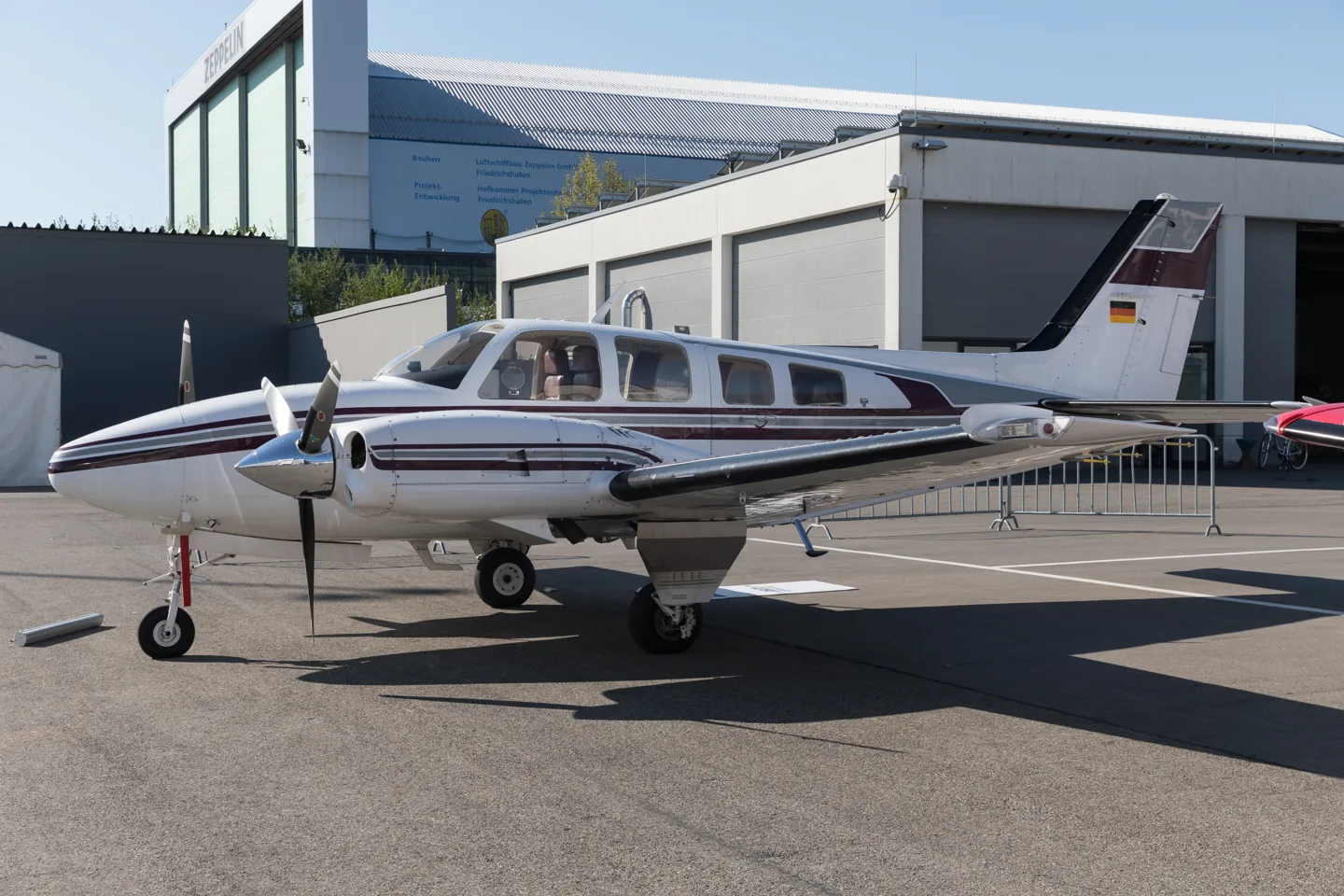 Matti Blume · CC BY-SA 4.0 · Beechcraft Baron.
The Baron entered the Beechcraft range in 1961, developing from the earlier Travel Air. Its retractable landing gear and two wing-mounted piston engines provide the familiar outline of a light touring twin. Several fuselage and engine combinations appeared over the family's long history.
The Model 58 and glass-cockpit G58 share a recognisable shape while representing different equipment generations. The simulator products span conventional-instrument aircraft and modern G58s, with avionics and systems described for each.
Beechcraft Baron · Specifications (B55) · real aircraft; source units retained
First flight: February 29, 1960
Developed from: Beechcraft Travel Air
Twombly's G58 demonstration began near sea level and close to maximum weight, yet the initial climb reached about 1,800 feet per minute. At 11,000 feet, he recorded roughly 200 knots true airspeed before exploring reduced fuel-flow settings. The pace reinforced his view that a Baron transition deserves substantial preparation. Once settled into airwork, however, he particularly enjoyed the smooth response during steep turns and the familiar Beechcraft cockpit around the modern Garmin displays.
The evaluation also included flight on one engine. In the cold conditions of that particular demonstration, he reported a continuing climb at 11,000 feet, with rudder and aileron trim helping reduce the workload. That observation should not be read as performance available at every temperature or loading. Returning to land required firm back pressure, followed by the satisfying touchdown he associated with the type. His report combines enthusiasm for the handling with a clear sense of how quickly a powerful twin can keep its pilot occupied.
Hill had operated one of the first Garmin-equipped G58s for nearly five months when Cox interviewed him. His construction business took him around Arizona, Nevada and California several times a week, usually with bankers, investors or employees aboard. Moving from a Bonanza made the cabin and panel layout familiar, while the twin's rear double doors proved popular with his passengers. He expected to fly about 500 hours annually if that early pattern continued.
He praised the climb and tightly coordinated controls, saying the aircraft's weight was less apparent in flight than he had expected. Learning the G1000 brought a clearer picture of his position in instrument conditions. His equipment choices reflected the work: relatively short trips and infrequent use of every seat allowed him to choose the smaller standard fuel capacity and preserve payload. For Hill, the appeal was how well the Baron fitted recurring business journeys, with enough speed and accommodation to meet the needs he actually had.
Lincoln had shared his 1984 Baron 58 with a partner for eight years when Courtney spoke with him. Their flying included journeys from Connecticut along the American East Coast, trips through the Bahamas and humanitarian work connected with Haiti's 2010 earthquake. He remembered feeling comfortable in the aeroplane from the first flight. The yoke felt substantial, but the response was precise, giving him a strong sense of connection with the aircraft.
He was preparing to sell because his own flying needs had changed and he expected fewer long journeys. That decision did not diminish his affection for the Baron. He regarded it as especially attractive when carrying a small number of passengers and valuing performance over maximum accommodation. He cautioned against treating every nominal seat as equally spacious, suggesting a larger aircraft for a larger family.
The Baron entered the Beechcraft range in 1961, developing from the earlier Travel Air. Its retractable landing gear and two wing-mounted piston engines provide the familiar outline of a light touring twin. Several fuselage and engine combinations appeared over the family's long history.
This profile selects Black Square Analog Baron 58 for MSFS 2020.
Spring resistance builds with the selected airspeed response. A separate aerodynamic term adds speed-dependent control load.
Valid trim provides the configured pressure relief. Autopilot following is off.
Baron products distinguish normally aspirated B58 aircraft, turbocharged B58TCs and pressurized B58Ps. Black Square documents three-axis trim and separate KFC150 autopilot and flight-director cancellation. Carenado's B58 uses its own KFC225 implementation. Engine boost and cabin pressure distinguish equipment and performance; they do not by themselves prescribe a different yoke force.
The Analog Baron guide separates normally aspirated 58 from turbocharged, pressurized 58P. Cabin pressure does not become a yoke-force command.
The gains are normalized profile settings. They describe the chosen effect balance; hand force depends on the device and its output limits. IAS references are tuning values rather than operating limits. Physical acceptance of this revision remains pending.
施加於模型產出的一切、在裝置上限之前的最終整體輸出縮放。
調高: 一切(彈簧、載荷、效果)一同增強。
調低: 一切一同變柔。
設定理由: Scales overall profile strength while preserving effect balance, subject to device and output limits.
把搖桿拉回中央的基礎回中力。其他所有力都疊加在它之上。太低,正常飛行中搖桿會發軟;太高,它會與你的手較勁,並掩蓋疊加其上的細微提示。
調高: 更硬的回中,更抗手。
調低: 更軟的桿,只靠氣動載荷。
設定理由: The piston twin's selected aerodynamic yoke loading is independent of whether its engines are normally aspirated or turbocharged and its cabin is pressurized. The baseline spring is 0.74. Its low-speed blend reaches baseline strength at 78 KIAS.
Analog Baron manualOperating ManualCarenado B58 Baron for X-Plane 11中央附近彈簧保持安靜的小中立區,讓靜止時的微小移動不會咔嗒作響。更寬更安穩但更松,更窄更精確但可能在中央附近抖動。
調高: 更安靜但更松的中央,曠量更大。
調低: 更緊的中央,靜止時可能抖動。
設定理由: Sets travel around the centre before the baseline spring resists. Smaller values engage it sooner.
作用於兩條持續軸載荷的主縮放,在它們各自的獨立平衡之前施加。設定檔通常不動它,而是調校兩條軸載荷。
調高: 兩軸載荷一同加重。
調低: 兩軸一同減輕。
設定理由: The aerodynamic-load gain is 0.8 with an indicated-speed reference of 156 KIAS. This supplies speed-dependent loading alongside the spring.
啟用低速彈簧介入視窗(上面的起始/全強度節數)。關閉時彈簧在所有速度下恆定。
設定理由: Allows baseline spring strength to rise with indicated airspeed where the control law permits it.
在靜止、空速尚未產生氣動力之前,彈簧還剩多少。下限高,停機時搖桿結實;下限低,則是停放輕型飛機那種鋼索鬆弛的感覺。
調高: 停機和滑行時桿更結實。
調低: 停機時桿發軟,只隨速度甦醒。
設定理由: Sets low-speed spring strength as a fraction of baseline when blending is enabled. One keeps full strength.
彈簧從低速下限開始向全強度攀升的空速:起飛滑跑中操縱面"甦醒"的那一刻。
設定理由: Sets the IAS where the low-speed spring blend starts rising. This is a feel threshold, not a flight limit.
彈簧達到全強度的空速。從起點到這裡,隨著氣流在操縱面上增強,回中逐漸變硬。
設定理由: Sets the IAS where the low-speed blend reaches baseline strength; high-speed stiffening also uses it.
氣動載荷達到設計滿值的指示空速。它把整條載荷曲線錨定在飛機真實的速度範圍:172在110節就載滿,噴氣機要晚得多。
調高: 載荷來得更晚;桿輕到更高速度。
調低: 載荷來得更早,巡航更沉。
設定理由: Sets the IAS reference for aerodynamic loading. It is an estimate, not published cruise TAS or a flight limit.
在偏轉載荷之外,回中本身隨速度變硬的程度。零則中央手感恆定;越大,巡航時回中越硬,起落航線上越松。
調高: 中央隨速度明顯變硬。
調低: 任何速度下中央手感恆定。
設定理由: The high-speed spring-stiffening gain is 0.15. It strengthens the permitted spring response above 78 KIAS, with the squared-speed ratio capped at 5.
速度驅動的中央變硬上限,防止高速飛行把彈簧無限上緊。
調高: 高速允許更多總硬化。
調低: 硬化更早封頂。
設定理由: Limits the squared airspeed ratio used for high-speed spring stiffening; it is not a device-force cap.
由副翼偏轉和空速產生的持續橫滾載荷,獨立於俯仰調校。與升降舵載荷一起,決定評測中常說的操縱協調比。
調高: 橫滾力更重。
調低: 副翼更輕更靈。
設定理由: Roll and pitch aerodynamic scales are 0.72 and 1, respectively. They set the aerodynamic axis balance. No custom spring-travel curve is enabled.
由升降舵偏轉和空速產生的持續俯仰載荷,獨立於橫滾調校。這是決定機型俯仰重量的主槓桿。它不影響副翼、彈簧、配平或抖振力。
調高: 速度下持續俯仰力更重。
調低: 升降舵更輕,握持更省力。
設定理由: Scales pitch aerodynamic loading; pitch spring travel and trim responses are separate settings.
每個穩態俯仰或橫滾力到達裝置前的上限,防止猛烈機動中砸擊或飽和硬體。
調高: 削波前更高的穩態力峰值。
調低: 更柔的上限;猛烈機動更早被抹平。
設定理由: Caps directed-force output. Native spring effects and device limits remain separate.
升降舵配平緩解持續俯仰力、移動桿的安定位置的強度。在100 %時,配平得當的飛機不需要保持壓力——正是真實飛行中"用配平消掉載荷"的流程。
調高: 配平消掉更多持續力;100 %時滿配平可完全抵消。
調低: 即使配平也仍要持續用力。
設定理由: Documented elevator trim supports pitch relief. Aileron and rudder trim serve separate axes, and a trim-tab animation is not a hardware-neutral calibration. Pitch authority 0.3 provides load relief and permitted centre movement; roll authority is 0.2.
Analog Baron manualOperating ManualCarenado B58 Baron for X-Plane 11橫滾配平的同類緩解。多數通航機型沒有真正的副翼配平,所以保持為零;有橫滾配平的機型獲得相應的值。
調高: 橫滾配平消掉更多持續力。
調低: 橫滾配平作用更小。
設定理由: Scales supported roll-trim relief and permitted centre movement. Zero removes roll response.
由輪速和地面型別(鋪裝、草地、礫石)產生的滾動振動。
調高: 桿上更強的地面質感。
調低: 更平滑的滑行。
設定理由: Sets rolling texture strength, modified by speed, surface and undercarriage configuration.
來自伸縮縫、車轍和粗糙地面的短促離散顛簸,為持續隆隆聲打上標點。
調高: 接縫與車轍的衝擊更清晰。
調低: 更柔的地面細節。
設定理由: Sets gear-bump texture during ground motion, separate from touchdown impact.
接近失速及失速警告響起時的機體抖動:這副機翼宣告不滿的音量。斷失乾脆的機型抖振收斂,讓喇叭承擔警告。
調高: 更強的失速前顫抖。
調低: 更含蓄的機翼;警告交給喇叭。
設定理由: Sets stall-buffet strength. Zero removes the cue without changing simulator stalls or warnings.
接近馬赫極限的跨音速抖振。對接近MMO的噴氣機有意義,對到不了那裡的活塞機和渦槳機為零。
調高: 接近馬赫極限時更強的跨音速抖振。
調低: 高馬赫下更平滑的飛行。
設定理由: Sets high-Mach buffet strength; onset and full-strength thresholds are separate.
襟翼伸入氣流後機體的低頻振動,發生在它們真正做功的速度視窗內。
調高: 襟翼做功時更粗糙的飛行。
調低: 更柔的進近襟翼。
設定理由: Sets flap buffet at the configured position and speed gates. Flap movement texture is separate.
可收放起落架懸在氣流中引起的機體鼓振。固定起落架機型為零,它們的機體外形從不改變。
調高: 放起落架時更多鼓振。
調低: 放起落架飛行更乾淨。
設定理由: Sets gear aerodynamic buffet; movement and ground-contact cues are separate.
由飛機自身失速警告系統觸發的專用抖桿器振動。只有真有抖桿器的機型才有值;其餘全靠氣動抖振和喇叭。
調高: 更硬的抖桿器。
調低: 更含蓄的抖桿器。
設定理由: Sets triggered shaker strength; inactive while the shaker feature is disabled.
機輪觸及跑道那一下的單次衝擊,按下沉率縮放:輕柔著陸是耳語,結實到達是一記悶響。
調高: 觸地時更硬的一擊。
調低: 更柔的到達。
設定理由: Sets landing-impact strength; landing telemetry and response shape determine the pulse.
反推或槳葉beta區工作時的滑跑振動。無反推機型為零。
調高: 反推下更粗糙的滑跑。
調低: 更含蓄的反推。
設定理由: Sets reverse-thrust vibration with valid reverser and engine conditions. Zero removes the cue.
從慢車到全功率跟隨轉速的持續動力裝置振動——前方有東西在燒油的永恆提醒。
調高: 桿裡更多引擎。
調低: 更含蓄的引擎。
設定理由: Sets estimated engine vibration using configured telemetry and response, not measured cockpit vibration.
僅在模擬器報告襟翼舵面確實移動時的持續振動。它跟隨真實作動器的運動和故障,而非估算的計時器。
調高: 襟翼移動中更多振動。
調低: 更含蓄的襟翼行程。
設定理由: Sets texture from observed flap movement; a command without movement does not establish the cue.
自動駕駛指令可以讓桿實際移動多遠。在MSFS中保持極小,因為移動的軸可能被讀回為飛行員輸入;零則完全停用跟隨。
調高: 自動駕駛讓你的桿移動得明顯更多。
調低: 幾乎察覺不到的跟隨。
設定理由: Sets admitted AP-follow gain, not a percentage of travel. Runtime ownership and input limits still apply.
Whether this feature is active in this profile.
設定理由: Retained for compatibility and group membership. Trim relief, rather than this flag, controls centre movement.
Whether this feature is active in this profile.
設定理由: Allows trim relief with supported control law and valid telemetry. Axis authorities set its amount.
Whether this feature is active in this profile.
設定理由: Enables local force trim, separate from aircraft-owned trim and add-on integration qualification.
Whether this feature is active in this profile.
設定理由: Allows load-factor changes to modify permitted spring laws. Passive fly-by-wire feel can suppress it.
Whether this feature is active in this profile.
設定理由: Enables rate damping with the configured coefficients and control law.
Whether this feature is active in this profile.
設定理由: Autopilot following is off; the configured spring and load retain the hardware feel.
Whether this feature is active in this profile.
設定理由: Permits centering hold during a supported AP state, separate from following a moving target.
設定理由: Sets admitted AP neutral-hold strength; inactive while neutral hold is disabled.
Whether this feature is active in this profile.
設定理由: Enables aerodynamic cues; each still needs nonzero strength and its simulator conditions.
Where this effect reaches full strength (or has fully faded, for washouts).
調高: a more gradual build to a later peak.
調低: a quicker build.
設定理由: Sets the final flap index for detent normalization. UP plus three detents uses maximum index3.
Where this effect begins fading in.
調高: the effect begins later.
調低: it begins earlier.
設定理由: Sets the first flap detent that admits buffet; this is a handle index, not degrees.
Whether this feature is active in this profile.
設定理由: Permits shaker at supported warning conditions; the switch does not establish aircraft equipment.
Whether this feature is active in this profile.
設定理由: Enables ground effects; each still needs its own strength and contact or motion telemetry.
Whether this feature is active in this profile.
設定理由: Enables engine cues with nonzero settings and valid running-engine telemetry.
Whether this feature is active in this profile.
設定理由: Enables accessory cues with configured strengths and observed accessory movement.
The strength of this effect.
調高: a stronger effect.
調低: a weaker one.
設定理由: Sets texture from observed gear movement, separate from aerodynamic and touchdown effects.
| 引數 | 數值 | 控制作用及原因 |
|---|---|---|
| Spring strength | 0.74 | The piston twin's selected aerodynamic yoke loading is independent of whether its engines are normally aspirated or turbocharged and its cabin is pressurized. The baseline spring is 0.74. Its low-speed blend reaches baseline strength at 78 KIAS. |
| Spring deadband | 0.045 | Sets travel around the centre before the baseline spring resists. Smaller values engage it sooner. |
| Force gain | 0.8 | The aerodynamic-load gain is 0.8 with an indicated-speed reference of 156 KIAS. This supplies speed-dependent loading alongside the spring. |
| Master gain | 0.85 | Scales overall profile strength while preserving effect balance, subject to device and output limits. |
| Dynamic-pressure blend | True | Allows baseline spring strength to rise with indicated airspeed where the control law permits it. |
| Minimum spring factor | 0.5 | Sets low-speed spring strength as a fraction of baseline when blending is enabled. One keeps full strength. |
| Spring wake-up speed | 21.8 kt | Sets the IAS where the low-speed spring blend starts rising. This is a feel threshold, not a flight limit. |
| Spring full-strength speed | 78.0 kt | Sets the IAS where the low-speed blend reaches baseline strength; high-speed stiffening also uses it. |
| 力回饋調校速度 | 156 kt | Sets the IAS reference for aerodynamic loading. It is an estimate, not published cruise TAS or a flight limit. |
| Airspeed spring stiffening | 0.15 | The high-speed spring-stiffening gain is 0.15. It strengthens the permitted spring response above 78 KIAS, with the squared-speed ratio capped at 5. |
| Airspeed stiffening cap | 5 | Limits the squared airspeed ratio used for high-speed spring stiffening; it is not a device-force cap. |
| Aileron force scale | 0.72 | Roll and pitch aerodynamic scales are 0.72 and 1, respectively. They set the aerodynamic axis balance. No custom spring-travel curve is enabled. |
| Elevator force scale | 1.0 | Scales pitch aerodynamic loading; pitch spring travel and trim responses are separate settings. |
| Maximum output force | 0.55 | Caps directed-force output. Native spring effects and device limits remain separate. |
| StickFeel · Trim feel enabled | True | Retained for compatibility and group membership. Trim relief, rather than this flag, controls centre movement. |
| StickFeel · Trim relief enabled | True | Allows trim relief with supported control law and valid telemetry. Axis authorities set its amount. |
| StickFeel · Elevator authority | 0.3 | Documented elevator trim supports pitch relief. Aileron and rudder trim serve separate axes, and a trim-tab animation is not a hardware-neutral calibration. Pitch authority 0.3 provides load relief and permitted centre movement; roll authority is 0.2. |
| StickFeel · Aileron authority | 0.2 | Scales supported roll-trim relief and permitted centre movement. Zero removes roll response. |
| StickFeel · Force trim enabled | False | Enables local force trim, separate from aircraft-owned trim and add-on integration qualification. |
| StickFeel · G load enabled | True | Allows load-factor changes to modify permitted spring laws. Passive fly-by-wire feel can suppress it. |
| StickFeel · Rate damping enabled | True | Enables rate damping with the configured coefficients and control law. |
| Autopilot · Follow enabled | False | Autopilot following is off; the configured spring and load retain the hardware feel. |
| Autopilot · Follow authority | 0.1 | Sets admitted AP-follow gain, not a percentage of travel. Runtime ownership and input limits still apply. |
| Autopilot · Neutral hold enabled | False | Permits centering hold during a supported AP state, separate from following a moving target. |
| Autopilot · Neutral hold strength | 0.6 | Sets admitted AP neutral-hold strength; inactive while neutral hold is disabled. |
| Aero · Enabled | True | Enables aerodynamic cues; each still needs nonzero strength and its simulator conditions. |
| Aero · Gain | 0.35 | Sets stall-buffet strength. Zero removes the cue without changing simulator stalls or warnings. |
| Aero · Gain | 0 | Sets high-Mach buffet strength; onset and full-strength thresholds are separate. |
| Aero · Gain | 0.12 | Sets flap buffet at the configured position and speed gates. Flap movement texture is separate. |
| Aero · Max flap index | 2 | Sets the final flap index for detent normalization. UP plus three detents uses maximum index3. |
| Aero · Min flap index | 2 | Sets the first flap detent that admits buffet; this is a handle index, not degrees. |
| Aero · Gain | 0.1 | Sets gear aerodynamic buffet; movement and ground-contact cues are separate. |
| Aero · Shaker enabled | False | Permits shaker at supported warning conditions; the switch does not establish aircraft equipment. |
| Aero · Amplitude | 0.5 | Sets triggered shaker strength; inactive while the shaker feature is disabled. |
| Ground · Enabled | True | Enables ground effects; each still needs its own strength and contact or motion telemetry. |
| Ground · Gain | 0.4 | Sets rolling texture strength, modified by speed, surface and undercarriage configuration. |
| Ground · Gain | 0.25 | Sets gear-bump texture during ground motion, separate from touchdown impact. |
| Ground · Gain | 0.65 | Sets landing-impact strength; landing telemetry and response shape determine the pulse. |
| Ground · Gain | 0 | Sets reverse-thrust vibration with valid reverser and engine conditions. Zero removes the cue. |
| Engine · Enabled | True | Enables engine cues with nonzero settings and valid running-engine telemetry. |
| Engine · Gain | 0.12 | Sets estimated engine vibration using configured telemetry and response, not measured cockpit vibration. |
| Mechanical · Enabled | True | Enables accessory cues with configured strengths and observed accessory movement. |
| Mechanical · Gain | 0.1 | Sets texture from observed flap movement; a command without movement does not establish the cue. |
| Mechanical · Gain | 0.12 | Sets texture from observed gear movement, separate from aerodynamic and touchdown effects. |
如果你的真機經驗表明本頁有誤,請在此指正。
本頁基於引用資料構建,而真機經驗勝過任何引用。 請引用有誤的主張,並告訴我們真機的實際表現。糾錯 將交由維護者稽核,並納入本研究的下一次修訂。
關於 Beechcraft Baron 58 / G58 的飛行與調校的公開討論(社群論壇)。上方的糾錯將私下送達維護者;機庫閒談是公開的。