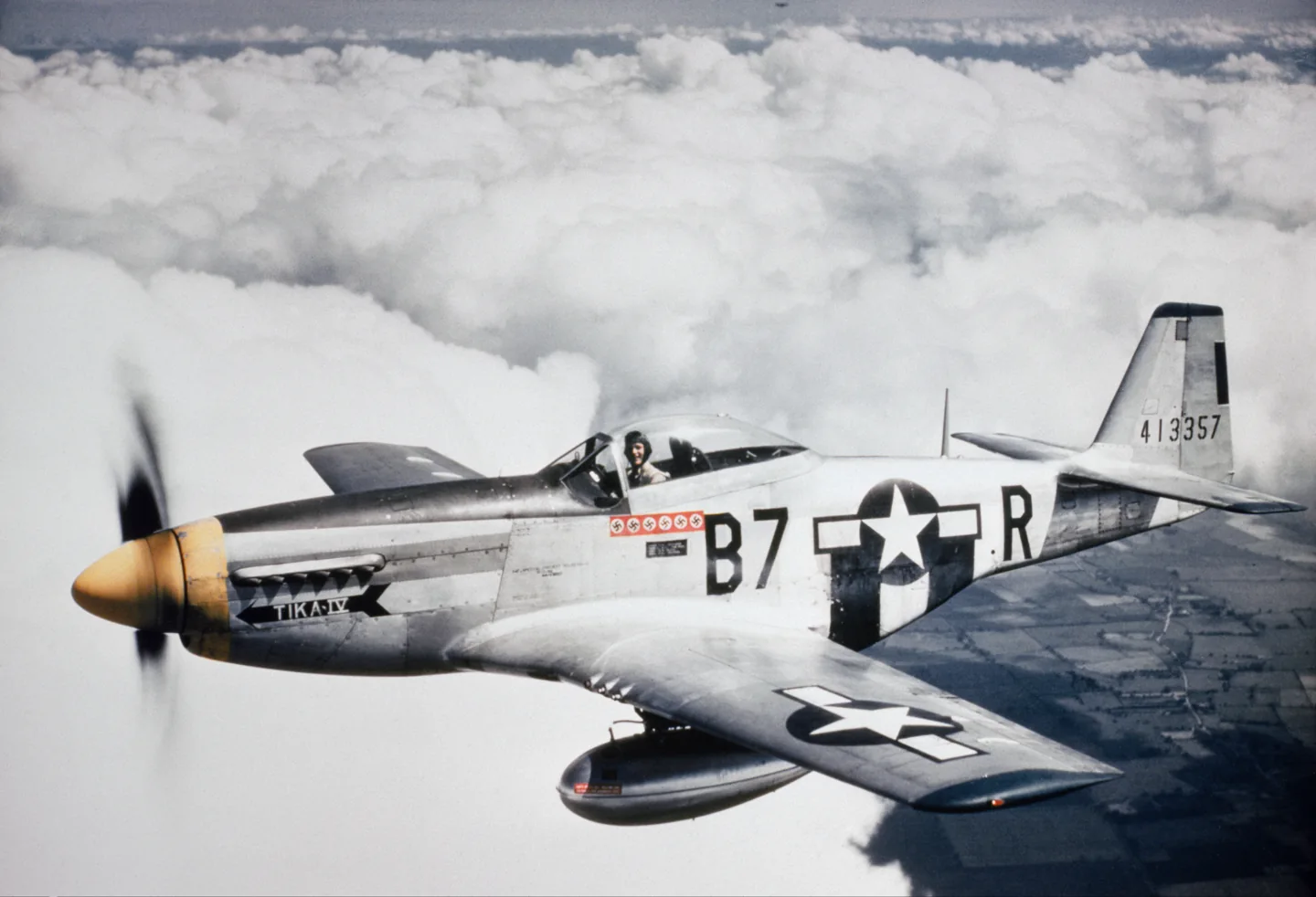
기체 라이브러리North American P-51 Mustang
North American P-51 MustangUSAAF/361st FG Association (via Al Richards) · Public domain · North American P-51 Mustang pictured

North American P-51 Mustang

Mechanical warbird controls with speed-dependent stick loading, elevator-trim relief and separate piston-engine cues.
WarbirdP51프로필 선택: 4개

기체 알기

North American designed the Mustang for a British requirement in 1940. Early aircraft used Allison engines; Merlin-powered developments became associated with long-range escort missions. The P-51D introduced the familiar bubble-canopy configuration.

Postwar service was followed by civilian display and racing. Racing Mustangs can carry extensive modifications, with equipment and handling that differ from wartime or restored warbird configurations.

North American P-51D Mustang

Powerplant
Packard V-1650-7 Merlin, 1,490 hp↗
Seats
1↗
Max takeoff weight
12,100 lb (5,490 kg)↗
Wingspan
37 ft 0 in (11.28 m)↗
Length
32 ft 3 in (9.83 m)↗
Never exceed
505 mph (439 kt)↗
Max speed
437 mph at 25,000 ft↗
Cruise
≈275 mph typical escort cruise↗
Service ceiling
41,900 ft↗
Range
950 mi internal fuel↗
Internal fuel
184 US gal↗
First flight
1940 (NA-73X prototype)↗

AirframeDB에서 이 항공기에 대해 더 알아보기

British origins and the Merlin transformation

North American proposed a new fighter when Britain approached it about manufacturing P-40s. The resulting NA-73X flew in October 1940. Later experimental installations of the Merlin engine led to the P-51B and C, giving the Mustang a major role in long-range escort over Europe. Those two designations reflected production at Inglewood and Dallas respectively.

The bubble canopy and a postwar return

The P-51D’s bubble canopy improved the pilot’s view, while revised armament and ammunition feeds were among its other changes. After the war, jets displaced many Mustangs from frontline service. Redesignated F-51s returned to combat in Korea, where their range supported missions from Japan and they subsequently served in close-support and interdiction roles.

A first Mustang solo at sixty-nine

Schiff had wanted to fly a Mustang for years before finally asking owner David Price. The invitation was immediate, but the preparation took more work: T-6 practice was followed by the insurer’s requirement for a Mustang instructor’s endorsement. At Stallion 51, Lee Lauderback provided extensive ground instruction and flight exercises. Schiff compared the seriousness of the course with his airline transition training.

Waiting to take off alone in Cottonmouth, he felt as anxious as he had on his first solo decades earlier. Once airborne, the acceleration and view were memorable, along with the need to keep adjusting rudder and elevator trim as speed and power changed. He found the aircraft manageable when flown with care.

A wartime encounter he remembered for decades

Anderson’s chapter opens with a mission that continued returning to his thoughts long after the war. Escorting bombers in a P-51B, he became engaged with German fighters and found himself in a close encounter with an opponent whose ability he respected. He remembers being occupied with the immediate work of flying, watching the other aircraft and protecting his wingman; the fear became easier to recognise afterwards.

The recollection also describes the less visible effort behind the manoeuvring. His hands and feet continually adjusted power, trim and control inputs as the Mustang changed speed. Experience had made much of that coordination automatic. He credited the aircraft with helping him survive, while acknowledging luck as well as skill. The episode remains his personal memory of combat, including the sensations and judgments he carried away from it.

Meeting an aircraft from childhood

Rankin had especially looked forward to the Mustang during his effort to fly fifty-two aircraft in a year. He remembered having a toy Mustang as a child and seeing that interest repeated in his son. Approaching the real aircraft felt like meeting someone famous: he wanted to do it justice. The Collings Foundation flight with Cliff Atkins gave him the chance to use the controls in a two-seat TF-51.

The impression that surprised him most was its smoothness. In the interview, he describes how comfortably it held a straight course once trimmed and how little vibration he noticed. The flight included aerobatics, with Atkins demonstrating an eight-point roll, and Rankin stayed airborne longer than he usually did for the project. His enthusiasm reflects this short introduction to a dual-control Mustang, alongside an experienced instructor.

공개 출처 13
  1. North American P-51 MustangResearch background · Wikipedia revision 1373879916 · retrieved 2026-09-12
  2. Microsoft Flight Simulator aircraft manuals
  3. MSFS 2024 FAQ and edition aircraft inventory
  4. P-51D MustangOfficial developer / designated store catalogue · checked 2026-09-12
  5. North American Aviation P-51D Mustang: Lone RangerBarry Schiff · 1 August 2007
  6. To Fly and Fight — Chapter OneC. E. “Bud” Anderson with Joseph P. Hamelin · authorised book excerpt
  7. From the Cockpit Part 50: TF-51 MustangPhilip Lederer interviews Ryan Rankin · 14 December 2017
  8. North American P-51D MustangFamily development, escort and postwar roles
  9. ICAO Doc 8643 — aircraft type designatorsPublic search data retrieved 2026-09-14; authority update 2026-09-03
  10. Aeroplane Heaven - You're virtually there.™ North American P-51D for MSFS2020Product listing captured 2026-09-30; edition scope from the reviewed catalogue
  11. Mustang P-51 XP12 HD exact product classificationProduct listing captured 2026-09-24; edition scope from the reviewed catalogue
  12. AAF Manual AN 01-60JE-1인쇄 또는 보관된 참고 자료; 공개 링크 없음
  13. North American Aviation records인쇄 또는 보관된 참고 자료; 공개 링크 없음

프로필의 모델링 방식

North American P-51 Mustang

Free + Pro
MSFS 2024X-Plane 12X-Plane 11

North American designed the Mustang for a British requirement in 1940. Early aircraft used Allison engines; Merlin-powered developments became associated with long-range escort missions. The P-51D introduced the familiar bubble-canopy configuration.

This starting point selects North American P-51 Mustang. Its aircraft-level settings do not select a particular developer’s custom systems.

Reversible fighter controls motivate aerodynamic stick loading. Spring resistance builds with the selected airspeed response. A separate aerodynamic term adds speed-dependent control load.

Elevator and aileron trim independently relieve their axes. Valid trim provides the configured pressure relief. Autopilot following is off.

About the values

The gains are normalized profile settings. They describe the chosen effect balance; hand force depends on the device and its output limits. IAS references are tuning values rather than operating limits. Physical acceptance of this revision remains pending.

Master gain & control system

Master gain85%

모델이 만드는 모든 것에 적용되는 최종 전체 출력 스케일로, 장치 상한 이전에 적용됩니다.

올리면: 모든 것(스프링, 하중, 효과)이 함께 강해집니다.

내리면: 모든 것이 함께 부드러워집니다.

이 값의 이유: Scales overall profile strength while preserving effect balance, subject to device and output limits.

Forces

Spring strength74%

스틱을 중앙으로 되돌리는 기본 센터링 힘입니다. 다른 모든 힘이 이 위에 쌓입니다. 너무 낮으면 정상 비행에서 스틱이 흐물거리고, 너무 높으면 손에 맞서며 그 위에 겹쳐진 작은 신호들을 가립니다.

올리면: 손에 더 저항하는 단단한 센터링.

내리면: 공기역학 하중에만 기대는 무른 스틱.

이 값의 이유: Reversible fighter controls motivate aerodynamic stick loading. The baseline spring is 0.74. Its low-speed blend reaches baseline strength at 90 KIAS.

Aeroplane Heaven - You're virtually there.™ North American P-51D for MSFS2020Original PDF pages 13,15-16,26,29Mustang P-51 XP12 HD exact product classificationP-51D MustangMustang Performance TestsMustang IV Dive TestMustang Tactical TrialsNACA Mustang report — NASA Technical Reports record 19930092576North American Aviation P-51D Mustang: Lone RangerP-51B Fuselage Tank Report 4-43-23-1
Spring deadband4%

중앙 주변에서 스프링이 조용히 머무는 작은 중립 구역으로, 정지 시의 미세한 움직임이 덜컹거리지 않게 합니다. 넓을수록 차분하지만 느슨해지고, 좁을수록 정밀하지만 중앙에서 떨릴 수 있습니다.

올리면: 더 차분하지만 더 느슨한, 유격이 큰 중앙.

내리면: 정지 시 떨릴 수 있는 더 조인 중앙.

이 값의 이유: Sets travel around the centre before the baseline spring resists. Smaller values engage it sooner.

Overall aerodynamic load95%

두 지속 축 하중에 걸리는 마스터 스케일로, 각 축의 독립 균형 이전에 적용됩니다. 프로파일은 보통 이것을 두고 두 축 하중을 조정합니다.

올리면: 두 축이 더 강하게 하중을 받습니다.

내리면: 두 축이 함께 가벼워집니다.

이 값의 이유: The aerodynamic-load gain is 0.95 with an indicated-speed reference of 240 KIAS. This supplies speed-dependent loading alongside the spring.

Airspeed blendingTrue

저속 스프링 진입 구간(위의 시작/최대 노트)을 켭니다. 끄면 스프링은 모든 속도에서 일정합니다.

이 값의 이유: Allows baseline spring strength to rise with indicated airspeed where the control law permits it.

Low-speed spring floor50%

속도가 공기역학적 힘을 만들기 전, 정지 상태에서 스프링이 얼마나 남는지입니다. 바닥이 높으면 주기된 스틱이 단단하고, 낮으면 주기된 경비행기의 케이블이 늘어진 듯한 느슨한 감각이 됩니다.

올리면: 주기·지상활주 시 더 단단한 스틱.

내리면: 속도로만 깨어나는 주기 시의 무른 스틱.

이 값의 이유: Sets low-speed spring strength as a fraction of baseline when blending is enabled. One keeps full strength.

Spring engagement start20 kt

스프링이 저속 바닥에서 전체 강도를 향해 오르기 시작하는 속도입니다. 이륙 활주에서 조종면이 "살아나는" 지점입니다.

이 값의 이유: Sets the IAS where the low-speed spring blend starts rising. This is a feel threshold, not a flight limit.

Spring engagement full90 kt

스프링이 전체 강도에 도달하는 속도입니다. 시작점과 이 지점 사이에서 조종면 위 기류가 늘며 센터링이 점차 단단해집니다.

이 값의 이유: Sets the IAS where the low-speed blend reaches baseline strength; high-speed stiffening also uses it.

포스 조정 속도240

공기역학 하중이 설계된 최대치에 도달하는 지시 속도입니다. 하중 곡선 전체를 기체의 실제 속도 범위에 고정합니다. 172는 110노트에서 하중이 차오르고, 제트기는 훨씬 나중입니다.

올리면: 하중이 늦게 오고, 더 빠른 속도까지 스틱이 가볍습니다.

내리면: 하중이 일찍 오고 순항이 더 무겁습니다.

이 값의 이유: Sets the IAS reference for aerodynamic loading. It is an estimate, not published cruise TAS or a flight limit.

Centre firmness vs speed10%

변위 하중에 더해 센터링 자체가 속도에 따라 얼마나 단단해지는지입니다. 0이면 중앙 감각이 일정하고, 클수록 순항에서 더 단단히, 장주에서 더 느슨하게 센터링됩니다.

올리면: 속도에 따라 뚜렷이 단단해지는 중앙.

내리면: 어떤 속도에서도 일정한 중앙 감각.

이 값의 이유: The high-speed spring-stiffening gain is 0.1. It strengthens the permitted spring response above 90 KIAS, with the squared-speed ratio capped at 5.

Centre stiffening cap5

속도로 인한 중앙 경화의 상한으로, 초고속 비행이 스프링을 무한정 감아올리지 못하게 합니다.

올리면: 고속에서 더 많은 총 경화 허용.

내리면: 경화가 더 일찍 멈춥니다.

이 값의 이유: Limits the squared airspeed ratio used for high-speed spring stiffening; it is not a device-force cap.

Aileron load72%

에일러론 변위와 속도에 의한 지속적인 롤 하중으로, 피치와 독립적으로 조정됩니다. 승강타 하중과 함께 리뷰에서 말하는 조종 조화 비율을 정합니다.

올리면: 더 무거운 롤 힘.

내리면: 더 가볍고 생기 있는 에일러론.

이 값의 이유: Roll and pitch aerodynamic scales are 0.72 and 1, respectively. They set the aerodynamic axis balance. No custom spring-travel curve is enabled.

Elevator load100%

승강타 변위와 속도에 의한 지속적인 피치 하중으로, 롤과 독립적으로 조정됩니다. 기종별 피치 무게를 결정하는 주 레버입니다. 에일러론, 스프링, 트림, 버핏 힘에는 관여하지 않습니다.

올리면: 속도에서 더 무거운 지속 피치 힘.

내리면: 붙들기 가벼운, 더 가뿐한 승강타.

이 값의 이유: Scales pitch aerodynamic loading; pitch spring travel and trim responses are separate settings.

Max output force55%

각 정상 피치·롤 힘이 장치에 닿기 전의 상한으로, 강한 기동에서 하드웨어를 때리거나 포화시키지 않게 보호합니다.

올리면: 잘리기 전의 더 높은 정상 힘 피크.

내리면: 더 부드러운 상한. 거친 기동이 더 일찍 평평해집니다.

이 값의 이유: Caps directed-force output. Native spring effects and device limits remain separate.

Trim

Trim relief (elevator)30%

승강타 트림이 유지 중인 피치 힘을 얼마나 덜어내고 스틱이 안착하는 지점을 옮기는지입니다. 100 %에서는 제대로 트림된 기체에 유지 압력이 필요 없어져, 실제 비행의 하중을-트림으로-지우는 절차 그대로입니다.

올리면: 트림이 더 많은 유지 힘을 덜어냅니다. 100 %에서는 완전 트림이 상쇄합니다.

내리면: 트림해도 힘을 계속 붙들게 됩니다.

이 값의 이유: Elevator and aileron trim independently relieve their axes. Pitch authority 0.3 provides load relief and permitted centre movement; roll authority is 0.12.

Aeroplane Heaven - You're virtually there.™ North American P-51D for MSFS2020Original PDF pages 13,15-16,26,29Mustang P-51 XP12 HD exact product classificationP-51D MustangMustang Performance TestsMustang IV Dive TestMustang Tactical TrialsNACA Mustang report — NASA Technical Reports record 19930092576North American Aviation P-51D Mustang: Lone RangerP-51B Fuselage Tank Report 4-43-23-1
Trim relief (aileron)12%

롤 트림에 대한 같은 경감입니다. 대부분의 GA 기종에는 실제 에일러론 트림이 없어 0으로 두고, 롤 트림이 있는 기종은 상응하는 값을 받습니다.

올리면: 롤 트림이 더 많은 유지 힘을 덜어냅니다.

내리면: 롤 트림의 효과가 줄어듭니다.

이 값의 이유: Scales supported roll-trim relief and permitted centre movement. Zero removes roll response.

Effect gains · Ground

Runway rumble42%

바퀴 속도와 노면 종류(포장, 잔디, 자갈)에 따른 구름 진동입니다.

올리면: 스틱의 노면 질감이 더 강하게.

내리면: 더 매끄러운 지상활주.

이 값의 이유: Sets rolling texture strength, modified by speed, surface and undercarriage configuration.

Gear bumps30%

신축 이음, 바퀴 자국, 거친 노면의 짧고 분리된 충격으로, 연속적인 우르릉거림에 마디를 찍습니다.

올리면: 이음과 자국의 더 또렷한 충격.

내리면: 더 부드러운 지면 디테일.

이 값의 이유: Sets gear-bump texture during ground motion, separate from touchdown impact.

Effect gains · Airframe

Stall buffet35%

실속 접근 시와 실속 경고가 울리는 동안의 기체 흔들림, 이 날개가 불만을 얼마나 크게 알리는지입니다. 깔끔하게 떨어지는 기종은 버핏을 절제하고 경적이 경고를 맡습니다.

올리면: 더 강한 실속 전 떨림.

내리면: 더 은은한 날개. 경적이 경고를 맡습니다.

이 값의 이유: Sets stall-buffet strength. Zero removes the cue without changing simulator stalls or warnings.

Mach buffet0%

마하 한계 접근 시의 천음속 버핏입니다. MMO 근처의 제트기에는 의미가 있고, 거기 도달하지 못하는 피스톤과 터보프롭은 0입니다.

올리면: 마하 한계 근처의 더 강한 천음속 버핏.

내리면: 높은 마하에서 더 매끄러운 비행.

이 값의 이유: Sets high-Mach buffet strength; onset and full-strength thresholds are separate.

Flap buffet14%

플랩이 실제로 공기를 일하는 속도 창에서, 기류에 펼쳐진 플랩에 의한 기체의 저주파 진동입니다.

올리면: 플랩 작동 중 더 거친 비행.

내리면: 더 부드러운 접근 플랩.

이 값의 이유: Sets flap buffet at the configured position and speed gates. Flap movement texture is separate.

Gear buffet10%

기류에 매달린 접이식 착륙장치에 의한 기체의 북소리입니다. 기체 형상이 변하지 않는 고정식 기종은 0입니다.

올리면: 착륙장치 내림 시 더 많은 북소리.

내리면: 더 깔끔한 착륙장치 내림 비행.

이 값의 이유: Sets gear aerodynamic buffet; movement and ground-contact cues are separate.

Stick shaker50%

기체 자체의 실속 경보 시스템이 발동하는 전용 스틱 셰이커 진동입니다. 실제 셰이커가 있는 기종만 값을 받고, 나머지는 공기역학 버핏과 경적에 의존합니다.

올리면: 더 단단한 셰이커.

내리면: 더 은은한 셰이커.

이 값의 이유: Sets triggered shaker strength; inactive while the shaker feature is disabled.

Effect gains · Engine, mechanical & drag

Touchdown thump75%

바퀴가 활주로에 닿는 순간의 단발 충격으로, 강하율에 따라 스케일됩니다. 부드러운 착륙은 속삭이고 단단한 도착은 쿵 울립니다.

올리면: 접지 시 더 단단한 충격.

내리면: 더 부드러운 도착.

이 값의 이유: Sets landing-impact strength; landing telemetry and response shape determine the pulse.

Reverse rumble0%

역추력이나 베타 범위 프로펠러가 작동하는 동안의 활주 진동입니다. 리버스가 없는 기종은 0입니다.

올리면: 리버스 중 더 거친 활주.

내리면: 더 은은한 리버스.

이 값의 이유: Sets reverse-thrust vibration with valid reverser and engine conditions. Zero removes the cue.

Engine rumble12%

공회전부터 최대 출력까지 회전수를 따르는 연속적인 동력장치 진동으로, 앞에서 무언가 연료를 태우고 있다는 늘 존재하는 상기입니다.

올리면: 스틱에 더 많은 엔진.

내리면: 더 은은한 엔진.

이 값의 이유: Sets estimated engine vibration using configured telemetry and response, not measured cockpit vibration.

Flap motion12%

시뮬레이터가 플랩 조종면의 실제 이동을 보고하는 동안만의 연속 진동입니다. 추정 타이머가 아니라 실제 액추에이터 동작과 고장을 따릅니다.

올리면: 플랩 이동 중 더 많은 진동.

내리면: 더 은은한 플랩 이동.

이 값의 이유: Sets texture from observed flap movement; a command without movement does not establish the cue.

Autopilot follow

AP follow authority5%

자동조종 명령이 스틱을 물리적으로 얼마나 움직일 수 있는지입니다. 움직인 축이 조종사 입력으로 읽힐 수 있는 MSFS에서는 극소로 유지하며, 0이면 따라가기가 완전히 꺼집니다.

올리면: 자동조종이 스틱을 눈에 띄게 더 움직입니다.

내리면: 거의 느껴지지 않는 따라가기.

이 값의 이유: Sets admitted AP-follow gain, not a percentage of travel. Runtime ownership and input limits still apply.

Stick feel

StickFeel · Trim feel enabledTrue

Whether this feature is active in this profile.

이 값의 이유: Retained for compatibility and group membership. Trim relief, rather than this flag, controls centre movement.

StickFeel · Trim relief enabledTrue

Whether this feature is active in this profile.

이 값의 이유: Allows trim relief with supported control law and valid telemetry. Axis authorities set its amount.

StickFeel · Force trim enabledFalse

Whether this feature is active in this profile.

이 값의 이유: Enables local force trim, separate from aircraft-owned trim and add-on integration qualification.

StickFeel · G load enabledTrue

Whether this feature is active in this profile.

이 값의 이유: Allows load-factor changes to modify permitted spring laws. Passive fly-by-wire feel can suppress it.

StickFeel · Rate damping enabledTrue

Whether this feature is active in this profile.

이 값의 이유: Enables rate damping with the configured coefficients and control law.

Autopilot

Autopilot · Follow enabledFalse

Whether this feature is active in this profile.

이 값의 이유: Autopilot following is off; the configured spring and load retain the hardware feel.

Autopilot · Neutral hold enabledFalse

Whether this feature is active in this profile.

이 값의 이유: Permits centering hold during a supported AP state, separate from following a moving target.

Autopilot · Neutral hold strength0.6

이 값의 이유: Sets admitted AP neutral-hold strength; inactive while neutral hold is disabled.

Aero

Aero · EnabledTrue

Whether this feature is active in this profile.

이 값의 이유: Enables aerodynamic cues; each still needs nonzero strength and its simulator conditions.

Aero · Max flap index5

Where this effect reaches full strength (or has fully faded, for washouts).

올리면: a more gradual build to a later peak.

내리면: a quicker build.

이 값의 이유: Sets the final flap index for detent normalization. UP plus three detents uses maximum index3.

Aero · Min flap index2

Where this effect begins fading in.

올리면: the effect begins later.

내리면: it begins earlier.

이 값의 이유: Sets the first flap detent that admits buffet; this is a handle index, not degrees.

Aero · Shaker enabledFalse

Whether this feature is active in this profile.

이 값의 이유: Permits shaker at supported warning conditions; the switch does not establish aircraft equipment.

Ground

Ground · EnabledTrue

Whether this feature is active in this profile.

이 값의 이유: Enables ground effects; each still needs its own strength and contact or motion telemetry.

Engine

Engine · EnabledTrue

Whether this feature is active in this profile.

이 값의 이유: Enables engine cues with nonzero settings and valid running-engine telemetry.

Mechanical

Mechanical · EnabledTrue

Whether this feature is active in this profile.

이 값의 이유: Enables accessory cues with configured strengths and observed accessory movement.

Mechanical · Gain0.12

The strength of this effect.

올리면: a stronger effect.

내리면: a weaker one.

이 값의 이유: Sets texture from observed gear movement, separate from aerodynamic and touchdown effects.

모든 프로필 설정
추정 프로필 설정
매개변수값제어 대상과 설정 이유
Spring strength0.74 Reversible fighter controls motivate aerodynamic stick loading. The baseline spring is 0.74. Its low-speed blend reaches baseline strength at 90 KIAS.
Spring deadband0.045 Sets travel around the centre before the baseline spring resists. Smaller values engage it sooner.
Force gain0.95 The aerodynamic-load gain is 0.95 with an indicated-speed reference of 240 KIAS. This supplies speed-dependent loading alongside the spring.
Master gain0.85 Scales overall profile strength while preserving effect balance, subject to device and output limits.
Dynamic-pressure blendTrue Allows baseline spring strength to rise with indicated airspeed where the control law permits it.
Minimum spring factor0.5 Sets low-speed spring strength as a fraction of baseline when blending is enabled. One keeps full strength.
Spring wake-up speed20 ktSets the IAS where the low-speed spring blend starts rising. This is a feel threshold, not a flight limit.
Spring full-strength speed90 ktSets the IAS where the low-speed blend reaches baseline strength; high-speed stiffening also uses it.
포스 조정 속도240.0 ktSets the IAS reference for aerodynamic loading. It is an estimate, not published cruise TAS or a flight limit.
Airspeed spring stiffening0.1 The high-speed spring-stiffening gain is 0.1. It strengthens the permitted spring response above 90 KIAS, with the squared-speed ratio capped at 5.
Airspeed stiffening cap5 Limits the squared airspeed ratio used for high-speed spring stiffening; it is not a device-force cap.
Aileron force scale0.72 Roll and pitch aerodynamic scales are 0.72 and 1, respectively. They set the aerodynamic axis balance. No custom spring-travel curve is enabled.
Elevator force scale1.0 Scales pitch aerodynamic loading; pitch spring travel and trim responses are separate settings.
Maximum output force0.55 Caps directed-force output. Native spring effects and device limits remain separate.
StickFeel · Trim feel enabledTrue Retained for compatibility and group membership. Trim relief, rather than this flag, controls centre movement.
StickFeel · Trim relief enabledTrue Allows trim relief with supported control law and valid telemetry. Axis authorities set its amount.
StickFeel · Elevator authority0.3 Elevator and aileron trim independently relieve their axes. Pitch authority 0.3 provides load relief and permitted centre movement; roll authority is 0.12.
StickFeel · Aileron authority0.12 Scales supported roll-trim relief and permitted centre movement. Zero removes roll response.
StickFeel · Force trim enabledFalse Enables local force trim, separate from aircraft-owned trim and add-on integration qualification.
StickFeel · G load enabledTrue Allows load-factor changes to modify permitted spring laws. Passive fly-by-wire feel can suppress it.
StickFeel · Rate damping enabledTrue Enables rate damping with the configured coefficients and control law.
Autopilot · Follow enabledFalse Autopilot following is off; the configured spring and load retain the hardware feel.
Autopilot · Follow authority0.05 Sets admitted AP-follow gain, not a percentage of travel. Runtime ownership and input limits still apply.
Autopilot · Neutral hold enabledFalse Permits centering hold during a supported AP state, separate from following a moving target.
Autopilot · Neutral hold strength0.6 Sets admitted AP neutral-hold strength; inactive while neutral hold is disabled.
Aero · EnabledTrue Enables aerodynamic cues; each still needs nonzero strength and its simulator conditions.
Aero · Gain0.35 Sets stall-buffet strength. Zero removes the cue without changing simulator stalls or warnings.
Aero · Gain0 Sets high-Mach buffet strength; onset and full-strength thresholds are separate.
Aero · Gain0.14 Sets flap buffet at the configured position and speed gates. Flap movement texture is separate.
Aero · Max flap index5 Sets the final flap index for detent normalization. UP plus three detents uses maximum index3.
Aero · Min flap index2 Sets the first flap detent that admits buffet; this is a handle index, not degrees.
Aero · Gain0.1 Sets gear aerodynamic buffet; movement and ground-contact cues are separate.
Aero · Shaker enabledFalse Permits shaker at supported warning conditions; the switch does not establish aircraft equipment.
Aero · Amplitude0.5 Sets triggered shaker strength; inactive while the shaker feature is disabled.
Ground · EnabledTrue Enables ground effects; each still needs its own strength and contact or motion telemetry.
Ground · Gain0.42 Sets rolling texture strength, modified by speed, surface and undercarriage configuration.
Ground · Gain0.3 Sets gear-bump texture during ground motion, separate from touchdown impact.
Ground · Gain0.75 Sets landing-impact strength; landing telemetry and response shape determine the pulse.
Ground · Gain0 Sets reverse-thrust vibration with valid reverser and engine conditions. Zero removes the cue.
Engine · EnabledTrue Enables engine cues with nonzero settings and valid running-engine telemetry.
Engine · Gain0.12 Sets estimated engine vibration using configured telemetry and response, not measured cockpit vibration.
Mechanical · EnabledTrue Enables accessory cues with configured strengths and observed accessory movement.
Mechanical · Gain0.12 Sets texture from observed flap movement; a command without movement does not establish the cue.
Mechanical · Gain0.12 Sets texture from observed gear movement, separate from aerodynamic and touchdown effects.
공개 출처 19
  1. North American P-51 MustangResearch background · Wikipedia revision 1373879916 · retrieved 2026-09-12
  2. Aeroplane Heaven - You're virtually there.™ North American P-51D for MSFS2020Exact product, simulator declarations and configuration featuresProduct listing captured 2026-09-30; edition scope from the reviewed catalogue
  3. Original PDF pages 13,15-16,26,29Original PDF pages 13,15-16,26,29
  4. Mustang P-51 XP12 HD exact product classificationXP12 features and flight/engine modelProduct listing captured 2026-09-24; edition scope from the reviewed catalogue
  5. P-51D MustangOfficial developer / designated store catalogue ·Official developer / designated store catalogue · checked 2026-09-12
  6. Mustang Performance TestsNorth American P-51 Mustang
  7. Mustang IV Dive TestNorth American P-51 Mustang
  8. Mustang Tactical TrialsNorth American P-51 Mustang
  9. NACA Mustang report — NASA Technical Reports record 19930092576North American P-51 Mustang
  10. North American Aviation P-51D Mustang: Lone RangerBarry Schiff · 1 August 2007
  11. P-51B Fuselage Tank Report 4-43-23-1North American P-51 Mustang
  12. Microsoft Flight Simulator aircraft manuals
  13. MSFS 2024 FAQ and edition aircraft inventory
  14. To Fly and Fight — Chapter OneC. E. “Bud” Anderson with Joseph P. Hamelin · authorised book excerpt
  15. From the Cockpit Part 50: TF-51 MustangPhilip Lederer interviews Ryan Rankin · 14 December 2017
  16. North American P-51D MustangFamily development, escort and postwar roles
  17. ICAO Doc 8643 — aircraft type designatorsPublic search data retrieved 2026-09-14; authority update 2026-09-03
  18. AAF Manual AN 01-60JE-1인쇄 또는 보관된 참고 자료; 공개 링크 없음
  19. North American Aviation records인쇄 또는 보관된 참고 자료; 공개 링크 없음

커뮤니티와 정정

실기종 경험상 이 페이지가 틀렸다면 여기서 바로잡아 주세요.

조종사 정정

이 기체를 모시나요? 이 페이지를 정정하세요.

이 페이지는 인용된 자료로 만들어졌지만, 실기종 경험은 인용을 이깁니다. 틀린 주장을 인용하고 실제 기체는 어떤지 알려주세요. 정정은 메인테이너가 검토하며 이 조사의 다음 개정에 반영됩니다.

행어 토크

North American P-51 Mustang의 비행과 튜닝에 대한 열린 대화(커뮤니티 포럼)입니다. 위의 정정은 메인테이너에게 비공개로 전달되며, 행어 토크는 공개입니다.

North American P-51 Mustang의 행어 토크가 아직 없습니다. 첫 번째가 되어 보세요.

커뮤니티

이 기체의 커뮤니티 프로필

이 기체의 커뮤니티 프로필이 아직 없습니다. 나만의 방식으로 튜닝했나요? 프로필 공유하기 그러면 여기에 표시됩니다.