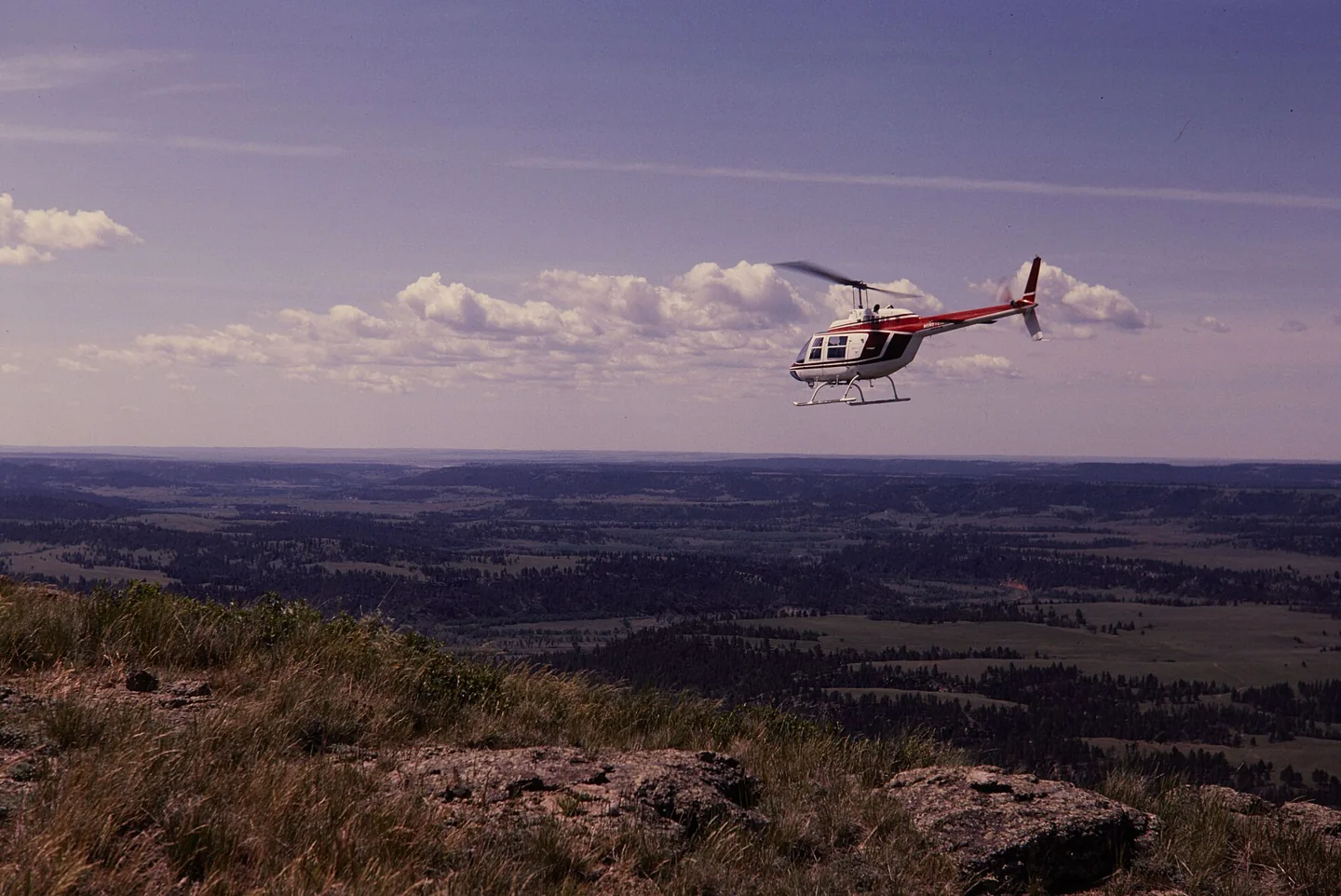
Bell 206 familyThomas C. Gray / National Park Service · Public domain · Bell 206 above Devils Tower National Monument

Bell 206 family

Hydraulically assisted cyclic controls with selected friction and trim behaviour, plus two-blade rotor cues.
HelicopterB0610 choix de profil

Connaître l'avion

Bell reworked an unsuccessful military observation-helicopter proposal into the commercial JetRanger. The resulting 206 family became widely used for passenger transport, observation and utility work. The familiar single-engine versions use a two-bladed main rotor.

The 206B JetRanger and stretched 206L LongRanger are separate branches of that story. Their cabins, engines and equipment are not identical. Cowan documents each model's trim, autopilot and stability-assistance features separately.

Bell 206 JetRanger

Powerplant
Rolls-Royce 250-C20J, 420 shp↗
Seats
5↗
Max takeoff weight
3,200 lb (1,451 kg)↗
Main rotor diameter
33 ft 4 in (10.16 m)↗
Length overall
39 ft 8 in (12.09 m)↗
Never exceed (Vne)
122 KIAS↗
Cruise
≈110 kt↗
Service ceiling
13,500 ft↗
Range
≈374 nm↗
Usable fuel
91 US gal↗
Rotor system
Two-blade teetering, hydraulically boosted↗
First flight (206A)
1966↗

En savoir plus sur cet aéronef sur AirframeDB

The expedition aircraft carried equipment beyond a normal cabin

Powerhouse records additional fuel capacity, navigation equipment, an autopilot and camera installations in VH-DIK. Its description also identifies survival equipment and later North Pole additions, showing why this individual expedition aircraft should not be treated as an ordinary passenger JetRanger.

Force trim has a mechanical basis

The 206B-3 manual describes magnetic brakes and force-gradient springs in the cyclic circuits, alongside adjustable control friction. This describes the documented trim equipment; a simulator profile must separately state whether local force trim is enabled.

A two-blade rotor brings a recognisable rhythm

The FAA handbook explains the characteristic two-per-revolution vibration of a two-bladed rotor. It may be felt through the cyclic as well as the airframe. The profile uses a rotor-related texture to suggest that rhythm; its gain is a simulator setting, not a measured hand force.

A childhood airshow ride becomes a training goal

An eight-minute JetRanger ride at Farnborough when he was nine stayed with Berry for years. A later trial lesson renewed that enthusiasm, but adding the type to his licence meant a difficult choice about a limited training budget. He decided that learning the turbine helicopter was worth the additional commitment.

The course challenged the confidence he had built in the R22. Unfamiliar hydraulic controls, greater weight and a new cockpit made previously comfortable tasks demanding again. Berry especially valued instructor Paul White’s calm approach and emphasis on understanding the aircraft. His account is openly affectionate, including the pleasure of the turbine’s sound, but its strongest theme is the mental adjustment from feeling competent in one helicopter to becoming a learner in another.

A winter demonstration of the developing JetRanger

Middlebrook introduced the reporting team to a JetRanger II from Atlantic Aviation at Teterboro. The aircraft’s cabin helped explain its appeal beyond traditional utility work: entry was straightforward, the windows were generous and the reviewers found useful room in the occupied seats. The middle rear position was less accommodating, a detail retained alongside the favourable first impression.

Flying on a cool winter day, the team found quick control response that could encourage overcorrection at first. The approach also required adjustment to the helicopter’s ability to retain speed. They measured cabin noise and described the vibration rather than relying only on appearance. Their report preserves a contemporary introduction to the developing turbine transport, while distinguishing the conditions they experienced from comments other pilots supplied about turbulence.

Filming the world while flying around it alone

Smith’s journey required him to fly, navigate, communicate and record the view for a documentary. The museum’s account describes the exhaustion of the first Atlantic leg, after which he considered abandoning the attempt. Family reunions and periods of maintenance punctuated a trip completed in three stages, with substantial help from people arranging matters on the ground.

Crossing the North Pacific brought another unusual logistical task: finding a cargo ship able to provide a refuelling stop along the route. The successful return to Texas in July 1983 completed the circumnavigation. Smith continued using the helicopter for further adventures before flying it to the Powerhouse Museum in 1990. The donated aircraft and film preserve both the record and the personal work involved in making the journey visible to others.

Sources publiques 28
  1. Bell 206Research background · Wikipedia revision 1373277311 · retrieved 2026-09-12
  2. CowanSim 206B3 user manual · MSFS
  3. CowanSim 206L3 user manual · MSFS
  4. CowanSim manuals
  5. Microsoft Flight Simulator aircraft manuals
  6. SAS Autopilot Manual
  7. B206 releases and manual
  8. User Manual for Microsoft Flight Simulator
  9. SAS Manual
  10. User Manual
  11. X-Plane aircraft and avionics manuals
  12. 206B3 for MSFSOfficial developer / designated store catalogue · checked 2026-09-12
  13. 206L3 for MSFSOfficial developer / designated store catalogue · checked 2026-09-12
  14. 206B3 for X-PlaneOfficial developer / designated store catalogue · checked 2026-09-12
  15. 206L3 for X-PlaneOfficial developer / designated store catalogue · checked 2026-09-12
  16. B-206Official developer / designated store catalogue · checked 2026-09-12
  17. Tur-bine or not Tur-bine?James Berry · May 2021, personal type-rating account
  18. Pilot Report: Bell JetRanger IIUncredited May 1973 flight report, republished March 2018; demonstration by Tuck Middlebrook
  19. Dick Smith Australian Explorer, VH-DIKDick Smith’s journey documented by curator Margaret Simpson; object 90/816
  20. Forty years since the first solo helicopter circumnavigationManufacturer retrospective · 2023
  21. ICAO Doc 8643 — aircraft type designatorsPublic search data retrieved 2026-09-14; authority update 2026-09-03
  22. B206 catalogue sourceProduct listing captured 2026-09-24; edition scope from the reviewed catalogue
  23. Bell 206B-3 Flight ManualOriginal published Bell 206 reference; scope given beside each claim
  24. FAA TCDS H2SWRéférence imprimée ou archivée ; aucun lien public
  25. Bell published dataRéférence imprimée ou archivée ; aucun lien public
  26. Vertical Magazine — Bell-heritage pilot on force-trim techniqueOriginal published Bell 206 reference; scope given beside each claim
  27. FAA Helicopter Flying Handbook — ETL, transverse flow, VRSOriginal published Bell 206 reference; scope given beside each claim
  28. Greenspun — Bell 505 (206L4 rotor) vibration notesOriginal published Bell 206 reference; scope given beside each claim

Comment le profil le modélise

CowanSim 206B3 JetRanger

Free + Pro
X-Plane 12CowanSim

Bell reworked an unsuccessful military observation-helicopter proposal into the commercial JetRanger. The resulting 206 family became widely used for passenger transport, observation and utility work. The familiar single-engine versions use a two-bladed main rotor.

This profile selects CowanSim 206B3 JetRanger for X-Plane 12.

The spring stays independent of airspeed. Directed aerodynamic loading is omitted.

Local force trim is off. Autopilot following is off.

Cyclic damping is on. Its configured gain is 0.35; it resists hardware motion separately from the spring and aircraft stabilization.

Controls and trim

The Bell 206B-3 flight manual describes adjustable cyclic and collective friction, together with magnetic brakes and force-gradient springs in its cyclic force-trim system. CowanSim's 206B3 and longer-cabin 206L3 have separate manuals and optional HeliSAS procedures. FlyInside and DreamFoil implement different dynamics and stability options. A software trim-release command, sound or stability setting does not provide a continuous physical cyclic-neutral position.

CowanSim 206B3 user manual — MSFSCowanSim HeloSAS autopilot manualCowanSim 206B3 user manual — X-PlaneCowanSim 206L3 user manual — MSFSFlyInside B206 user manual — MSFSBell 206B-3 Flight Manual

The selected implementation

CowanSim's per-aircraft and simulator-edition trim/reset behavior remains separate from a local hardware-centre latch. An unsupported hydraulic binding does not create a force command.

CowanSim 206B3 user manual — X-PlaneSAS Manual

About the values

The gains are normalized profile settings. They describe the chosen effect balance; hand force depends on the device and its output limits. IAS references are tuning values rather than operating limits. Physical acceptance of this revision remains pending.

Master gain & control system

Master gain65%

L'échelle globale finale appliquée à tout ce que produit le modèle, avant la limite du périphérique.

Plus : tout (ressort, charges, effets) se renforce ensemble.

Moins : tout s'adoucit ensemble.

Pourquoi ici : Scales overall profile strength while preserving effect balance, subject to device and output limits.

Forces

Spring strength14%

La force de rappel de base qui ramène le manche au neutre. Toutes les autres forces s'empilent dessus. Trop faible, le manche paraît mou en vol normal ; trop forte, elle lutte contre la main et masque les signaux plus fins.

Plus : un centrage plus ferme qui résiste davantage à la main.

Moins : un manche plus mou qui ne compte que sur la charge aérodynamique.

Pourquoi ici : Magnetic brakes and force-gradient springs provide mechanism context for cyclic centering; longer cabin or rotor audio does not establish a heavier cyclic. The baseline spring is 0.14. Low-speed spring blending is off.

CowanSim 206B3 user manual — MSFSCowanSim HeloSAS autopilot manualCowanSim 206B3 user manual — X-PlaneCowanSim 206L3 user manual — MSFSFlyInside B206 user manual — MSFSBell 206B-3 Flight Manual
Spring deadband2%

Une petite zone neutre autour du centre où le ressort reste muet, pour que les micro-mouvements à l'arrêt ne vibrent pas. Plus large, c'est plus calme mais plus lâche ; plus étroite, plus précis mais parfois nerveux au neutre.

Plus : un centre plus calme mais plus lâche, avec plus de jeu.

Moins : un centre plus serré qui peut vibrer au repos.

Pourquoi ici : Sets travel around the centre before the baseline spring resists. Smaller values engage it sooner.

Overall aerodynamic load0%

Une échelle maîtresse sur les deux charges d'axe, appliquée avant leur équilibre individuel. Les profils la laissent en général en place et règlent les deux axes.

Plus : les deux axes chargent plus fort.

Moins : les deux axes s'allègent ensemble.

Pourquoi ici : The 0 gain omits sustained directed airspeed loading. Spring resistance remains independent.

Airspeed blendingFalse

Active la fenêtre d'engagement basse vitesse du ressort (début/plein en nœuds ci-dessus). Désactivé, le ressort est constant à toute vitesse.

Pourquoi ici : Allows baseline spring strength to rise with indicated airspeed where the control law permits it.

Low-speed spring floor100%

La part du ressort qui survit à l'arrêt, avant que la vitesse ne crée la moindre force aérodynamique. Un plancher haut garde le manche ferme au parking ; un plancher bas donne le jeu de câbles d'un avion léger au parking.

Plus : un manche plus ferme au parking et au roulage.

Moins : un manche mou au parking qui ne s'éveille qu'avec la vitesse.

Pourquoi ici : Sets low-speed spring strength as a fraction of baseline when blending is enabled. One keeps full strength.

Spring engagement start8 kt

La vitesse à laquelle le ressort quitte son plancher basse vitesse vers la pleine raideur : le début du réveil des commandes au roulage de décollage.

Pourquoi ici : Sets the IAS where the low-speed spring blend starts rising. This is a feel threshold, not a flight limit.

Spring engagement full50.0 kt

La vitesse où le ressort atteint sa pleine raideur. Entre le début et ce point, le centrage se raffermit avec le vent relatif.

Pourquoi ici : Sets the IAS where the low-speed blend reaches baseline strength; high-speed stiffening also uses it.

Vitesse de réglage des forces100

La vitesse indiquée où la charge aérodynamique atteint son niveau de conception. Elle ancre toute la courbe au domaine réel : un 172 charge dès 110 nœuds, un jet bien plus tard.

Plus : les charges arrivent plus tard ; le manche reste léger jusqu'à plus vite.

Moins : les charges arrivent plus tôt et la croisière pèse davantage.

Pourquoi ici : Sets the IAS reference for aerodynamic loading. It is an estimate, not published cruise TAS or a flight limit.

Centre firmness vs speed0%

Combien le centrage lui-même se raidit avec la vitesse, en plus des charges de braquage. Zéro garde un centre constant ; plus fait centrer dur en croisière et souple en tour de piste.

Plus : un centre qui durcit nettement avec la vitesse.

Moins : une sensation de centre constante à toute vitesse.

Pourquoi ici : Adds permitted spring resistance above the full-blend speed. Zero removes this high-speed increase.

Centre stiffening cap5

La limite haute du raidissement lié à la vitesse, pour que le vol très rapide ne remonte pas le ressort sans borne.

Plus : plus de raidissement total permis à haute vitesse.

Moins : le raidissement se bride plus tôt.

Pourquoi ici : Limits the squared airspeed ratio used for high-speed spring stiffening; it is not a device-force cap.

Aileron load72%

La charge de roulis soutenue issue du braquage d'ailerons et de la vitesse, équilibrée indépendamment du tangage. Avec la charge de profondeur, elle fixe l'harmonie des commandes dont parlent les essais.

Plus : des efforts de roulis plus lourds.

Moins : des ailerons plus légers, plus vifs.

Pourquoi ici : Roll and pitch aerodynamic scales are 0.72 and 1, respectively. These stored weights do not create directed aerodynamic loading while that term is inactive. No custom spring-travel curve is enabled.

Elevator load100%

La charge de tangage soutenue issue du braquage de profondeur et de la vitesse, équilibrée indépendamment du roulis. Le levier principal du poids en tangage d'un type. Il ne touche ni ailerons, ni ressort, ni trim, ni buffet.

Plus : des efforts de tangage soutenus plus lourds en vitesse.

Moins : une profondeur plus légère, moins musclée à tenir.

Pourquoi ici : Scales pitch aerodynamic loading; pitch spring travel and trim responses are separate settings.

Max output force55%

Un plafond par force stable de tangage ou roulis avant le périphérique : la garde contre le claquement ou la saturation du matériel en manœuvre forte.

Plus : des pics de force stable plus élevés avant écrêtage.

Moins : un plafond plus doux ; les manœuvres dures s'aplatissent plus tôt.

Pourquoi ici : Caps directed-force output. Native spring effects and device limits remain separate.

Trim

Trim relief (elevator)0%

Combien le trim de profondeur soulage l'effort tenu et déplace le point de repos du manche. À 100 %, un avion bien compensé ne demande aucune pression : le geste réel de compenser la charge.

Plus : le trim retire plus d'effort tenu ; à 100 %, plein trim l'annule.

Moins : vous continuez à tenir de l'effort même compensé.

Pourquoi ici : Scales supported pitch-trim relief and permitted centre movement. Zero removes pitch response.

Trim relief (aileron)0%

Le même soulagement pour le trim de roulis. La plupart des avions légers n'ont pas de vrai trim d'ailerons, donc zéro ; les types qui en ont reçoivent une valeur adaptée.

Plus : le trim de roulis retire plus d'effort tenu.

Moins : le trim de roulis fait moins.

Pourquoi ici : Scales supported roll-trim relief and permitted centre movement. Zero removes roll response.

Effect gains · Ground

Runway rumble0%

Vibration de roulement issue de la vitesse des roues et du revêtement : la texture du bitume, de l'herbe ou du gravier sous le train.

Plus : une texture de surface plus forte dans le manche.

Moins : un roulage plus lisse.

Pourquoi ici : Sets rolling texture strength, modified by speed, surface and undercarriage configuration.

Gear bumps0%

Chocs courts et distincts des joints, ornières et surfaces rugueuses : la ponctuation au-dessus du grondement continu.

Plus : des chocs plus nets des joints et ornières.

Moins : des détails de sol plus doux.

Pourquoi ici : Sets gear-bump texture during ground motion, separate from touchdown impact.

Effect gains · Airframe

Stall buffet0%

Buffet de cellule à l'approche du décrochage et pendant l'avertisseur : la voix de cette aile quand elle est mécontente. Les types à décrochage franc reçoivent un buffet modéré, le klaxon porte l'alerte.

Plus : un tremblement pré-décrochage plus fort.

Moins : une aile plus discrète ; le klaxon porte l'alerte.

Pourquoi ici : Sets stall-buffet strength. Zero removes the cue without changing simulator stalls or warnings.

Mach buffet0%

Buffet transsonique près de la limite de Mach. Parlant pour les jets près de MMO, zéro pour pistons et turbopropulseurs qui n'y vont jamais.

Plus : un buffet transsonique plus fort près de la limite de Mach.

Moins : un vol plus lisse à haut Mach.

Pourquoi ici : Sets high-Mach buffet strength; onset and full-strength thresholds are separate.

Flap buffet0%

Vibration basse fréquence de cellule avec les volets dans le vent, dans la fenêtre où ils travaillent vraiment l'air.

Plus : un vol plus rugueux volets au travail.

Moins : des volets d'approche plus doux.

Pourquoi ici : Sets flap buffet at the configured position and speed gates. Flap movement texture is separate.

Gear buffet0%

Le tambourinement du train rentrant sorti dans le flux. Zéro pour les trains fixes, dont la cellule ne change jamais de forme.

Plus : plus de tambourinement train sorti.

Moins : un vol train sorti plus propre.

Pourquoi ici : Sets gear aerodynamic buffet; movement and ground-contact cues are separate.

Stick shaker50%

Le vibreur de manche dédié, déclenché par l'avertisseur de décrochage de l'avion. Seuls les types à vrai vibreur reçoivent une valeur ; les autres comptent sur buffet et klaxon.

Plus : un vibreur plus dur.

Moins : un vibreur plus discret.

Pourquoi ici : Sets triggered shaker strength; inactive while the shaker feature is disabled.

Effect gains · Engine, mechanical & drag

Touchdown thump50%

Le coup unique au toucher, proportionnel au taux de chute : un kiss se murmure, une arrivée ferme cogne.

Plus : un coup plus dur au toucher.

Moins : des arrivées plus douces.

Pourquoi ici : Sets landing-impact strength; landing telemetry and response shape determine the pulse.

Reverse rumble0%

Vibration de roulage sous inversion de poussée ou plage bêta. Zéro pour les types sans reverse.

Plus : un roulage plus rugueux sous reverse.

Moins : une reverse plus discrète.

Pourquoi ici : Sets reverse-thrust vibration with valid reverser and engine conditions. Zero removes the cue.

Engine rumble0%

Vibration continue du moteur suivant le régime du ralenti à la pleine puissance : le rappel permanent que quelque chose brûle du carburant devant.

Plus : plus de moteur dans le manche.

Moins : un moteur plus discret.

Pourquoi ici : Sets estimated engine vibration using configured telemetry and response, not measured cockpit vibration.

Flap motion0%

Vibration continue seulement pendant que le simulateur signale les volets réellement en mouvement. Elle suit la course réelle et les pannes, pas un minuteur estimé.

Plus : plus de vibration volets en mouvement.

Moins : des courses de volets plus discrètes.

Pourquoi ici : Sets texture from observed flap movement; a command without movement does not establish the cue.

Autopilot follow

AP follow authority5%

Jusqu'où les ordres du pilote automatique peuvent bouger le manche physique. Minuscule dans MSFS, où un axe déplacé peut être relu comme entrée pilote ; zéro coupe le suivi.

Plus : le pilote automatique bouge visiblement plus votre manche.

Moins : un suivi à peine perceptible.

Pourquoi ici : Sets admitted AP-follow gain, not a percentage of travel. Runtime ownership and input limits still apply.

Stick feel

StickFeel · Trim feel enabledFalse

Whether this feature is active in this profile.

Pourquoi ici : Retained for compatibility and group membership. Trim relief, rather than this flag, controls centre movement.

StickFeel · Trim relief enabledFalse

Whether this feature is active in this profile.

Pourquoi ici : Allows trim relief with supported control law and valid telemetry. Axis authorities set its amount.

StickFeel · Force trim enabledFalse

Whether this feature is active in this profile.

Pourquoi ici : An enabled local latch approximates holding a hardware neutral. CowanSim's SAS-dependent software trim and the aircraft's magnetic-brake system remain separate scope. Local force trim is off. The stored latch parameters are inactive; the profile does not supply a local hold-where-left neutral.

CowanSim 206B3 user manual — MSFSCowanSim HeloSAS autopilot manualCowanSim 206B3 user manual — X-PlaneCowanSim 206L3 user manual — MSFSFlyInside B206 user manual — MSFSBell 206B-3 Flight Manual
StickFeel · G load enabledFalse

Whether this feature is active in this profile.

Pourquoi ici : Allows load-factor changes to modify permitted spring laws. Passive fly-by-wire feel can suppress it.

StickFeel · Rate damping enabledFalse

Whether this feature is active in this profile.

Pourquoi ici : Enables rate damping with the configured coefficients and control law.

Autopilot

Autopilot · Follow enabledFalse

Whether this feature is active in this profile.

Pourquoi ici : Autopilot following is off; the configured spring and load retain the hardware feel.

Autopilot · Neutral hold enabledFalse

Whether this feature is active in this profile.

Pourquoi ici : Permits centering hold during a supported AP state, separate from following a moving target.

Autopilot · Neutral hold strength0.6

Pourquoi ici : Sets admitted AP neutral-hold strength; inactive while neutral hold is disabled.

Aero

Aero · EnabledTrue

Whether this feature is active in this profile.

Pourquoi ici : Enables aerodynamic cues; each still needs nonzero strength and its simulator conditions.

Aero · Max flap index1

Where this effect reaches full strength (or has fully faded, for washouts).

Plus : a more gradual build to a later peak.

Moins : a quicker build.

Pourquoi ici : Sets the final flap index for detent normalization. UP plus three detents uses maximum index3.

Aero · Min flap index1

Where this effect begins fading in.

Plus : the effect begins later.

Moins : it begins earlier.

Pourquoi ici : Sets the first flap detent that admits buffet; this is a handle index, not degrees.

Aero · Shaker enabledFalse

Whether this feature is active in this profile.

Pourquoi ici : Permits shaker at supported warning conditions; the switch does not establish aircraft equipment.

Ground

Ground · EnabledTrue

Whether this feature is active in this profile.

Pourquoi ici : Enables ground effects; each still needs its own strength and contact or motion telemetry.

Engine

Engine · EnabledTrue

Whether this feature is active in this profile.

Pourquoi ici : Enables engine cues with nonzero settings and valid running-engine telemetry.

Mechanical

Mechanical · EnabledTrue

Whether this feature is active in this profile.

Pourquoi ici : Enables accessory cues with configured strengths and observed accessory movement.

Mechanical · Gain0

The strength of this effect.

Plus : a stronger effect.

Moins : a weaker one.

Pourquoi ici : Sets texture from observed gear movement, separate from aerodynamic and touchdown effects.

Tous les réglages du profil
Réglages estimés du profil
ParamètreValeurCe que cela contrôle et pourquoi
Spring strength0.14 Magnetic brakes and force-gradient springs provide mechanism context for cyclic centering; longer cabin or rotor audio does not establish a heavier cyclic. The baseline spring is 0.14. Low-speed spring blending is off.
Spring deadband0.02 Sets travel around the centre before the baseline spring resists. Smaller values engage it sooner.
Force gain0 The 0 gain omits sustained directed airspeed loading. Spring resistance remains independent.
Master gain0.65 Scales overall profile strength while preserving effect balance, subject to device and output limits.
Dynamic-pressure blendFalse Allows baseline spring strength to rise with indicated airspeed where the control law permits it.
Minimum spring factor1 Sets low-speed spring strength as a fraction of baseline when blending is enabled. One keeps full strength.
Spring wake-up speed8 ktSets the IAS where the low-speed spring blend starts rising. This is a feel threshold, not a flight limit.
Spring full-strength speed50.0 ktSets the IAS where the low-speed blend reaches baseline strength; high-speed stiffening also uses it.
Vitesse de réglage des forces100 ktSets the IAS reference for aerodynamic loading. It is an estimate, not published cruise TAS or a flight limit.
Airspeed spring stiffening0 Adds permitted spring resistance above the full-blend speed. Zero removes this high-speed increase.
Airspeed stiffening cap5 Limits the squared airspeed ratio used for high-speed spring stiffening; it is not a device-force cap.
Aileron force scale0.72 Roll and pitch aerodynamic scales are 0.72 and 1, respectively. These stored weights do not create directed aerodynamic loading while that term is inactive. No custom spring-travel curve is enabled.
Elevator force scale1 Scales pitch aerodynamic loading; pitch spring travel and trim responses are separate settings.
Maximum output force0.55 Caps directed-force output. Native spring effects and device limits remain separate.
StickFeel · Trim feel enabledFalse Retained for compatibility and group membership. Trim relief, rather than this flag, controls centre movement.
StickFeel · Trim relief enabledFalse Allows trim relief with supported control law and valid telemetry. Axis authorities set its amount.
StickFeel · Elevator authority0 Scales supported pitch-trim relief and permitted centre movement. Zero removes pitch response.
StickFeel · Aileron authority0 Scales supported roll-trim relief and permitted centre movement. Zero removes roll response.
StickFeel · Force trim enabledFalse An enabled local latch approximates holding a hardware neutral. CowanSim's SAS-dependent software trim and the aircraft's magnetic-brake system remain separate scope. Local force trim is off. The stored latch parameters are inactive; the profile does not supply a local hold-where-left neutral.
StickFeel · G load enabledFalse Allows load-factor changes to modify permitted spring laws. Passive fly-by-wire feel can suppress it.
StickFeel · Rate damping enabledFalse Enables rate damping with the configured coefficients and control law.
Autopilot · Follow enabledFalse Autopilot following is off; the configured spring and load retain the hardware feel.
Autopilot · Follow authority0.05 Sets admitted AP-follow gain, not a percentage of travel. Runtime ownership and input limits still apply.
Autopilot · Neutral hold enabledFalse Permits centering hold during a supported AP state, separate from following a moving target.
Autopilot · Neutral hold strength0.6 Sets admitted AP neutral-hold strength; inactive while neutral hold is disabled.
Aero · EnabledTrue Enables aerodynamic cues; each still needs nonzero strength and its simulator conditions.
Aero · Gain0 Sets stall-buffet strength. Zero removes the cue without changing simulator stalls or warnings.
Aero · Gain0 Sets high-Mach buffet strength; onset and full-strength thresholds are separate.
Aero · Gain0 Sets flap buffet at the configured position and speed gates. Flap movement texture is separate.
Aero · Max flap index1 Sets the final flap index for detent normalization. UP plus three detents uses maximum index3.
Aero · Min flap index1 Sets the first flap detent that admits buffet; this is a handle index, not degrees.
Aero · Gain0 Sets gear aerodynamic buffet; movement and ground-contact cues are separate.
Aero · Shaker enabledFalse Permits shaker at supported warning conditions; the switch does not establish aircraft equipment.
Aero · Amplitude0.5 Sets triggered shaker strength; inactive while the shaker feature is disabled.
Ground · EnabledTrue Enables ground effects; each still needs its own strength and contact or motion telemetry.
Ground · Gain0 Sets rolling texture strength, modified by speed, surface and undercarriage configuration.
Ground · Gain0 Sets gear-bump texture during ground motion, separate from touchdown impact.
Ground · Gain0.5 Sets landing-impact strength; landing telemetry and response shape determine the pulse.
Ground · Gain0 Sets reverse-thrust vibration with valid reverser and engine conditions. Zero removes the cue.
Engine · EnabledTrue Enables engine cues with nonzero settings and valid running-engine telemetry.
Engine · Gain0 Sets estimated engine vibration using configured telemetry and response, not measured cockpit vibration.
Mechanical · EnabledTrue Enables accessory cues with configured strengths and observed accessory movement.
Mechanical · Gain0 Sets texture from observed flap movement; a command without movement does not establish the cue.
Mechanical · Gain0 Sets texture from observed gear movement, separate from aerodynamic and touchdown effects.
Sources publiques 29
  1. Bell 206Research background · Wikipedia revision 1373277311 · retrieved 2026-09-12
  2. CowanSim 206B3 user manual — MSFSExact MSFS aircraft hardware/control manual
  3. CowanSim HeloSAS autopilot manualCowan HeloSAS manual pp.2/5
  4. CowanSim 206B3 user manual — X-PlaneExact XP12 manual, title/configuration and trim sections
  5. CowanSim 206L3 user manual — MSFSExact MSFS aircraft hardware/control manual
  6. FlyInside B206 user manual — MSFSFlight control/model options and startup chapters
  7. Bell 206B-3 Flight ManualBell 206 familyOriginal published Bell 206 reference; scope given beside each claim
  8. SAS ManualCowan XP SAS manual pp.1-4
  9. CowanSim manuals
  10. Microsoft Flight Simulator aircraft manuals
  11. B206 releases and manual
  12. SAS Manual
  13. X-Plane aircraft and avionics manuals
  14. 206B3 for MSFSOfficial developer / designated store catalogue · checked 2026-09-12
  15. 206L3 for MSFSOfficial developer / designated store catalogue · checked 2026-09-12
  16. 206B3 for X-PlaneOfficial developer / designated store catalogue · checked 2026-09-12
  17. 206L3 for X-PlaneOfficial developer / designated store catalogue · checked 2026-09-12
  18. B-206Official developer / designated store catalogue · checked 2026-09-12
  19. Tur-bine or not Tur-bine?James Berry · May 2021, personal type-rating account
  20. Pilot Report: Bell JetRanger IIUncredited May 1973 flight report, republished March 2018; demonstration by Tuck Middlebrook
  21. Dick Smith Australian Explorer, VH-DIKDick Smith’s journey documented by curator Margaret Simpson; object 90/816
  22. Forty years since the first solo helicopter circumnavigationManufacturer retrospective · 2023
  23. ICAO Doc 8643 — aircraft type designatorsPublic search data retrieved 2026-09-14; authority update 2026-09-03
  24. B206 catalogue sourceProduct listing captured 2026-09-24; edition scope from the reviewed catalogue
  25. FAA TCDS H2SWRéférence imprimée ou archivée ; aucun lien public
  26. Bell published dataRéférence imprimée ou archivée ; aucun lien public
  27. Vertical Magazine — Bell-heritage pilot on force-trim techniqueOriginal published Bell 206 reference; scope given beside each claim
  28. FAA Helicopter Flying Handbook — ETL, transverse flow, VRSOriginal published Bell 206 reference; scope given beside each claim
  29. Greenspun — Bell 505 (206L4 rotor) vibration notesOriginal published Bell 206 reference; scope given beside each claim

Communauté et corrections

Si votre expérience du type dit que cette page se trompe, corrigez-la ici.

Corrections de pilotes

Vous volez sur cet appareil ? Corrigez cette page.

Cette page repose sur des références citées, et l'expérience réelle du type vaut mieux qu'une citation. Citez l'affirmation erronée et dites-nous ce que fait l'appareil réel. Les corrections vont au mainteneur pour examen et nourrissent la prochaine révision de cette recherche.

Discussions de hangar

Conversation ouverte sur le pilotage et le réglage du Bell 206 family, sur le forum communautaire. Les corrections ci-dessus vont en privé au mainteneur ; les discussions de hangar sont publiques.

Pas encore de discussion de hangar sur le Bell 206 family. Lancez-la.

Communauté

Profils communautaires pour cet appareil

Voir les 1 dans la bibliothèque
Avion Profil Simulateur Matériel Added ReviewsDiscussionTéléchargements Open profile
DreamFoil B206 JetRanger XP12B06 DreamFoil B206 JetRanger XP12 - research candidate 1 by FFB-Bridge X-Plane Unspecified Aucun avisStart discussion364