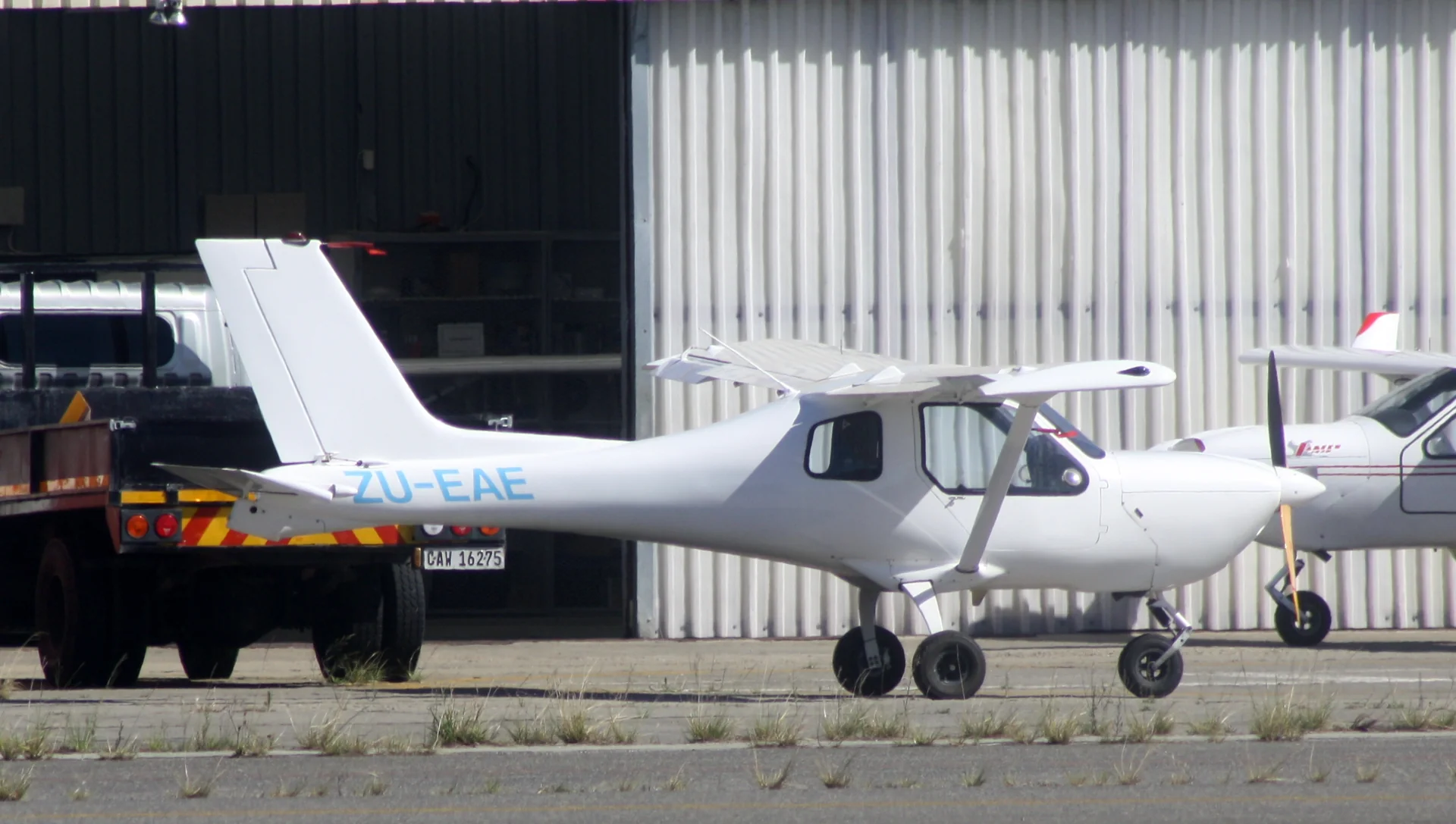
Jabiru J160Bob Adams from Amanzimtoti, South Africa · CC BY-SA 2.0 · Jabiru J160 ZU-EAE.

Jabiru J160

A two-seat high-wing light aircraft with a central stick and push-pull controls.
General aviation2 Profiloptionen

Kenne das Flugzeug

The J160 is a strut-braced high-wing aircraft with fixed tricycle landing gear and two seats, intended for training and recreation. Its Jabiru 2200 four-cylinder engine accompanies electrically operated flaps.

IRIS's shared J160/J170 manual describes a common central stick and Teleflex push-pull primary controls. The J160 and J170 differ in wing and weight; the package offers Option A and Option B avionics arrangements.

Jabiru J160

Seats
2↗
Engine
Jabiru 2200 · four-cylinder↗
Primary controls
Teleflex push-pull↗
Landing gear
Fixed tricycle↗

Mehr über dieses Flugzeug auf AirframeDB

An Australian aircraft and engine programme

Jabiru was founded in Bundaberg in 1988 to develop a light composite aircraft. When the original engine supplier stopped aircraft-engine production, the company developed its own powerplant. Its later 2200 engine and airframe programmes grew together, establishing the background to the J160 family.

The J160C milestone

The manufacturer records J160C type certification in December 2005 during a period of expanding international approvals and production. This is a specific milestone for the J160C, rather than a statement that every later kit or light-sport model carries the same approval.

Öffentliche Quellen 3
  1. Jabiru J160 — IRIS Simulations / Orbx referencePDF1,11-14,21,32-33
  2. Jabiru J160 — IRIS Simulations referenceAircraft-specific product description and compatibility requirements
  3. Our journeyReviewed public summary; original privately archived 2026-10-12

Wie das Profil es modelliert

Jabiru J160

Free + Pro
MSFS 2020MSFS 2024X-Plane 12

A two-seat high-wing light aircraft with a central stick and push-pull controls.

Spring resistance builds with the selected airspeed response. A separate aerodynamic term adds speed-dependent control load.

Valid trim provides the configured pressure relief. Autopilot following is off.

Diese genaue Revision wurde noch nicht für die öffentliche Installation freigegeben.

Aircraft and configuration

Four-cylinder Jabiru 2200 engine, fixed tricycle gear and electric flaps.

Jabiru J170 — IRIS Simulations / Orbx referenceJabiru J170 — IRIS Simulations reference

Central stick and spring trim

The manual describes Teleflex push-pull primary controls operated from a common central stick. Cable-operated elevator trim loads springs against a friction lock; nose-up trim raises the elevator. The electric flaps have their own actuation, separate from the manual primary controls.

Jabiru J170 — IRIS Simulations / Orbx reference

J160 and J170 package context

Wing and weight distinguish the J160 and J170. Option A and Option B denote avionics choices. The archived AFM identifies v2.0.0, while the product page lists 1.5.6; those are retained as separate document and product versions.

Jabiru J170 — IRIS Simulations / Orbx reference

About the values

Strengths are normalized hardware-feel settings. They set the effect balance; hand force depends on the device and its limits. The IAS reference is a tuning value.

Master gain & control system

Master gain85%

Die letzte Gesamtskalierung über alles, was das Modell erzeugt, vor der Gerätegrenze.

Mehr: alles (Feder, Lasten, Effekte) wird gemeinsam stärker.

Weniger: alles wird gemeinsam weicher.

Warum hier: Scales overall profile strength while preserving effect balance, subject to device and output limits.

Forces

Spring strength74%

Die Grundzentrierkraft, die den Stick zur Mitte zieht. Jede andere Kraft baut darauf auf. Zu niedrig fühlt sich der Stick im Normalflug schlaff an; zu hoch kämpft er gegen deine Hand und überdeckt die feineren Signale.

Mehr: festere Zentrierung, die der Hand jederzeit mehr widersteht.

Weniger: ein schlafferer Stick, der sich allein auf die aerodynamische Last stützt.

Warum hier: Primary controls: Teleflex push-pull. The baseline spring is 0.74. Its low-speed blend reaches baseline strength at 45 KIAS.

Jabiru J170 — IRIS Simulations / Orbx reference
Overall aerodynamic load80%

Ein Gesamtmaß über beide anhaltenden Achslasten, vor ihrer Einzelbalance angewendet. Profile lassen es normalerweise stehen und stimmen die beiden Achslasten ab.

Mehr: beide Achsen laden härter auf.

Weniger: beide Achsen werden gemeinsam leichter.

Warum hier: The aerodynamic-load gain is 0.8 with an indicated-speed reference of 100 KIAS. This supplies speed-dependent loading alongside the spring.

Elevator load100%

Die anhaltende Nicklast aus Höhenruderausschlag und Fahrt, unabhängig von der Rollachse balanciert. Der Haupthebel für das Nickgewicht eines Musters. Er verändert weder Querruder, Feder, Trimmung noch Schüttelkräfte.

Mehr: schwerere anhaltende Nickkräfte bei Fahrt.

Weniger: ein leichteres Höhenruder, das weniger Muskel braucht.

Warum hier: Scales pitch aerodynamic loading; pitch spring travel and trim responses are separate settings.

Aileron load72%

Die anhaltende Rolllast aus Querruderausschlag und Fahrt, unabhängig vom Nick balanciert. Zusammen mit der Höhenruderlast bestimmt sie die Ruderharmonie, von der Testberichte sprechen.

Mehr: schwerere Rollkräfte.

Weniger: leichtere, quirligere Querruder.

Warum hier: Roll and pitch aerodynamic scales are 0.72 and 1, respectively. They set the aerodynamic axis balance. No custom spring-travel curve is enabled.

Max output force55%

Eine Kappe je stetiger Nick- oder Rollkraft vor dem Gerät. Der Schutz davor, die Hardware in harten Manövern zu überfahren oder zu sättigen.

Mehr: stärkere Spitzenkräfte vor dem Abschneiden.

Weniger: eine sanftere Decke; harte Manöver flachen früher ab.

Warum hier: Caps directed-force output. Native spring effects and device limits remain separate.

Geschwindigkeit zur Kraftabstimmung100

Die angezeigte Fahrt, bei der die aerodynamische Last ihr ausgelegtes Vollniveau erreicht. Sie verankert die gesamte Lastkurve am realen Geschwindigkeitsbereich: eine 172 lädt bis 110 Knoten auf, ein Jet viel später.

Mehr: Lasten kommen später; der Stick bleibt bis zu höherer Fahrt leicht.

Weniger: Lasten kommen früher, und die Reise fühlt sich schwerer an.

Warum hier: Sets the IAS reference for aerodynamic loading. It is an estimate, not published cruise TAS or a flight limit.

Spring deadband4%

Eine kleine neutrale Zone um die Mitte, in der die Feder ruhig bleibt, damit kleinste Bewegungen im Stand nicht flattern. Breiter ist ruhiger, aber lockerer; enger ist präziser, kann aber um die Mitte zittern.

Mehr: eine ruhigere, aber lockerere Mitte mit mehr Spiel.

Weniger: eine straffere Mitte, die in Ruhe zittern kann.

Warum hier: Sets travel around the centre before the baseline spring resists. Smaller values engage it sooner.

Airspeed blendingTrue

Aktiviert das Niedrigfahrt-Einblendfenster der Feder (Beginn/Voll in Knoten oben). Aus bleibt die Feder bei jeder Fahrt konstant.

Warum hier: Allows baseline spring strength to rise with indicated airspeed where the control law permits it.

Low-speed spring floor55%

Wie viel Feder im Stillstand übrig bleibt, bevor Fahrt überhaupt aerodynamische Kraft aufbauen kann. Ein hoher Sockel hält den geparkten Stick straff; ein niedriger ergibt das lose Seilzuggefühl eines geparkten Leichtflugzeugs.

Mehr: ein festerer Stick beim Parken und Rollen.

Weniger: ein schlaffer geparkter Stick, der erst mit Fahrt aufwacht.

Warum hier: Sets low-speed spring strength as a fraction of baseline when blending is enabled. One keeps full strength.

Spring engagement start10 kt

Die Fahrt, ab der die Feder vom Niedrigfahrt-Sockel Richtung volle Stärke steigt: der Beginn des "Lebendigwerdens" der Ruder im Startlauf.

Warum hier: Sets the IAS where the low-speed spring blend starts rising. This is a feel threshold, not a flight limit.

Spring engagement full45 kt

Die Fahrt, bei der die Feder volle Stärke erreicht. Zwischen Beginn und diesem Punkt strafft sich die Zentrierung zunehmend mit der Anströmung.

Warum hier: Sets the IAS where the low-speed blend reaches baseline strength; high-speed stiffening also uses it.

Centre firmness vs speed15%

Wie stark sich die Zentrierung selbst mit der Fahrt strafft, zusätzlich zu den Ausschlaglasten. Null hält das Mittengefühl konstant; mehr lässt den Stick im Reiseflug härter und im Anflug lockerer zentrieren.

Mehr: eine Mitte, die mit Fahrt spürbar härter wird.

Weniger: konstantes Mittengefühl bei jeder Fahrt.

Warum hier: The high-speed spring-stiffening gain is 0.15. It strengthens the permitted spring response above 45 KIAS, with the squared-speed ratio capped at 5.

Centre stiffening cap5

Die Obergrenze der fahrtabhängigen Mittenstraffung, damit sehr hohe Fahrt die Feder nicht grenzenlos aufzieht.

Mehr: mehr Gesamtstraffung bei hoher Fahrt erlaubt.

Weniger: die Straffung klemmt früher ab.

Warum hier: Limits the squared airspeed ratio used for high-speed spring stiffening; it is not a device-force cap.

Trim

Trim relief (elevator)30%

Wie stark Höhenrudertrimmung die gehaltene Nickkraft abbaut und den Ruhepunkt des Sticks verschiebt. Bei 100 % braucht ein sauber getrimmtes Flugzeug keinen gehaltenen Druck: das Wegtrimmen der Last wie im echten Fliegen.

Mehr: Trimmung nimmt mehr der gehaltenen Nickkraft; bei 100 % nullt volle Trimmung sie.

Weniger: du hältst auch getrimmt weiter Kraft.

Warum hier: The manual describes Teleflex push-pull primary controls operated from a common central stick. Pitch authority 0.3 provides load relief and permitted centre movement; roll authority is 0.

Jabiru J170 — IRIS Simulations / Orbx reference
Trim relief (aileron)0%

Dieselbe Entlastung für Rolltrimmung. Die meisten GA-Muster haben keine echte Querrudertrimmung, daher bleibt sie bei null; Muster mit Rolltrimmung bekommen einen passenden Wert.

Mehr: Rolltrimmung nimmt mehr gehaltene Rollkraft.

Weniger: Rolltrimmung bewirkt weniger.

Warum hier: Scales supported roll-trim relief and permitted centre movement. Zero removes roll response.

Effect gains · Ground

Runway rumble40%

Rollende Untergrundvibration aus Radgeschwindigkeit und Oberflächenart: die Textur von Asphalt, Gras oder Schotter unter dem Fahrwerk.

Mehr: lautere Oberflächentextur durch den Stick.

Weniger: ruhigeres Rollen.

Warum hier: Sets rolling texture strength, modified by speed, surface and undercarriage configuration.

Gear bumps25%

Kurze einzelne Stöße von Dehnfugen, Spurrillen und rauem Belag: die Interpunktion über dem kontinuierlichen Rumpeln.

Mehr: schärfere Stöße von Fugen und Rillen.

Weniger: weichere Bodendetails.

Warum hier: Sets gear-bump texture during ground motion, separate from touchdown impact.

Effect gains · Airframe

Stall buffet35%

Zellenschütteln vor dem Überziehen und bei aktiver Überziehwarnung: wie laut diese Fläche ihr Unbehagen ankündigt. Muster mit sauberem Abriss bekommen moderates Schütteln, das Horn trägt die Warnung.

Mehr: lauteres Schütteln vor dem Überziehen.

Weniger: eine leisere Fläche; das Horn trägt die Warnung.

Warum hier: Sets stall-buffet strength. Zero removes the cue without changing simulator stalls or warnings.

Mach buffet0%

Transsonisches Schütteln nahe der Machgrenze. Relevant für Jets nahe MMO, null für Kolben und Turboprops, die nie dort ankommen.

Mehr: stärkeres transsonisches Schütteln nahe der Machgrenze.

Weniger: ruhigerer Flug bei hohem Mach.

Warum hier: Sets high-Mach buffet strength; onset and full-strength thresholds are separate.

Flap buffet0%

Niederfrequente Zellenvibration mit Klappen im Fahrtwind, im Fenster, in dem sie wirklich Luft arbeiten.

Mehr: ein rauerer Lauf mit arbeitenden Klappen.

Weniger: ruhigere Anflugklappen.

Warum hier: Sets flap buffet at the configured position and speed gates. Flap movement texture is separate.

Gear buffet0%

Zellentrommeln vom ausgefahrenen Einziehfahrwerk im Fahrtwind. Null für Festfahrwerke, deren Zelle nie die Form ändert.

Mehr: mehr Trommeln mit hängendem Fahrwerk.

Weniger: saubererer Flug mit Fahrwerk.

Warum hier: Sets gear aerodynamic buffet; movement and ground-contact cues are separate.

Stick shaker50%

Der dedizierte Stall-Stickshaker-Buzz, ausgelöst von der Überziehwarnanlage des Flugzeugs. Nur Muster mit echtem Shaker bekommen einen Wert; alle anderen verlassen sich auf Schütteln und Horn.

Mehr: ein härterer Shaker-Buzz.

Weniger: ein dezenterer Shaker.

Warum hier: Sets triggered shaker strength; inactive while the shaker feature is disabled.

Effect gains · Engine, mechanical & drag

Touchdown thump65%

Der Einmalstoß beim Aufsetzen, skaliert mit der Sinkrate: ein Butterlander flüstert, ein fester Aufsetzer wummst.

Mehr: ein härterer Tritt beim Aufsetzen.

Weniger: weichere Ankünfte.

Warum hier: Sets landing-impact strength; landing telemetry and response shape determine the pulse.

Reverse rumble0%

Ausrollvibration bei Schubumkehr oder Beta-Verstellung. Null für Muster ohne Umkehr.

Mehr: ein rauerer Ausrollvorgang unter Umkehrschub.

Weniger: leisere Umkehr.

Warum hier: Sets reverse-thrust vibration with valid reverser and engine conditions. Zero removes the cue.

Engine rumble12%

Kontinuierliche Triebwerksvibration, die der Drehzahl von Leerlauf bis Volllast folgt: die allgegenwärtige Erinnerung, dass vorn etwas Kraftstoff verbrennt.

Mehr: mehr Triebwerk im Stick.

Weniger: ein leiseres Triebwerk.

Warum hier: Sets estimated engine vibration using configured telemetry and response, not measured cockpit vibration.

Flap motion12%

Dauervibration nur, solange der Simulator tatsächlich fahrende Klappenflächen meldet. Folgt echter Aktuatorbewegung und Ausfällen, keinem geschätzten Timer.

Mehr: mehr Vibration bei fahrenden Klappen.

Weniger: leisere Klappenläufe.

Warum hier: Sets texture from observed flap movement; a command without movement does not establish the cue.

Autopilot follow

AP follow authority10%

Wie weit Autopilotbefehle den physischen Stick bewegen dürfen. In MSFS winzig gehalten, weil eine bewegte Achse als Pilotene ingabe zurückgelesen werden kann; null schaltet das Folgen ab.

Mehr: der Autopilot bewegt deinen Stick sichtbar weiter.

Weniger: ein kaum wahrnehmbares Folgen.

Warum hier: Sets admitted AP-follow gain, not a percentage of travel. Runtime ownership and input limits still apply.

Stick feel

StickFeel · Trim feel enabledFalse

Whether this feature is active in this profile.

Warum hier: Retained for compatibility and group membership. Trim relief, rather than this flag, controls centre movement.

StickFeel · Trim relief enabledTrue

Whether this feature is active in this profile.

Warum hier: Allows trim relief with supported control law and valid telemetry. Axis authorities set its amount.

StickFeel · Force trim enabledFalse

Whether this feature is active in this profile.

Warum hier: Enables local force trim, separate from aircraft-owned trim and add-on integration qualification.

StickFeel · G load enabledTrue

Whether this feature is active in this profile.

Warum hier: Allows load-factor changes to modify permitted spring laws. Passive fly-by-wire feel can suppress it.

StickFeel · Rate damping enabledTrue

Whether this feature is active in this profile.

Warum hier: Enables rate damping with the configured coefficients and control law.

Autopilot

Autopilot · Follow enabledFalse

Whether this feature is active in this profile.

Warum hier: Autopilot following is off; the configured spring and load retain the hardware feel.

Autopilot · Neutral hold enabledFalse

Whether this feature is active in this profile.

Warum hier: Permits centering hold during a supported AP state, separate from following a moving target.

Autopilot · Neutral hold strength0.6

Warum hier: Sets admitted AP neutral-hold strength; inactive while neutral hold is disabled.

Aero

Aero · EnabledTrue

Whether this feature is active in this profile.

Warum hier: Enables aerodynamic cues; each still needs nonzero strength and its simulator conditions.

Aero · Max flap index3

Where this effect reaches full strength (or has fully faded, for washouts).

Mehr: a more gradual build to a later peak.

Weniger: a quicker build.

Warum hier: Sets the final flap index for detent normalization. UP plus three detents uses maximum index3.

Aero · Min flap index2

Where this effect begins fading in.

Mehr: the effect begins later.

Weniger: it begins earlier.

Warum hier: Sets the first flap detent that admits buffet; this is a handle index, not degrees.

Aero · Shaker enabledFalse

Whether this feature is active in this profile.

Warum hier: Permits shaker at supported warning conditions; the switch does not establish aircraft equipment.

Ground

Ground · EnabledTrue

Whether this feature is active in this profile.

Warum hier: Enables ground effects; each still needs its own strength and contact or motion telemetry.

Engine

Engine · EnabledTrue

Whether this feature is active in this profile.

Warum hier: Enables engine cues with nonzero settings and valid running-engine telemetry.

Mechanical

Mechanical · EnabledTrue

Whether this feature is active in this profile.

Warum hier: Enables accessory cues with configured strengths and observed accessory movement.

Mechanical · Gain0

The strength of this effect.

Mehr: a stronger effect.

Weniger: a weaker one.

Warum hier: Sets texture from observed gear movement, separate from aerodynamic and touchdown effects.

Alle Profileinstellungen
Geschätzte Profileinstellungen
ParameterWertWas es steuert und warum
Spring strength0.74 Primary controls: Teleflex push-pull. The baseline spring is 0.74. Its low-speed blend reaches baseline strength at 45 KIAS.
Force gain0.8 The aerodynamic-load gain is 0.8 with an indicated-speed reference of 100 KIAS. This supplies speed-dependent loading alongside the spring.
Elevator force scale1.0 Scales pitch aerodynamic loading; pitch spring travel and trim responses are separate settings.
Aileron force scale0.72 Roll and pitch aerodynamic scales are 0.72 and 1, respectively. They set the aerodynamic axis balance. No custom spring-travel curve is enabled.
Maximum output force0.55 Caps directed-force output. Native spring effects and device limits remain separate.
StickFeel · Elevator authority0.3 The manual describes Teleflex push-pull primary controls operated from a common central stick. Pitch authority 0.3 provides load relief and permitted centre movement; roll authority is 0.
StickFeel · Aileron authority0 Scales supported roll-trim relief and permitted centre movement. Zero removes roll response.
Geschwindigkeit zur Kraftabstimmung100 ktSets the IAS reference for aerodynamic loading. It is an estimate, not published cruise TAS or a flight limit.
Spring deadband0.04 Sets travel around the centre before the baseline spring resists. Smaller values engage it sooner.
Master gain0.85 Scales overall profile strength while preserving effect balance, subject to device and output limits.
Dynamic-pressure blendTrue Allows baseline spring strength to rise with indicated airspeed where the control law permits it.
Minimum spring factor0.55 Sets low-speed spring strength as a fraction of baseline when blending is enabled. One keeps full strength.
Spring wake-up speed10 ktSets the IAS where the low-speed spring blend starts rising. This is a feel threshold, not a flight limit.
Spring full-strength speed45 ktSets the IAS where the low-speed blend reaches baseline strength; high-speed stiffening also uses it.
Airspeed spring stiffening0.15 The high-speed spring-stiffening gain is 0.15. It strengthens the permitted spring response above 45 KIAS, with the squared-speed ratio capped at 5.
Airspeed stiffening cap5 Limits the squared airspeed ratio used for high-speed spring stiffening; it is not a device-force cap.
StickFeel · Trim feel enabledFalse Retained for compatibility and group membership. Trim relief, rather than this flag, controls centre movement.
StickFeel · Trim relief enabledTrue Allows trim relief with supported control law and valid telemetry. Axis authorities set its amount.
StickFeel · Force trim enabledFalse Enables local force trim, separate from aircraft-owned trim and add-on integration qualification.
StickFeel · G load enabledTrue Allows load-factor changes to modify permitted spring laws. Passive fly-by-wire feel can suppress it.
StickFeel · Rate damping enabledTrue Enables rate damping with the configured coefficients and control law.
Autopilot · Follow enabledFalse Autopilot following is off; the configured spring and load retain the hardware feel.
Autopilot · Follow authority0.1 Sets admitted AP-follow gain, not a percentage of travel. Runtime ownership and input limits still apply.
Autopilot · Neutral hold enabledFalse Permits centering hold during a supported AP state, separate from following a moving target.
Autopilot · Neutral hold strength0.6 Sets admitted AP neutral-hold strength; inactive while neutral hold is disabled.
Aero · EnabledTrue Enables aerodynamic cues; each still needs nonzero strength and its simulator conditions.
Aero · Gain0.35 Sets stall-buffet strength. Zero removes the cue without changing simulator stalls or warnings.
Aero · Gain0 Sets high-Mach buffet strength; onset and full-strength thresholds are separate.
Aero · Gain0 Sets flap buffet at the configured position and speed gates. Flap movement texture is separate.
Aero · Max flap index3 Sets the final flap index for detent normalization. UP plus three detents uses maximum index3.
Aero · Min flap index2 Sets the first flap detent that admits buffet; this is a handle index, not degrees.
Aero · Gain0 Sets gear aerodynamic buffet; movement and ground-contact cues are separate.
Aero · Shaker enabledFalse Permits shaker at supported warning conditions; the switch does not establish aircraft equipment.
Aero · Amplitude0.5 Sets triggered shaker strength; inactive while the shaker feature is disabled.
Ground · EnabledTrue Enables ground effects; each still needs its own strength and contact or motion telemetry.
Ground · Gain0.4 Sets rolling texture strength, modified by speed, surface and undercarriage configuration.
Ground · Gain0.25 Sets gear-bump texture during ground motion, separate from touchdown impact.
Ground · Gain0.65 Sets landing-impact strength; landing telemetry and response shape determine the pulse.
Ground · Gain0 Sets reverse-thrust vibration with valid reverser and engine conditions. Zero removes the cue.
Engine · EnabledTrue Enables engine cues with nonzero settings and valid running-engine telemetry.
Engine · Gain0.12 Sets estimated engine vibration using configured telemetry and response, not measured cockpit vibration.
Mechanical · EnabledTrue Enables accessory cues with configured strengths and observed accessory movement.
Mechanical · Gain0.12 Sets texture from observed flap movement; a command without movement does not establish the cue.
Mechanical · Gain0 Sets texture from observed gear movement, separate from aerodynamic and touchdown effects.
Öffentliche Quellen 3
  1. Jabiru J170 — IRIS Simulations / Orbx referencePDF1,11-14,21,32-33
  2. Jabiru J170 — IRIS Simulations referenceAircraft-specific product description and compatibility requirements
  3. Our journeyReviewed public summary; original privately archived 2026-10-12

Community & Korrekturen

Wenn deine Erfahrung im Muster sagt, dass hier etwas falsch ist, korrigiere es hier.

Pilotenkorrekturen

Du fliegst dieses Muster? Korrigiere diese Seite.

Diese Seite basiert auf zitierten Quellen, und echte Erfahrung im Muster schlägt jedes Zitat. Zitiere die falsche Aussage und sag uns, was das echte Flugzeug tut. Korrekturen gehen zur Prüfung an den Maintainer und fließen in die nächste Fassung dieser Recherche ein.

Hangargespräche

Offene Unterhaltung über das Fliegen und Tunen der Jabiru J160, im Community-Forum. Korrekturen oben gehen privat an den Maintainer; Hangargespräche sind öffentlich.

Noch keine Hangargespräche zur Jabiru J160. Sei die erste Stimme.

Community

Community-Profile für dieses Luftfahrzeug

Noch keine Community-Profile für dieses Luftfahrzeug. Nach deinem Geschmack getunt? Teile ein Profil und es erscheint hier.