Development milestones
First flight: May 24, 1956
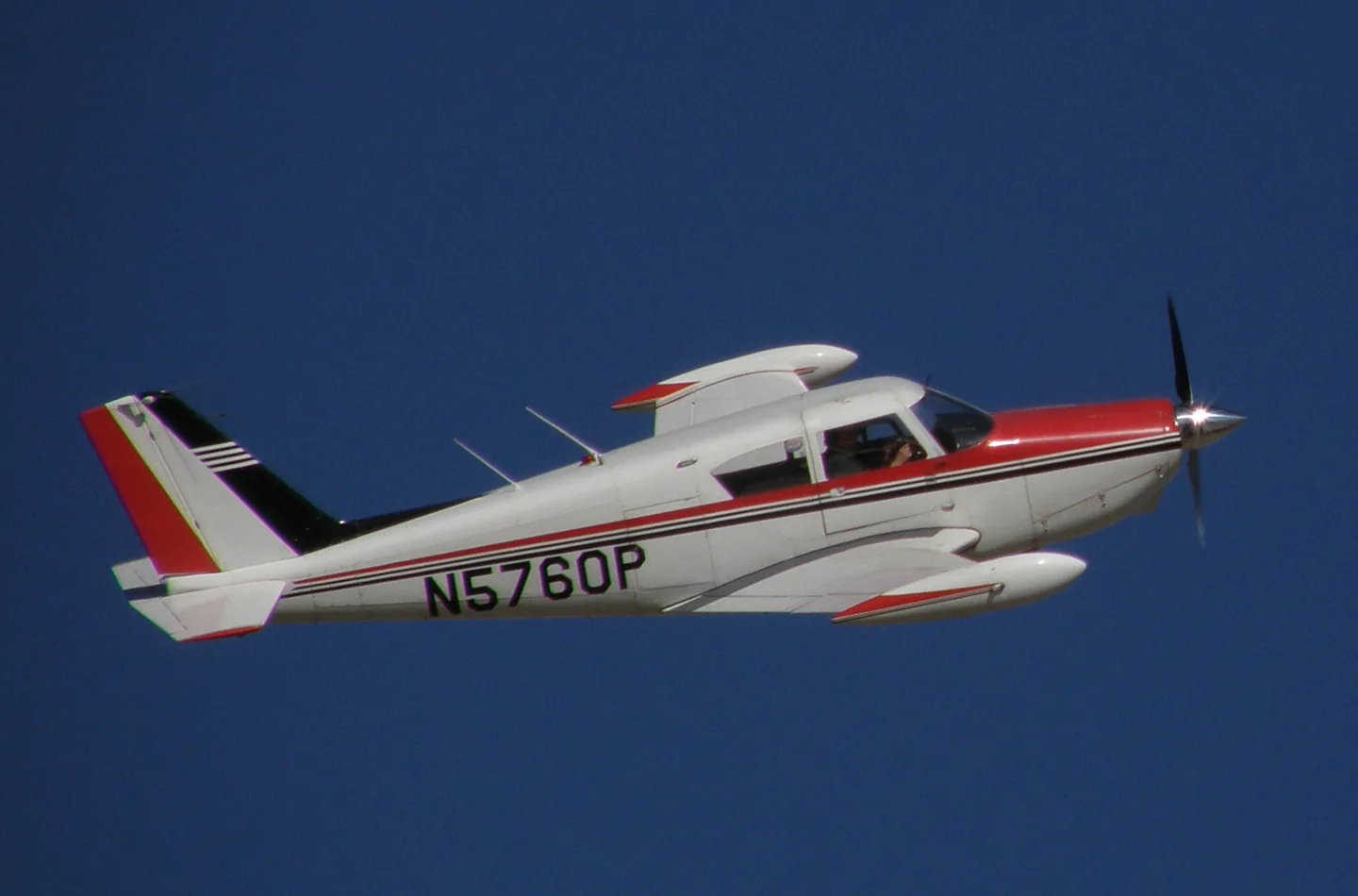 Alan Radecki Akradecki · CC BY-SA 4.0 · Piper PA-24 Comanche pictured
Piper's Comanche first flew in 1956 with an all-metal low-wing airframe, enclosed cabin and retractable tricycle gear. Later versions changed engine power and seating, alongside the separate Twin Comanche line.
Production ended after the 1972 flood at Piper's Lock Haven plant. A2A models a particular Comanche with persistent engine and airframe condition; its manual describes the loading, maintenance and mechanical systems included in the simulation.
Piper PA-24 Comanche · Specifications (PA-24-260C) · real aircraft; source units retained
First flight: May 24, 1956
The Comanche 250’s pitch control uses a stabilator: the horizontal tail moves as a unit instead of carrying a separate hinged elevator. Its anti-servo tab also provides longitudinal trim. A2A’s aircraft description pairs that arrangement with manually operated flaps and conventional yoke-and-pedal controls. This combination gives the cockpit several distinct mechanical controls, even before the separate engine and propeller levers are considered.
An electric motor and reduction mechanism beneath the floor move the three landing-gear units through push-pull cables. The nosewheel steering disconnects as the gear retracts, reducing the steering mechanism’s contribution to airborne rudder-pedal loads. The manual also describes a ground anti-retraction switch and separate indications for gear position. The selector operates the documented electrical and mechanical landing-gear system.
The list supplies trim-required lights and AP controls, and identifies the elevator trim handle with a standard SimVar requested in percent.
Unwin flew Mark Bonsall's refurbished 1963 Comanche 250 from Netherthorpe with instructor Nick Riddin. This particular aircraft had fuel injection and a three-blade propeller, so it was not an untouched factory example. With two aboard and partial fuel, it accelerated briskly from the grass strip. Unwin liked the harmonisation of the primary controls and their low initial resistance, although he found the older instrument and engine-control layout less intuitive than a modern cockpit. In airwork, his stalls gave clear warning and little inclination to drop a wing.
The landing and photo flights exposed different demands. He could feel the aircraft entering ground effect and thought excess approach speed would produce a long float; careful speed control rewarded him with successive satisfactory landings. Flying close formation for the photographer required more work, partly because the view from his chosen seat was restrictive. His overall appreciation was for a capable touring aircraft, with handling observations tied to the loading and modifications of the example he actually flew.
Wall's attachment to the Comanche began with a flying-club comparison in 1958. Interviewed by Bill Cox, he recalled flying a loaded Comanche 250 and a contemporary Bonanza between Burbank and Phoenix. He considered the Comanche the stronger performer in that particular comparison, while acknowledging the appeal of the Beechcraft's handling. Decades later, after a professional flying career, that experience helped draw him back to a 1958 Comanche of his own.
By the 2005 article, Wall had accumulated more than a thousand hours in the type and restored his aircraft extensively. He distinguished brochure claims from his experience: the advertised climb figure seemed optimistic to him, while maximum cruise was closer to what he observed. His usual choice was an economical high-altitude cruise rather than maximum speed. As an owner and mechanic, he also valued access for maintenance and familiarity with the systems he had rebuilt. These are the preferences and reported results of one experienced owner, rather than a controlled comparison of all Comanches and Bonanzas.
Looking back on his test-flying years, Kershner remembered the Comanche 400 as one of the aircraft that stood out. He identified the two final test aircraft and explained Pug Piper's interest in obtaining high-altitude performance without turbocharging. The extra power gave him an impression reminiscent of a fighter, but he also recalled substantial fuel consumption and troublesome hot starts during the flight-test period. His account concerns the eight-cylinder 400, a different proposition from the familiar 180 and 250.
One flight supplied the story's human detail. Over Lock Haven, he overtook a conventional Comanche and made further passes that prompted its pilot to ask what version he was flying. Kershner gave an evasive answer over the radio, then returned to a reprimand for drawing attention to an aircraft Piper had not yet announced. He also remembered watching the fuel indication move towards empty.
In the manual's developer notes, Gentile explains why A2A chose his own Comanche 250, N6229P, for its new Accu-Sim system. He had owned and operated the aeroplane for more than a decade. That familiarity gave the team continuing access to an aircraft they could examine and fly while investigating questions raised during development. His account describes the connection between an owner's long experience and the choice of a simulation subject.
Gentile's affection is equally explicit. He values the Comanche's combination of speed, load-carrying ability, cabin room and manageable handling, and says the aircraft has become part of the family. The appeal began with its appearance and deepened over years of operation. This is an enthusiastic owner's introduction, written by the developer selling the simulation, rather than an independent comparison flight.
Piper's Comanche first flew in 1956 with an all-metal low-wing airframe, enclosed cabin and retractable tricycle gear. Later versions changed engine power and seating, alongside the separate Twin Comanche line.
This profile selects A2A Comanche 250 for MSFS 2020, MSFS 2024.
The stabilator/anti-servo arrangement motivates reversible yoke loading. Spring resistance builds with the selected airspeed response. A separate aerodynamic term adds speed-dependent control load.
The anti-servo tab supplies pitch relief; ALT-mode trim lamps request manual action. Valid trim provides the configured pressure relief. Autopilot following is enabled for supported control references.
The Comanche’s manually controlled stabilator uses an anti-servo tab for longitudinal trim. A2A’s S-TEC30 altitude hold has an elevator servo and lamps requesting pilot trim, without automatic pitch trim. Native 2024 GPSS supplies lateral steering as a separate addition.
A2A’s native 2024 Comanche removes the earlier Elevator Force tablet input option and adds ST901 GPSS lateral guidance; S-TEC30 ALT still requests manual trimming.
The gains are normalized profile settings. They describe the chosen effect balance; hand force depends on the device and its output limits. IAS references are tuning values rather than operating limits. Physical acceptance of this revision remains pending.
施加于模型产出的一切、在设备上限之前的最终整体输出缩放。
调高: 一切(弹簧、载荷、效果)一同增强。
调低: 一切一同变柔。
设定理由: Scales overall profile strength while preserving effect balance, subject to device and output limits.
把摇杆拉回中央的基础回中力。其他所有力都叠加在它之上。太低,正常飞行中摇杆会发软;太高,它会与你的手较劲,并掩盖叠加其上的细微提示。
调高: 更硬的回中,更抗手。
调低: 更软的杆,只靠气动载荷。
设定理由: The stabilator/anti-servo arrangement motivates reversible yoke loading. The baseline spring is 0.74. Its low-speed blend reaches baseline strength at 75 KIAS.
Comanche Pilot ManualComanche variables listExact product and documentation researchNative Comanche中央附近弹簧保持安静的小中立区,让静止时的微小移动不会咔嗒作响。更宽更安稳但更松,更窄更精确但可能在中央附近抖动。
调高: 更安静但更松的中央,旷量更大。
调低: 更紧的中央,静止时可能抖动。
设定理由: Sets travel around the centre before the baseline spring resists. Smaller values engage it sooner.
作用于两条持续轴载荷的主缩放,在它们各自的独立平衡之前施加。配置文件通常不动它,而是调校两条轴载荷。
调高: 两轴载荷一同加重。
调低: 两轴一同减轻。
设定理由: The aerodynamic-load gain is 0.8 with an indicated-speed reference of 150 KIAS. This supplies speed-dependent loading alongside the spring.
启用低速弹簧介入窗口(上面的起始/全强度节数)。关闭时弹簧在所有速度下恒定。
设定理由: Allows baseline spring strength to rise with indicated airspeed where the control law permits it.
在静止、空速尚未产生气动力之前,弹簧还剩多少。下限高,停机时摇杆结实;下限低,则是停放轻型飞机那种钢索松弛的感觉。
调高: 停机和滑行时杆更结实。
调低: 停机时杆发软,只随速度苏醒。
设定理由: Sets low-speed spring strength as a fraction of baseline when blending is enabled. One keeps full strength.
弹簧从低速下限开始向全强度攀升的空速:起飞滑跑中操纵面"苏醒"的那一刻。
设定理由: Sets the IAS where the low-speed spring blend starts rising. This is a feel threshold, not a flight limit.
弹簧达到全强度的空速。从起点到这里,随着气流在操纵面上增强,回中逐渐变硬。
设定理由: Sets the IAS where the low-speed blend reaches baseline strength; high-speed stiffening also uses it.
气动载荷达到设计满值的指示空速。它把整条载荷曲线锚定在飞机真实的速度范围:172在110节就载满,喷气机要晚得多。
调高: 载荷来得更晚;杆轻到更高速度。
调低: 载荷来得更早,巡航更沉。
设定理由: Sets the IAS reference for aerodynamic loading. It is an estimate, not published cruise TAS or a flight limit.
在偏转载荷之外,回中本身随速度变硬的程度。零则中央手感恒定;越大,巡航时回中越硬,起落航线上越松。
调高: 中央随速度明显变硬。
调低: 任何速度下中央手感恒定。
设定理由: The high-speed spring-stiffening gain is 0.15. It strengthens the permitted spring response above 75 KIAS, with the squared-speed ratio capped at 5.
速度驱动的中央变硬上限,防止高速飞行把弹簧无限上紧。
调高: 高速允许更多总硬化。
调低: 硬化更早封顶。
设定理由: Limits the squared airspeed ratio used for high-speed spring stiffening; it is not a device-force cap.
由副翼偏转和空速产生的持续横滚载荷,独立于俯仰调校。与升降舵载荷一起,决定评测中常说的操纵协调比。
调高: 横滚力更重。
调低: 副翼更轻更灵。
设定理由: Roll and pitch aerodynamic scales are 0.72 and 1, respectively. They set the aerodynamic axis balance. No custom spring-travel curve is enabled.
由升降舵偏转和空速产生的持续俯仰载荷,独立于横滚调校。这是决定机型俯仰重量的主杠杆。它不影响副翼、弹簧、配平或抖振力。
调高: 速度下持续俯仰力更重。
调低: 升降舵更轻,握持更省力。
设定理由: Scales pitch aerodynamic loading; pitch spring travel and trim responses are separate settings.
每个稳态俯仰或横滚力到达设备前的上限,防止猛烈机动中砸击或饱和硬件。
调高: 削波前更高的稳态力峰值。
调低: 更柔的上限;猛烈机动更早被抹平。
设定理由: Caps directed-force output. Native spring effects and device limits remain separate.
升降舵配平缓解持续俯仰力、移动杆的安定位置的强度。在100 %时,配平得当的飞机不需要保持压力——正是真实飞行中"用配平消掉载荷"的流程。
调高: 配平消掉更多持续力;100 %时满配平可完全抵消。
调低: 即使配平也仍要持续用力。
设定理由: The anti-servo tab supplies pitch relief; ALT-mode trim lamps request manual action. Pitch authority 0.3 provides load relief and permitted centre movement; roll authority is 0.
Comanche Pilot ManualComanche variables listExact product and documentation researchNative Comanche横滚配平的同类缓解。多数通航机型没有真正的副翼配平,所以保持为零;有横滚配平的机型获得相应的值。
调高: 横滚配平消掉更多持续力。
调低: 横滚配平作用更小。
设定理由: Scales supported roll-trim relief and permitted centre movement. Zero removes roll response.
由轮速和地面类型(铺装、草地、砾石)产生的滚动振动。
调高: 杆上更强的地面质感。
调低: 更平滑的滑行。
设定理由: Sets rolling texture strength, modified by speed, surface and undercarriage configuration.
来自伸缩缝、车辙和粗糙地面的短促离散颠簸,为持续隆隆声打上标点。
调高: 接缝与车辙的冲击更清晰。
调低: 更柔的地面细节。
设定理由: Sets gear-bump texture during ground motion, separate from touchdown impact.
接近失速及失速警告响起时的机体抖动:这副机翼宣告不满的音量。断失干脆的机型抖振收敛,让喇叭承担警告。
调高: 更强的失速前颤抖。
调低: 更含蓄的机翼;警告交给喇叭。
设定理由: Sets stall-buffet strength. Zero removes the cue without changing simulator stalls or warnings.
接近马赫极限的跨音速抖振。对接近MMO的喷气机有意义,对到不了那里的活塞机和涡桨机为零。
调高: 接近马赫极限时更强的跨音速抖振。
调低: 高马赫下更平滑的飞行。
设定理由: Sets high-Mach buffet strength; onset and full-strength thresholds are separate.
襟翼伸入气流后机体的低频振动,发生在它们真正做功的速度窗口内。
调高: 襟翼做功时更粗糙的飞行。
调低: 更柔的进近襟翼。
设定理由: Sets flap buffet at the configured position and speed gates. Flap movement texture is separate.
可收放起落架悬在气流中引起的机体鼓振。固定起落架机型为零,它们的机体外形从不改变。
调高: 放起落架时更多鼓振。
调低: 放起落架飞行更干净。
设定理由: Sets gear aerodynamic buffet; movement and ground-contact cues are separate.
由飞机自身失速警告系统触发的专用抖杆器振动。只有真有抖杆器的机型才有值;其余全靠气动抖振和喇叭。
调高: 更硬的抖杆器。
调低: 更含蓄的抖杆器。
设定理由: Sets triggered shaker strength; inactive while the shaker feature is disabled.
机轮触及跑道那一下的单次冲击,按下沉率缩放:轻柔着陆是耳语,结实到达是一记闷响。
调高: 触地时更硬的一击。
调低: 更柔的到达。
设定理由: Sets landing-impact strength; landing telemetry and response shape determine the pulse.
反推或桨叶beta区工作时的滑跑振动。无反推机型为零。
调高: 反推下更粗糙的滑跑。
调低: 更含蓄的反推。
设定理由: Sets reverse-thrust vibration with valid reverser and engine conditions. Zero removes the cue.
从慢车到全功率跟随转速的持续动力装置振动——前方有东西在烧油的永恒提醒。
调高: 杆里更多发动机。
调低: 更含蓄的发动机。
设定理由: Sets estimated engine vibration using configured telemetry and response, not measured cockpit vibration.
仅在模拟器报告襟翼舵面确实移动时的持续振动。它跟随真实作动器的运动和故障,而非估算的计时器。
调高: 襟翼移动中更多振动。
调低: 更含蓄的襟翼行程。
设定理由: Sets texture from observed flap movement; a command without movement does not establish the cue.
自动驾驶指令可以让杆实际移动多远。在MSFS中保持极小,因为移动的轴可能被读回为飞行员输入;零则完全禁用跟随。
调高: 自动驾驶让你的杆移动得明显更多。
调低: 几乎察觉不到的跟随。
设定理由: Sets admitted AP-follow gain, not a percentage of travel. Runtime ownership and input limits still apply.
Whether this feature is active in this profile.
设定理由: Retained for compatibility and group membership. Trim relief, rather than this flag, controls centre movement.
Whether this feature is active in this profile.
设定理由: Allows trim relief with supported control law and valid telemetry. Axis authorities set its amount.
Whether this feature is active in this profile.
设定理由: Enables local force trim, separate from aircraft-owned trim and add-on integration qualification.
Whether this feature is active in this profile.
设定理由: Allows load-factor changes to modify permitted spring laws. Passive fly-by-wire feel can suppress it.
Whether this feature is active in this profile.
设定理由: Enables rate damping with the configured coefficients and control law.
Whether this feature is active in this profile.
设定理由: Following is on at 1 authority when a supported, valid autopilot control reference is available.
Whether this feature is active in this profile.
设定理由: Permits centering hold during a supported AP state, separate from following a moving target.
设定理由: Sets admitted AP neutral-hold strength; inactive while neutral hold is disabled.
Whether this feature is active in this profile.
设定理由: Enables aerodynamic cues; each still needs nonzero strength and its simulator conditions.
Where this effect reaches full strength (or has fully faded, for washouts).
调高: a more gradual build to a later peak.
调低: a quicker build.
设定理由: Sets the final flap index for detent normalization. UP plus three detents uses maximum index3.
Where this effect begins fading in.
调高: the effect begins later.
调低: it begins earlier.
设定理由: Sets the first flap detent that admits buffet; this is a handle index, not degrees.
Whether this feature is active in this profile.
设定理由: Permits shaker at supported warning conditions; the switch does not establish aircraft equipment.
Whether this feature is active in this profile.
设定理由: Enables ground effects; each still needs its own strength and contact or motion telemetry.
Whether this feature is active in this profile.
设定理由: Enables engine cues with nonzero settings and valid running-engine telemetry.
Whether this feature is active in this profile.
设定理由: Enables accessory cues with configured strengths and observed accessory movement.
The strength of this effect.
调高: a stronger effect.
调低: a weaker one.
设定理由: Sets texture from observed gear movement, separate from aerodynamic and touchdown effects.
| 参数 | 数值 | 控制作用及原因 |
|---|---|---|
| Spring strength | 0.74 | The stabilator/anti-servo arrangement motivates reversible yoke loading. The baseline spring is 0.74. Its low-speed blend reaches baseline strength at 75 KIAS. |
| Spring deadband | 0.045 | Sets travel around the centre before the baseline spring resists. Smaller values engage it sooner. |
| Force gain | 0.8 | The aerodynamic-load gain is 0.8 with an indicated-speed reference of 150 KIAS. This supplies speed-dependent loading alongside the spring. |
| Master gain | 0.85 | Scales overall profile strength while preserving effect balance, subject to device and output limits. |
| Dynamic-pressure blend | True | Allows baseline spring strength to rise with indicated airspeed where the control law permits it. |
| Minimum spring factor | 0.5 | Sets low-speed spring strength as a fraction of baseline when blending is enabled. One keeps full strength. |
| Spring wake-up speed | 20 kt | Sets the IAS where the low-speed spring blend starts rising. This is a feel threshold, not a flight limit. |
| Spring full-strength speed | 75.0 kt | Sets the IAS where the low-speed blend reaches baseline strength; high-speed stiffening also uses it. |
| 力反馈调校速度 | 150.0 kt | Sets the IAS reference for aerodynamic loading. It is an estimate, not published cruise TAS or a flight limit. |
| Airspeed spring stiffening | 0.15 | The high-speed spring-stiffening gain is 0.15. It strengthens the permitted spring response above 75 KIAS, with the squared-speed ratio capped at 5. |
| Airspeed stiffening cap | 5 | Limits the squared airspeed ratio used for high-speed spring stiffening; it is not a device-force cap. |
| Aileron force scale | 0.72 | Roll and pitch aerodynamic scales are 0.72 and 1, respectively. They set the aerodynamic axis balance. No custom spring-travel curve is enabled. |
| Elevator force scale | 1.0 | Scales pitch aerodynamic loading; pitch spring travel and trim responses are separate settings. |
| Maximum output force | 0.55 | Caps directed-force output. Native spring effects and device limits remain separate. |
| StickFeel · Trim feel enabled | True | Retained for compatibility and group membership. Trim relief, rather than this flag, controls centre movement. |
| StickFeel · Trim relief enabled | True | Allows trim relief with supported control law and valid telemetry. Axis authorities set its amount. |
| StickFeel · Elevator authority | 0.3 | The anti-servo tab supplies pitch relief; ALT-mode trim lamps request manual action. Pitch authority 0.3 provides load relief and permitted centre movement; roll authority is 0. |
| StickFeel · Aileron authority | 0 | Scales supported roll-trim relief and permitted centre movement. Zero removes roll response. |
| StickFeel · Force trim enabled | False | Enables local force trim, separate from aircraft-owned trim and add-on integration qualification. |
| StickFeel · G load enabled | True | Allows load-factor changes to modify permitted spring laws. Passive fly-by-wire feel can suppress it. |
| StickFeel · Rate damping enabled | True | Enables rate damping with the configured coefficients and control law. |
| Autopilot · Follow enabled | True | Following is on at 1 authority when a supported, valid autopilot control reference is available. |
| Autopilot · Follow authority | 1.0 | Sets admitted AP-follow gain, not a percentage of travel. Runtime ownership and input limits still apply. |
| Autopilot · Neutral hold enabled | False | Permits centering hold during a supported AP state, separate from following a moving target. |
| Autopilot · Neutral hold strength | 0.6 | Sets admitted AP neutral-hold strength; inactive while neutral hold is disabled. |
| Aero · Enabled | True | Enables aerodynamic cues; each still needs nonzero strength and its simulator conditions. |
| Aero · Gain | 0.35 | Sets stall-buffet strength. Zero removes the cue without changing simulator stalls or warnings. |
| Aero · Gain | 0 | Sets high-Mach buffet strength; onset and full-strength thresholds are separate. |
| Aero · Gain | 0.14 | Sets flap buffet at the configured position and speed gates. Flap movement texture is separate. |
| Aero · Max flap index | 3 | Sets the final flap index for detent normalization. UP plus three detents uses maximum index3. |
| Aero · Min flap index | 2 | Sets the first flap detent that admits buffet; this is a handle index, not degrees. |
| Aero · Gain | 0.1 | Sets gear aerodynamic buffet; movement and ground-contact cues are separate. |
| Aero · Shaker enabled | False | Permits shaker at supported warning conditions; the switch does not establish aircraft equipment. |
| Aero · Amplitude | 0.5 | Sets triggered shaker strength; inactive while the shaker feature is disabled. |
| Ground · Enabled | True | Enables ground effects; each still needs its own strength and contact or motion telemetry. |
| Ground · Gain | 0.4 | Sets rolling texture strength, modified by speed, surface and undercarriage configuration. |
| Ground · Gain | 0.25 | Sets gear-bump texture during ground motion, separate from touchdown impact. |
| Ground · Gain | 0.65 | Sets landing-impact strength; landing telemetry and response shape determine the pulse. |
| Ground · Gain | 0 | Sets reverse-thrust vibration with valid reverser and engine conditions. Zero removes the cue. |
| Engine · Enabled | True | Enables engine cues with nonzero settings and valid running-engine telemetry. |
| Engine · Gain | 0.12 | Sets estimated engine vibration using configured telemetry and response, not measured cockpit vibration. |
| Mechanical · Enabled | True | Enables accessory cues with configured strengths and observed accessory movement. |
| Mechanical · Gain | 0.12 | Sets texture from observed flap movement; a command without movement does not establish the cue. |
| Mechanical · Gain | 0.12 | Sets texture from observed gear movement, separate from aerodynamic and touchdown effects. |
如果你的真机经验表明本页有误,请在此指正。
本页基于引用资料构建,而真机经验胜过任何引用。 请引用有误的主张,并告诉我们真机的实际表现。纠错 将交由维护者审核,并纳入本研究的下一次修订。