Development milestones
First flight: February 9, 1963 ( 1963-02-09 )
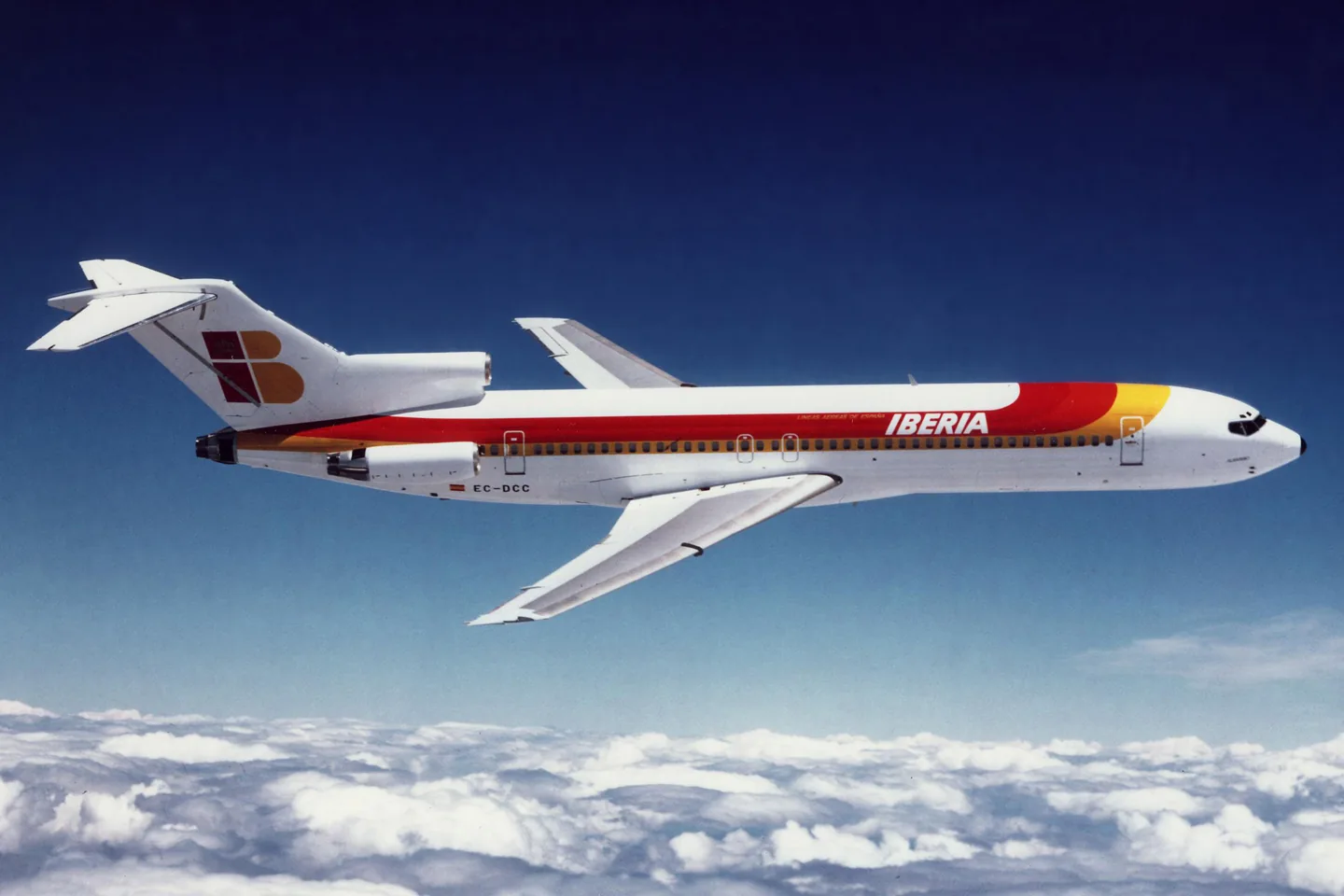 Iberia Airlines · CC BY 2.0 · Boeing 727 pictured
Boeing developed the 727 after the 707, arranging three engines around the rear fuselage and a high T-tail. The first flight took place in 1963, with service following in 1964. Its elaborate high-lift wing supported the programme's airport-access ambitions.
The -100 and longer -200 have different proportions, while freighter conversions add another role. In the cockpit, a flight engineer and period autopilot installations create a very different workflow from a modern 737. The simulator manuals identify the installed flight-guidance systems.
Boeing 727 · Specifications (Boeing 727-100 with JT8D-7) · real aircraft; source units retained
First flight: February 9, 1963 ( 1963-02-09 )
Armstrong remembers the 727 through the varied people and places that filled its charter schedule. Her flying included sports teams, professional wrestlers, firefighters and unusual destinations where the aircraft’s independence from extensive ground services was useful. Having worked in all three cockpit positions, she valued the flight engineer’s seat as a place to learn the aircraft and observe how a crew worked together.
The physical setting is just as vivid in her recollection: noisy engines, a trim wheel close to her knee and, on one aircraft with defective heating ducts, winter coats and hot coffee in a very cold cockpit. Simulator sessions explored failures that were uncomfortable to practise but valuable to understand. She remembers the aircraft as demanding familiarity and respect, then rewarding that effort with an unusually direct connection between pilot and machine.
Powell volunteered for the first 727’s final delivery because he still flew the type regularly and had accumulated more than ten thousand hours in it. His connection went back to eight years as a Western Airlines flight engineer, after which returning to a forward-facing pilot’s seat had been a particular pleasure. Above all, he enjoyed the aircraft’s hand-flying qualities.
For the planned flight to Seattle’s Museum of Flight, he expected to work with colleagues he already knew well and wanted an additional observer watching from the jump seat. He trusted the restoration team’s preparation and described the prospect as bittersweet. Even his intended clothes carried a connection to the past: a flight jacket, white shirt and tie would echo first-flight pilot Lew Wallick. His aim for the occasion was a straightforward, careful delivery of an aircraft that had already done its work.
Tarsa’s first 727 flight came at thirteen, when his father bought him a short sightseeing trip from Chicago Midway. The acceleration, the view of the lakeshore and the realisation that only air supported the aircraft made him want to become a pilot. Decades later, starting with UPS as a 727 second officer, he saw the Chicago skyline again and remembered that first ride with his father.
His last flight on the type brought another sequence of personal landmarks. Ferrying an aircraft back from Europe in November 2003, he landed in Iceland and shared the Atlantic crossing duties with his first officer. On the final leg from Bangor to Louisville, the landscape below recalled his childhood home, meeting his wife and her family’s hometown. As he approached Louisville, he could see his own neighbourhood. His farewell to the aircraft became a quiet expression of gratitude to his father.
Boeing developed the 727 after the 707, arranging three engines around the rear fuselage and a high T-tail. The first flight took place in 1963, with service following in 1964. Its elaborate high-lift wing supported the programme's airport-access ambitions.
This profile selects FlightSim Studio 727-200 Passenger for MSFS 2020, MSFS 2024.
The spring stays independent of airspeed. A separate aerodynamic term adds speed-dependent control load.
Pitch-trim relief is off. Autopilot following is off.
FlightSim Studio documents powered elevators and ailerons, with elevator feel depending on dynamic pressure and stabilizer position. Aileron trim moves the wheels; its specific pitch-neutral effect is associated with a limited trim-unit range rather than a universal linear offset. Classic SP-150 and Super27 APS85/EFIS installations have different scope, and the Super27-100's advertised guidance must not inherit the Super27-200's interface.
FlightSim Studio separates -200 passenger/freighter, -100 and Super27 products. Powered-control documentation does not supply a calibrated external yoke target.
The gains are normalized profile settings. They describe the chosen effect balance; hand force depends on the device and its output limits. IAS references are tuning values rather than operating limits. Physical acceptance of this revision remains pending.
モデルが生み出すすべてに適用される最終的な全体出力スケール。デバイス上限の前に適用されます。
上げると: すべて(バネ、荷重、効果)が一緒に強まります。
下げると: すべてが一緒に和らぎます。
この値の理由: Scales overall profile strength while preserving effect balance, subject to device and output limits.
スティックを中央へ引き戻す基本のセンタリング力。他のすべての力はこの上に積み重なります。低すぎると通常飛行でスティックが頼りなく、高すぎると手に逆らい、上に重なる細かな手がかりを覆い隠します。
上げると: 手により強く抵抗する、固いセンタリング。
下げると: 空力荷重だけに頼る、柔らかいスティック。
この値の理由: The selected spring approximates artificial feel for powered controls, without treating direct surface loading as a mechanical return path. The baseline spring is 0.8. Low-speed spring blending is off.
727 flight control systems727-100 package variants and simulator scopeSuper27 autopilot中央付近でバネが沈黙する小さなニュートラルゾーン。静止時の微小な動きがガタつかないようにします。広いほど落ち着きますが緩くなり、狭いほど精密ですが中央で震えることがあります。
上げると: より静かだが緩い、遊びの多い中央。
下げると: 静止時に震えうる、締まった中央。
この値の理由: Sets travel around the centre before the baseline spring resists. Smaller values engage it sooner.
両軸の持続荷重にかかるマスタースケールで、各軸の独立バランスの前に適用されます。プロファイルは通常これに触れず、二つの軸荷重を調整します。
上げると: 両軸がより強く荷重します。
下げると: 両軸が一緒に軽くなります。
この値の理由: The aerodynamic-load gain is 0.25 with an indicated-speed reference of 250 KIAS. The hydraulic-load factor of 0.45 scales that modeled term; it is a selected artificial-feel approximation.
低速のバネ立ち上げ窓(上記の開始/全強度ノット)を有効にします。オフではバネは全速度で一定です。
この値の理由: Allows baseline spring strength to rise with indicated airspeed where the control law permits it.
停止状態で、速度が空力を生む前にバネがどれだけ残るか。床が高いと駐機中のスティックはしっかりし、低いと駐機した軽飛行機のケーブルが緩んだような感触になります。
上げると: 駐機・タキシー時により固いスティック。
下げると: 速度でしか目覚めない、駐機時の柔らかいスティック。
この値の理由: Sets low-speed spring strength as a fraction of baseline when blending is enabled. One keeps full strength.
バネが低速の床から全強度へ立ち上がり始める速度。離陸滑走で操縦系統が「目を覚ます」ポイントです。
この値の理由: Sets the IAS where the low-speed spring blend starts rising. This is a feel threshold, not a flight limit.
バネが全強度に達する速度。開始点からここまでの間、舵面上の気流が増すにつれセンタリングは徐々に固まります。
この値の理由: Sets the IAS where the low-speed blend reaches baseline strength; high-speed stiffening also uses it.
空力荷重が設計上の満量に達する指示対気速度。荷重カーブ全体を機体の実際の速度域に固定します。172は110ノットで荷重が乗り、ジェットはずっと後です。
上げると: 荷重の到来が遅くなり、より速くまでスティックが軽いまま。
下げると: 荷重が早く到来し、巡航がより重く。
この値の理由: Sets the IAS reference for aerodynamic loading. It is an estimate, not published cruise TAS or a flight limit.
舵角荷重に加えて、センタリング自体が速度でどれだけ固くなるか。ゼロなら中央の感触は一定、大きくすると巡航で固く、場周で緩くなります。
上げると: 速度とともに明確に固くなる中央。
下げると: どの速度でも一定の中央感覚。
この値の理由: The high-speed spring-stiffening gain is 0. No additional speed-driven stiffening is added; this does not disable independent aerodynamic loading.
速度によるセンター硬化の上限。超高速飛行でバネが際限なく巻き上がるのを防ぎます。
上げると: 高速でより多くの総硬化を許容。
下げると: 硬化がより早く頭打ちに。
この値の理由: Limits the squared airspeed ratio used for high-speed spring stiffening; it is not a device-force cap.
エルロン舵角と速度による持続的なロール荷重で、ピッチとは独立に調整されます。エレベーター荷重と合わせて、レビューで語られる操縦調和の比率を決めます。
上げると: より重いロール力。
下げると: より軽く機敏なエルロン。
この値の理由: Roll and pitch aerodynamic scales are 0.7 and 0.86, respectively. They set the aerodynamic axis balance. No custom spring-travel curve is enabled.
エレベーター舵角と速度による持続的なピッチ荷重で、ロールとは独立に調整されます。機種ごとのピッチの重さを決める主レバーです。エルロン、バネ、トリム、バフェットの力には触れません。
上げると: 速度での持続ピッチ力がより重く。
下げると: 保持する力の軽い、より軽やかなエレベーター。
この値の理由: Scales pitch aerodynamic loading; pitch spring travel and trim responses are separate settings.
各定常ピッチ・ロール力がデバイスへ届く前の上限。強い機動でハードウェアを叩いたり飽和させたりしないための保護です。
上げると: クリップ前の定常力ピークがより高く。
下げると: より柔らかい天井。激しい機動が早く平らに。
この値の理由: Caps directed-force output. Native spring effects and device limits remain separate.
エレベータートリムが保持ピッチ力をどれだけ和らげ、スティックの落ち着き位置をずらすか。100 %では正しくトリムされた機体は保持圧が不要になり、実機の「荷重をトリムで消す」手順そのものです。
上げると: トリムがより多くの保持力を除去。100 %ではフルトリムで打ち消し。
下げると: トリムしても力を保持し続けます。
この値の理由: A centre response remains an approximation: the documented pitch-neutral effect is limited to a stated stabilizer-trim range, not every trim position. Pitch relief is off, with stored authority 0; roll authority is 0.14.
727 flight control systems727-100 package variants and simulator scopeSuper27 autopilotロールトリムの同じ軽減。多くのGA機には本物のエルロントリムがないためゼロのまま。ロールトリムを持つ機種には相応の値が入ります。
上げると: ロールトリムがより多くの保持力を除去。
下げると: ロールトリムの効きが弱く。
この値の理由: Scales supported roll-trim relief and permitted centre movement. Zero removes roll response.
車輪速度と路面種別(舗装、草、砂利)による転がりの振動。
上げると: スティックの路面テクスチャがより強く。
下げると: より滑らかなタキシー。
この値の理由: Sets rolling texture strength, modified by speed, surface and undercarriage configuration.
伸縮継ぎ目や轍、荒れた路面からの短い個別の衝撃で、連続的なゴロゴロに句読点を打ちます。
上げると: 継ぎ目と轍の衝撃がより鋭く。
下げると: より柔らかな地面のディテール。
この値の理由: Sets gear-bump texture during ground motion, separate from touchdown impact.
失速接近時と失速警報作動中の機体の震え。この翼が不満をどれだけ大声で告げるかです。切れ味よく落ちる機種は控えめなバフェットになり、警報音に警告を任せます。
上げると: より強い失速前の震え。
下げると: より控えめな翼。警報音が警告を担います。
この値の理由: Sets stall-buffet strength. Zero removes the cue without changing simulator stalls or warnings.
マッハ限界接近時の遷音速バフェット。MMO付近のジェットには意味があり、そこへ到達しないレシプロやターボプロップではゼロです。
上げると: マッハ限界近くのより強い遷音速バフェット。
下げると: 高マッハでより滑らかな飛行。
この値の理由: Sets high-Mach buffet strength; onset and full-strength thresholds are separate.
フラップが実際に空気を掴む速度窓で、気流に展開されたフラップによる機体の低周波振動。
上げると: フラップ作動中のより荒い飛行。
下げると: より柔らかな進入フラップ。
この値の理由: Sets flap buffet at the configured position and speed gates. Flap movement texture is separate.
気流中に垂れた引込脚による機体のドラミング。機体形状が変わらない固定脚の機種ではゼロです。
上げると: 脚下げ時のドラミングが増加。
下げると: 脚下げ飛行がより綺麗に。
この値の理由: Sets gear aerodynamic buffet; movement and ground-contact cues are separate.
機体自身の失速警報システムが発火させる専用のスティックシェーカーの振動。本物のシェーカーを持つ機種だけに値が入り、他はすべて空力バフェットと警報音に頼ります。
上げると: より固いシェーカー。
下げると: より控えめなシェーカー。
この値の理由: Sets triggered shaker strength; inactive while the shaker feature is disabled.
車輪が滑走路に触れる瞬間の単発のキック。沈下率でスケールされ、グリーサーはささやき、固い接地はドンと響きます。
上げると: 接地のより固い衝撃。
下げると: より柔らかな到着。
この値の理由: Sets landing-impact strength; landing telemetry and response shape determine the pulse.
逆推力やベータ域のプロペラが働いている間の滑走振動。リバースのない機種ではゼロです。
上げると: リバース中のより荒い滑走。
下げると: より控えめなリバース。
この値の理由: Sets reverse-thrust vibration with valid reverser and engine conditions. Zero removes the cue.
アイドルから全出力まで回転数に従う連続的な動力装置の振動。前方で何かが燃料を燃やしている、常に存在する注意喚起です。
上げると: スティックのエンジンが増加。
下げると: より控えめなエンジン。
この値の理由: Sets estimated engine vibration using configured telemetry and response, not measured cockpit vibration.
シミュレーターがフラップ舵面の実際の移動を報告している間だけの連続振動。推定タイマーではなく、実際のアクチュエーター動作と故障に従います。
上げると: フラップ移動中の振動が増加。
下げると: より控えめなフラップ走行。
この値の理由: Sets texture from observed flap movement; a command without movement does not establish the cue.
オートパイロットの指令がスティックを物理的にどこまで動かせるか。動いた軸がパイロット入力として読み返されうるMSFSでは極小に保ちます。ゼロで追従は完全に無効です。
上げると: オートパイロットがスティックを目に見えて多く動かします。
下げると: ほぼ気づかない追従。
この値の理由: Sets admitted AP-follow gain, not a percentage of travel. Runtime ownership and input limits still apply.
Whether this feature is active in this profile.
この値の理由: Retained for compatibility and group membership. Trim relief, rather than this flag, controls centre movement.
Whether this feature is active in this profile.
この値の理由: Allows trim relief with supported control law and valid telemetry. Axis authorities set its amount.
Whether this feature is active in this profile.
この値の理由: Enables local force trim, separate from aircraft-owned trim and add-on integration qualification.
Whether this feature is active in this profile.
この値の理由: Allows load-factor changes to modify permitted spring laws. Passive fly-by-wire feel can suppress it.
Whether this feature is active in this profile.
この値の理由: Enables rate damping with the configured coefficients and control law.
Whether this feature is active in this profile.
この値の理由: Autopilot following is off; the configured spring and load retain the hardware feel.
Whether this feature is active in this profile.
この値の理由: Permits centering hold during a supported AP state, separate from following a moving target.
この値の理由: Sets admitted AP neutral-hold strength; inactive while neutral hold is disabled.
Whether this feature is active in this profile.
この値の理由: Enables aerodynamic cues; each still needs nonzero strength and its simulator conditions.
Where this effect reaches full strength (or has fully faded, for washouts).
上げると: a more gradual build to a later peak.
下げると: a quicker build.
この値の理由: Sets the final flap index for detent normalization. UP plus three detents uses maximum index3.
Where this effect begins fading in.
上げると: the effect begins later.
下げると: it begins earlier.
この値の理由: Sets the first flap detent that admits buffet; this is a handle index, not degrees.
Whether this feature is active in this profile.
この値の理由: Permits shaker at supported warning conditions; the switch does not establish aircraft equipment.
Whether this feature is active in this profile.
この値の理由: Enables ground effects; each still needs its own strength and contact or motion telemetry.
Whether this feature is active in this profile.
この値の理由: Enables engine cues with nonzero settings and valid running-engine telemetry.
Whether this feature is active in this profile.
この値の理由: Enables accessory cues with configured strengths and observed accessory movement.
The strength of this effect.
上げると: a stronger effect.
下げると: a weaker one.
この値の理由: Sets texture from observed gear movement, separate from aerodynamic and touchdown effects.
| パラメーター | 値 | 何を制御するのかとその理由 |
|---|---|---|
| Spring strength | 0.8 | The selected spring approximates artificial feel for powered controls, without treating direct surface loading as a mechanical return path. The baseline spring is 0.8. Low-speed spring blending is off. |
| Spring deadband | 0.04 | Sets travel around the centre before the baseline spring resists. Smaller values engage it sooner. |
| Force gain | 0.25 | The aerodynamic-load gain is 0.25 with an indicated-speed reference of 250 KIAS. The hydraulic-load factor of 0.45 scales that modeled term; it is a selected artificial-feel approximation. |
| Master gain | 0.85 | Scales overall profile strength while preserving effect balance, subject to device and output limits. |
| Dynamic-pressure blend | False | Allows baseline spring strength to rise with indicated airspeed where the control law permits it. |
| Minimum spring factor | 0.55 | Sets low-speed spring strength as a fraction of baseline when blending is enabled. One keeps full strength. |
| Spring wake-up speed | 20 kt | Sets the IAS where the low-speed spring blend starts rising. This is a feel threshold, not a flight limit. |
| Spring full-strength speed | 70 kt | Sets the IAS where the low-speed blend reaches baseline strength; high-speed stiffening also uses it. |
| フォース調整速度 | 250 kt | Sets the IAS reference for aerodynamic loading. It is an estimate, not published cruise TAS or a flight limit. |
| Airspeed spring stiffening | 0 | The high-speed spring-stiffening gain is 0. No additional speed-driven stiffening is added; this does not disable independent aerodynamic loading. |
| Airspeed stiffening cap | 5 | Limits the squared airspeed ratio used for high-speed spring stiffening; it is not a device-force cap. |
| Aileron force scale | 0.7 | Roll and pitch aerodynamic scales are 0.7 and 0.86, respectively. They set the aerodynamic axis balance. No custom spring-travel curve is enabled. |
| Elevator force scale | 0.86 | Scales pitch aerodynamic loading; pitch spring travel and trim responses are separate settings. |
| Maximum output force | 0.55 | Caps directed-force output. Native spring effects and device limits remain separate. |
| StickFeel · Trim feel enabled | False | Retained for compatibility and group membership. Trim relief, rather than this flag, controls centre movement. |
| StickFeel · Trim relief enabled | True | Allows trim relief with supported control law and valid telemetry. Axis authorities set its amount. |
| StickFeel · Elevator authority | 0 | A centre response remains an approximation: the documented pitch-neutral effect is limited to a stated stabilizer-trim range, not every trim position. Pitch relief is off, with stored authority 0; roll authority is 0.14. |
| StickFeel · Aileron authority | 0.14 | Scales supported roll-trim relief and permitted centre movement. Zero removes roll response. |
| StickFeel · Force trim enabled | False | Enables local force trim, separate from aircraft-owned trim and add-on integration qualification. |
| StickFeel · G load enabled | True | Allows load-factor changes to modify permitted spring laws. Passive fly-by-wire feel can suppress it. |
| StickFeel · Rate damping enabled | True | Enables rate damping with the configured coefficients and control law. |
| Autopilot · Follow enabled | False | Autopilot following is off; the configured spring and load retain the hardware feel. |
| Autopilot · Follow authority | 0.1 | Sets admitted AP-follow gain, not a percentage of travel. Runtime ownership and input limits still apply. |
| Autopilot · Neutral hold enabled | False | Permits centering hold during a supported AP state, separate from following a moving target. |
| Autopilot · Neutral hold strength | 0.6 | Sets admitted AP neutral-hold strength; inactive while neutral hold is disabled. |
| Aero · Enabled | True | Enables aerodynamic cues; each still needs nonzero strength and its simulator conditions. |
| Aero · Gain | 0.3 | Sets stall-buffet strength. Zero removes the cue without changing simulator stalls or warnings. |
| Aero · Gain | 0 | Sets high-Mach buffet strength; onset and full-strength thresholds are separate. |
| Aero · Gain | 0 | Sets flap buffet at the configured position and speed gates. Flap movement texture is separate. |
| Aero · Max flap index | 6 | Sets the final flap index for detent normalization. UP plus three detents uses maximum index3. |
| Aero · Min flap index | 2 | Sets the first flap detent that admits buffet; this is a handle index, not degrees. |
| Aero · Gain | 0 | Sets gear aerodynamic buffet; movement and ground-contact cues are separate. |
| Aero · Shaker enabled | False | Permits shaker at supported warning conditions; the switch does not establish aircraft equipment. |
| Aero · Amplitude | 0.9 | Sets triggered shaker strength; inactive while the shaker feature is disabled. |
| Ground · Enabled | True | Enables ground effects; each still needs its own strength and contact or motion telemetry. |
| Ground · Gain | 0.4 | Sets rolling texture strength, modified by speed, surface and undercarriage configuration. |
| Ground · Gain | 0.32 | Sets gear-bump texture during ground motion, separate from touchdown impact. |
| Ground · Gain | 0.9 | Sets landing-impact strength; landing telemetry and response shape determine the pulse. |
| Ground · Gain | 0 | Sets reverse-thrust vibration with valid reverser and engine conditions. Zero removes the cue. |
| Engine · Enabled | True | Enables engine cues with nonzero settings and valid running-engine telemetry. |
| Engine · Gain | 0.06 | Sets estimated engine vibration using configured telemetry and response, not measured cockpit vibration. |
| Mechanical · Enabled | True | Enables accessory cues with configured strengths and observed accessory movement. |
| Mechanical · Gain | 0.12 | Sets texture from observed flap movement; a command without movement does not establish the cue. |
| Mechanical · Gain | 0.12 | Sets texture from observed gear movement, separate from aerodynamic and touchdown effects. |
実機経験からこのページに誤りがあると思ったら、ここで訂正してください。
このページは引用文献に基づいていますが、実機での経験は引用に勝ります。 誤っている主張を引用し、実機が実際にどうかを教えてください。訂正は メンテナーが確認し、この調査の次の改訂に反映されます。
Boeing 727の操縦や調整についてのオープンな会話です(コミュニティフォーラム)。上の訂正はメンテナーに非公開で届きます。ハンガートークは公開です。