Development milestones
First flight: 1990
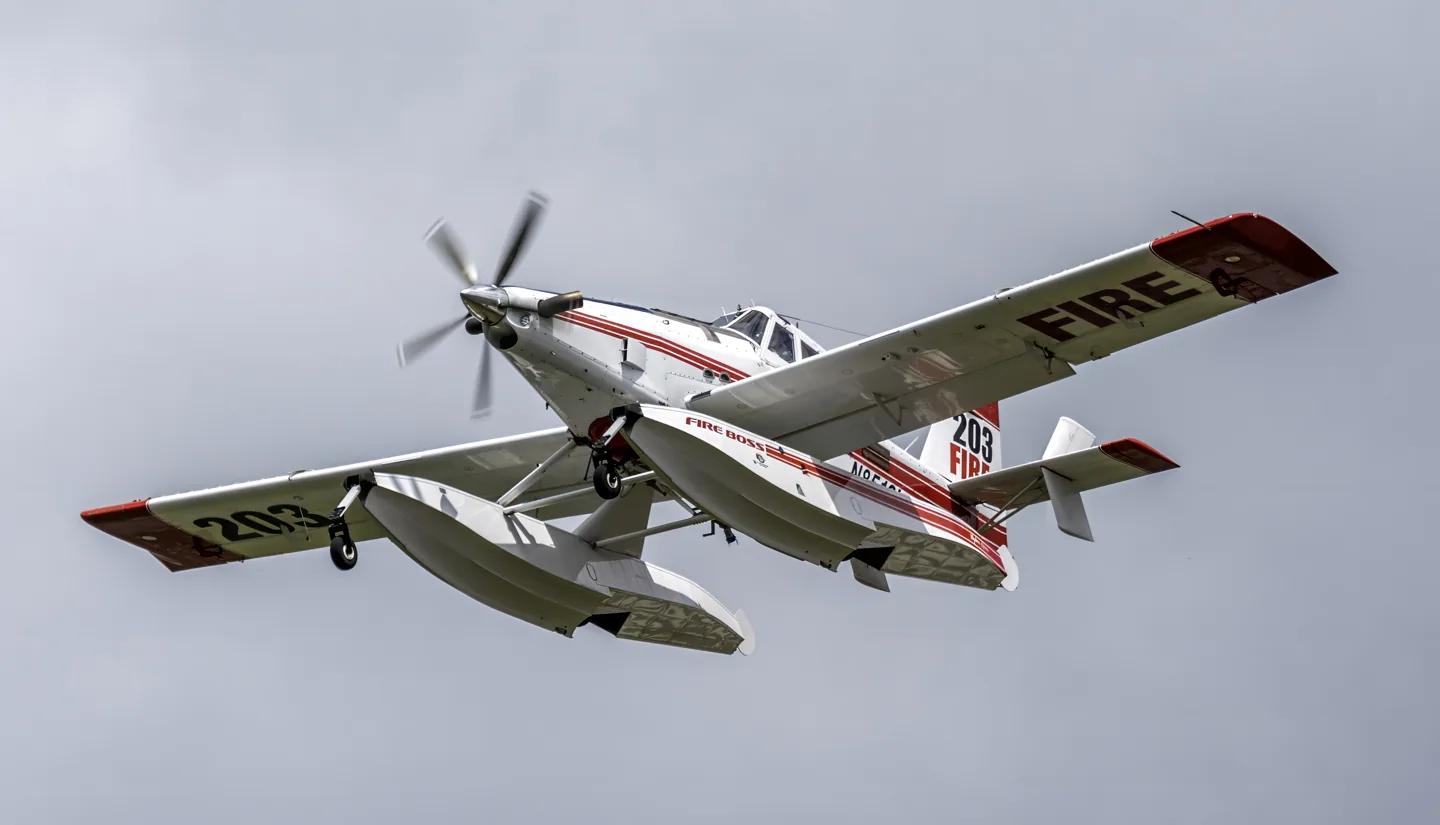 Acroterion · CC BY-SA 4.0 · Air Tractor AT-802 Fire Boss on floats.
The AT-802 carries its working load in a hopper ahead of the cockpit. Its low wing, large turboprop and elevated pilot position reflect its agricultural origins. The same basic platform has been adapted for firefighting and other specialist work.
An agricultural aircraft and an amphibious Fire Boss are distinct configurations. Floats, water collection and delivery equipment change the role as well as the appearance. The simulator products identify their agricultural or firefighting mission equipment.
Air Tractor AT-802 · Specifications (AT-802) · real aircraft; source units retained
En savoir plus sur cet aéronef sur AirframeDB
First flight: 1990
McSpadden joined Dauntless Air's annual training at Cleburne, Texas, flying with chief pilot Jesse Weaver in a Fire Boss. He found the aircraft's ordinary handling approachable, despite its size and large floats, and admired how Weaver used bank, flap and careful energy management to position it smoothly. A simulated attack on an island in Lake Whitney demonstrated the coordination between aircraft making successive drops.
His own attempt to collect water brought a different experience. Concerned about engine limits, he added too little power while the hopper filled. The aircraft began to oscillate, and his control inputs did not settle it. Weaver directed him to dump the water and accelerate away. McSpadden describes the relief as the load disappeared and the aircraft lifted off. The exercise made the distinction between basic floatplane handling and a well-executed scoop tangible; Weaver explained that even experienced seaplane pilots needed dedicated practice.
Young connects his earlier A-10 service with his work flying Air Spray's AT-802F Fire Bosses from Chico, California. In Air Tractor's interview, he describes the familiar demands of airspace coordination, communication and supporting people on the ground. Flying in organised groups, under an air tactical supervisor or lead aircraft, gives that support a structure he recognised from military operations.
The aircraft still demanded humility. Young warned that a pilot arriving with complete confidence in an ability to fly anything would quickly meet a challenge in the Fire Boss. His emphasis was on preparation, disciplined execution and honest debriefing. Annual spring training brought crews back to scooping, dropping and coordinated tactics before the season. The work also had a local significance: the Camp Fire had affected colleagues, neighbours and families around Chico. This is a manufacturer's published interview, with Young's operational experience clearly attributed to him.
Young first encountered a Fire Boss during a cargo stop at Galena, Alaska, in 2021. A tour with its pilot persuaded her to pursue the aircraft herself. Coming from work as a mechanic, flight engineer and cargo pilot, she took leave to train, paid for simulator time and built aerial-application experience on jobs including tree fertilising. She joined Dauntless Air in 2022 and flew her first fire in Alaska that year.
In Sylvia Schneider Horne's interview, Young describes enjoying both the independence of a single-pilot cockpit and the formation work and group tactics of firefighting. Scooping was a distinct challenge that required its own practice, even for someone already comfortable with floatplanes. Alaska remained central to her enjoyment of the work and where she wanted to spend the summer.
Smajo moved from military flying instruction into Croatia's firefighting squadron when it needed additional pilots in 2008. In his interview about the AT-802 Fire Boss, he describes an aircraft whose manoeuvrability allowed useful work around difficult terrain and the edges of a fire. The most satisfying moment was a well-placed water drop and the knowledge that it had helped people below. He also wanted recognition for the maintainers and other crews whose work was often overlooked.
The 2011 Brač fire remained a difficult memory: lingering smoke reduced visibility, and sustained effort left the crews exhausted. At other times, strong wind and turbulence kept them grounded while a fire continued to spread. He describes the frustration of being needed but unable to fly, as happened around Split before conditions improved the next day. His family helped him recover from the emotional demands.
The AT-802 carries its working load in a hopper ahead of the cockpit. Its low wing, large turboprop and elevated pilot position reflect its agricultural origins. The same basic platform has been adapted for firefighting and other specialist work.
This starting point selects Air Tractor AT-802. Its aircraft-level settings do not select a particular developer’s custom systems.
Spring resistance builds with the selected airspeed response. A separate aerodynamic term adds speed-dependent control load.
Valid trim provides the configured pressure relief. Autopilot following is off.
Air Tractor describes the wheeled AT-802A with its PT6A-65AG installation and agricultural working configuration. Main wheels, a tailwheel and flap-dependent performance belong to that layout. Amphibious Fire Boss equipment is a separate selection. Working speed and published cruise conditions describe aircraft operation rather than a calibration of the selected stick-loading response.
The gains are normalized profile settings. They describe the chosen effect balance; hand force depends on the device and its output limits. IAS references are tuning values rather than operating limits. Physical acceptance of this revision remains pending.
L'échelle globale finale appliquée à tout ce que produit le modèle, avant la limite du périphérique.
Plus : tout (ressort, charges, effets) se renforce ensemble.
Moins : tout s'adoucit ensemble.
Pourquoi ici : Scales overall profile strength while preserving effect balance, subject to device and output limits.
La force de rappel de base qui ramène le manche au neutre. Toutes les autres forces s'empilent dessus. Trop faible, le manche paraît mou en vol normal ; trop forte, elle lutte contre la main et masque les signaux plus fins.
Plus : un centrage plus ferme qui résiste davantage à la main.
Moins : un manche plus mou qui ne compte que sur la charge aérodynamique.
Pourquoi ici : The wheeled agricultural configuration supplies equipment context; the profile's speed-dependent resistance remains nominal control loading. The baseline spring is 0.74. Its low-speed blend reaches baseline strength at 72.5 KIAS.
Air Tractor AT-802AUne petite zone neutre autour du centre où le ressort reste muet, pour que les micro-mouvements à l'arrêt ne vibrent pas. Plus large, c'est plus calme mais plus lâche ; plus étroite, plus précis mais parfois nerveux au neutre.
Plus : un centre plus calme mais plus lâche, avec plus de jeu.
Moins : un centre plus serré qui peut vibrer au repos.
Pourquoi ici : Sets travel around the centre before the baseline spring resists. Smaller values engage it sooner.
Une échelle maîtresse sur les deux charges d'axe, appliquée avant leur équilibre individuel. Les profils la laissent en général en place et règlent les deux axes.
Plus : les deux axes chargent plus fort.
Moins : les deux axes s'allègent ensemble.
Pourquoi ici : The aerodynamic-load gain is 0.68 with an indicated-speed reference of 145 KIAS. This supplies speed-dependent loading alongside the spring.
Active la fenêtre d'engagement basse vitesse du ressort (début/plein en nœuds ci-dessus). Désactivé, le ressort est constant à toute vitesse.
Pourquoi ici : Allows baseline spring strength to rise with indicated airspeed where the control law permits it.
La part du ressort qui survit à l'arrêt, avant que la vitesse ne crée la moindre force aérodynamique. Un plancher haut garde le manche ferme au parking ; un plancher bas donne le jeu de câbles d'un avion léger au parking.
Plus : un manche plus ferme au parking et au roulage.
Moins : un manche mou au parking qui ne s'éveille qu'avec la vitesse.
Pourquoi ici : Sets low-speed spring strength as a fraction of baseline when blending is enabled. One keeps full strength.
La vitesse à laquelle le ressort quitte son plancher basse vitesse vers la pleine raideur : le début du réveil des commandes au roulage de décollage.
Pourquoi ici : Sets the IAS where the low-speed spring blend starts rising. This is a feel threshold, not a flight limit.
La vitesse où le ressort atteint sa pleine raideur. Entre le début et ce point, le centrage se raffermit avec le vent relatif.
Pourquoi ici : Sets the IAS where the low-speed blend reaches baseline strength; high-speed stiffening also uses it.
La vitesse indiquée où la charge aérodynamique atteint son niveau de conception. Elle ancre toute la courbe au domaine réel : un 172 charge dès 110 nœuds, un jet bien plus tard.
Plus : les charges arrivent plus tard ; le manche reste léger jusqu'à plus vite.
Moins : les charges arrivent plus tôt et la croisière pèse davantage.
Pourquoi ici : Sets the IAS reference for aerodynamic loading. It is an estimate, not published cruise TAS or a flight limit.
Combien le centrage lui-même se raidit avec la vitesse, en plus des charges de braquage. Zéro garde un centre constant ; plus fait centrer dur en croisière et souple en tour de piste.
Plus : un centre qui durcit nettement avec la vitesse.
Moins : une sensation de centre constante à toute vitesse.
Pourquoi ici : The high-speed spring-stiffening gain is 0.1. It strengthens the permitted spring response above 72.5 KIAS, with the squared-speed ratio capped at 5.
La limite haute du raidissement lié à la vitesse, pour que le vol très rapide ne remonte pas le ressort sans borne.
Plus : plus de raidissement total permis à haute vitesse.
Moins : le raidissement se bride plus tôt.
Pourquoi ici : Limits the squared airspeed ratio used for high-speed spring stiffening; it is not a device-force cap.
La charge de roulis soutenue issue du braquage d'ailerons et de la vitesse, équilibrée indépendamment du tangage. Avec la charge de profondeur, elle fixe l'harmonie des commandes dont parlent les essais.
Plus : des efforts de roulis plus lourds.
Moins : des ailerons plus légers, plus vifs.
Pourquoi ici : Roll and pitch aerodynamic scales are 0.72 and 1, respectively. They set the aerodynamic axis balance. No custom spring-travel curve is enabled.
La charge de tangage soutenue issue du braquage de profondeur et de la vitesse, équilibrée indépendamment du roulis. Le levier principal du poids en tangage d'un type. Il ne touche ni ailerons, ni ressort, ni trim, ni buffet.
Plus : des efforts de tangage soutenus plus lourds en vitesse.
Moins : une profondeur plus légère, moins musclée à tenir.
Pourquoi ici : Scales pitch aerodynamic loading; pitch spring travel and trim responses are separate settings.
Un plafond par force stable de tangage ou roulis avant le périphérique : la garde contre le claquement ou la saturation du matériel en manœuvre forte.
Plus : des pics de force stable plus élevés avant écrêtage.
Moins : un plafond plus doux ; les manœuvres dures s'aplatissent plus tôt.
Pourquoi ici : Caps directed-force output. Native spring effects and device limits remain separate.
Combien le trim de profondeur soulage l'effort tenu et déplace le point de repos du manche. À 100 %, un avion bien compensé ne demande aucune pression : le geste réel de compenser la charge.
Plus : le trim retire plus d'effort tenu ; à 100 %, plein trim l'annule.
Moins : vous continuez à tenir de l'effort même compensé.
Pourquoi ici : Pitch-trim relief is a selected software response. The manufacturer overview does not provide an exact trim-to-stick force relationship. Pitch authority 0.3 provides load relief and permitted centre movement; roll authority is 0.14.
Air Tractor AT-802ALe même soulagement pour le trim de roulis. La plupart des avions légers n'ont pas de vrai trim d'ailerons, donc zéro ; les types qui en ont reçoivent une valeur adaptée.
Plus : le trim de roulis retire plus d'effort tenu.
Moins : le trim de roulis fait moins.
Pourquoi ici : Scales supported roll-trim relief and permitted centre movement. Zero removes roll response.
Vibration de roulement issue de la vitesse des roues et du revêtement : la texture du bitume, de l'herbe ou du gravier sous le train.
Plus : une texture de surface plus forte dans le manche.
Moins : un roulage plus lisse.
Pourquoi ici : Sets rolling texture strength, modified by speed, surface and undercarriage configuration.
Chocs courts et distincts des joints, ornières et surfaces rugueuses : la ponctuation au-dessus du grondement continu.
Plus : des chocs plus nets des joints et ornières.
Moins : des détails de sol plus doux.
Pourquoi ici : Sets gear-bump texture during ground motion, separate from touchdown impact.
Buffet de cellule à l'approche du décrochage et pendant l'avertisseur : la voix de cette aile quand elle est mécontente. Les types à décrochage franc reçoivent un buffet modéré, le klaxon porte l'alerte.
Plus : un tremblement pré-décrochage plus fort.
Moins : une aile plus discrète ; le klaxon porte l'alerte.
Pourquoi ici : Sets stall-buffet strength. Zero removes the cue without changing simulator stalls or warnings.
Buffet transsonique près de la limite de Mach. Parlant pour les jets près de MMO, zéro pour pistons et turbopropulseurs qui n'y vont jamais.
Plus : un buffet transsonique plus fort près de la limite de Mach.
Moins : un vol plus lisse à haut Mach.
Pourquoi ici : Sets high-Mach buffet strength; onset and full-strength thresholds are separate.
Vibration basse fréquence de cellule avec les volets dans le vent, dans la fenêtre où ils travaillent vraiment l'air.
Plus : un vol plus rugueux volets au travail.
Moins : des volets d'approche plus doux.
Pourquoi ici : Sets flap buffet at the configured position and speed gates. Flap movement texture is separate.
Le tambourinement du train rentrant sorti dans le flux. Zéro pour les trains fixes, dont la cellule ne change jamais de forme.
Plus : plus de tambourinement train sorti.
Moins : un vol train sorti plus propre.
Pourquoi ici : Sets gear aerodynamic buffet; movement and ground-contact cues are separate.
Le vibreur de manche dédié, déclenché par l'avertisseur de décrochage de l'avion. Seuls les types à vrai vibreur reçoivent une valeur ; les autres comptent sur buffet et klaxon.
Plus : un vibreur plus dur.
Moins : un vibreur plus discret.
Pourquoi ici : Sets triggered shaker strength; inactive while the shaker feature is disabled.
Le coup unique au toucher, proportionnel au taux de chute : un kiss se murmure, une arrivée ferme cogne.
Plus : un coup plus dur au toucher.
Moins : des arrivées plus douces.
Pourquoi ici : Sets landing-impact strength; landing telemetry and response shape determine the pulse.
Vibration de roulage sous inversion de poussée ou plage bêta. Zéro pour les types sans reverse.
Plus : un roulage plus rugueux sous reverse.
Moins : une reverse plus discrète.
Pourquoi ici : Sets reverse-thrust vibration with valid reverser and engine conditions. Zero removes the cue.
Vibration continue du moteur suivant le régime du ralenti à la pleine puissance : le rappel permanent que quelque chose brûle du carburant devant.
Plus : plus de moteur dans le manche.
Moins : un moteur plus discret.
Pourquoi ici : Sets estimated engine vibration using configured telemetry and response, not measured cockpit vibration.
Vibration continue seulement pendant que le simulateur signale les volets réellement en mouvement. Elle suit la course réelle et les pannes, pas un minuteur estimé.
Plus : plus de vibration volets en mouvement.
Moins : des courses de volets plus discrètes.
Pourquoi ici : Sets texture from observed flap movement; a command without movement does not establish the cue.
Jusqu'où les ordres du pilote automatique peuvent bouger le manche physique. Minuscule dans MSFS, où un axe déplacé peut être relu comme entrée pilote ; zéro coupe le suivi.
Plus : le pilote automatique bouge visiblement plus votre manche.
Moins : un suivi à peine perceptible.
Pourquoi ici : Sets admitted AP-follow gain, not a percentage of travel. Runtime ownership and input limits still apply.
Whether this feature is active in this profile.
Pourquoi ici : Retained for compatibility and group membership. Trim relief, rather than this flag, controls centre movement.
Whether this feature is active in this profile.
Pourquoi ici : Allows trim relief with supported control law and valid telemetry. Axis authorities set its amount.
Whether this feature is active in this profile.
Pourquoi ici : Enables local force trim, separate from aircraft-owned trim and add-on integration qualification.
Whether this feature is active in this profile.
Pourquoi ici : Allows load-factor changes to modify permitted spring laws. Passive fly-by-wire feel can suppress it.
Whether this feature is active in this profile.
Pourquoi ici : Enables rate damping with the configured coefficients and control law.
Whether this feature is active in this profile.
Pourquoi ici : Autopilot following is off; the configured spring and load retain the hardware feel.
Whether this feature is active in this profile.
Pourquoi ici : Permits centering hold during a supported AP state, separate from following a moving target.
Pourquoi ici : Sets admitted AP neutral-hold strength; inactive while neutral hold is disabled.
Whether this feature is active in this profile.
Pourquoi ici : Enables aerodynamic cues; each still needs nonzero strength and its simulator conditions.
Where this effect reaches full strength (or has fully faded, for washouts).
Plus : a more gradual build to a later peak.
Moins : a quicker build.
Pourquoi ici : Sets the final flap index for detent normalization. UP plus three detents uses maximum index3.
Where this effect begins fading in.
Plus : the effect begins later.
Moins : it begins earlier.
Pourquoi ici : Sets the first flap detent that admits buffet; this is a handle index, not degrees.
Whether this feature is active in this profile.
Pourquoi ici : Permits shaker at supported warning conditions; the switch does not establish aircraft equipment.
Whether this feature is active in this profile.
Pourquoi ici : Enables ground effects; each still needs its own strength and contact or motion telemetry.
Whether this feature is active in this profile.
Pourquoi ici : Enables engine cues with nonzero settings and valid running-engine telemetry.
Whether this feature is active in this profile.
Pourquoi ici : Enables accessory cues with configured strengths and observed accessory movement.
The strength of this effect.
Plus : a stronger effect.
Moins : a weaker one.
Pourquoi ici : Sets texture from observed gear movement, separate from aerodynamic and touchdown effects.
| Paramètre | Valeur | Ce que cela contrôle et pourquoi |
|---|---|---|
| Spring strength | 0.74 | The wheeled agricultural configuration supplies equipment context; the profile's speed-dependent resistance remains nominal control loading. The baseline spring is 0.74. Its low-speed blend reaches baseline strength at 72.5 KIAS. |
| Spring deadband | 0.05 | Sets travel around the centre before the baseline spring resists. Smaller values engage it sooner. |
| Force gain | 0.68 | The aerodynamic-load gain is 0.68 with an indicated-speed reference of 145 KIAS. This supplies speed-dependent loading alongside the spring. |
| Master gain | 0.85 | Scales overall profile strength while preserving effect balance, subject to device and output limits. |
| Dynamic-pressure blend | True | Allows baseline spring strength to rise with indicated airspeed where the control law permits it. |
| Minimum spring factor | 0.55 | Sets low-speed spring strength as a fraction of baseline when blending is enabled. One keeps full strength. |
| Spring wake-up speed | 20 kt | Sets the IAS where the low-speed spring blend starts rising. This is a feel threshold, not a flight limit. |
| Spring full-strength speed | 72.5 kt | Sets the IAS where the low-speed blend reaches baseline strength; high-speed stiffening also uses it. |
| Vitesse de réglage des forces | 145.0 kt | Sets the IAS reference for aerodynamic loading. It is an estimate, not published cruise TAS or a flight limit. |
| Airspeed spring stiffening | 0.1 | The high-speed spring-stiffening gain is 0.1. It strengthens the permitted spring response above 72.5 KIAS, with the squared-speed ratio capped at 5. |
| Airspeed stiffening cap | 5 | Limits the squared airspeed ratio used for high-speed spring stiffening; it is not a device-force cap. |
| Aileron force scale | 0.72 | Roll and pitch aerodynamic scales are 0.72 and 1, respectively. They set the aerodynamic axis balance. No custom spring-travel curve is enabled. |
| Elevator force scale | 1.0 | Scales pitch aerodynamic loading; pitch spring travel and trim responses are separate settings. |
| Maximum output force | 0.55 | Caps directed-force output. Native spring effects and device limits remain separate. |
| StickFeel · Trim feel enabled | True | Retained for compatibility and group membership. Trim relief, rather than this flag, controls centre movement. |
| StickFeel · Trim relief enabled | True | Allows trim relief with supported control law and valid telemetry. Axis authorities set its amount. |
| StickFeel · Elevator authority | 0.3 | Pitch-trim relief is a selected software response. The manufacturer overview does not provide an exact trim-to-stick force relationship. Pitch authority 0.3 provides load relief and permitted centre movement; roll authority is 0.14. |
| StickFeel · Aileron authority | 0.14 | Scales supported roll-trim relief and permitted centre movement. Zero removes roll response. |
| StickFeel · Force trim enabled | False | Enables local force trim, separate from aircraft-owned trim and add-on integration qualification. |
| StickFeel · G load enabled | True | Allows load-factor changes to modify permitted spring laws. Passive fly-by-wire feel can suppress it. |
| StickFeel · Rate damping enabled | True | Enables rate damping with the configured coefficients and control law. |
| Autopilot · Follow enabled | False | Autopilot following is off; the configured spring and load retain the hardware feel. |
| Autopilot · Follow authority | 0.1 | Sets admitted AP-follow gain, not a percentage of travel. Runtime ownership and input limits still apply. |
| Autopilot · Neutral hold enabled | False | Permits centering hold during a supported AP state, separate from following a moving target. |
| Autopilot · Neutral hold strength | 0.6 | Sets admitted AP neutral-hold strength; inactive while neutral hold is disabled. |
| Aero · Enabled | True | Enables aerodynamic cues; each still needs nonzero strength and its simulator conditions. |
| Aero · Gain | 0.28 | Sets stall-buffet strength. Zero removes the cue without changing simulator stalls or warnings. |
| Aero · Gain | 0 | Sets high-Mach buffet strength; onset and full-strength thresholds are separate. |
| Aero · Gain | 0.14 | Sets flap buffet at the configured position and speed gates. Flap movement texture is separate. |
| Aero · Max flap index | 3 | Sets the final flap index for detent normalization. UP plus three detents uses maximum index3. |
| Aero · Min flap index | 2 | Sets the first flap detent that admits buffet; this is a handle index, not degrees. |
| Aero · Gain | 0 | Sets gear aerodynamic buffet; movement and ground-contact cues are separate. |
| Aero · Shaker enabled | False | Permits shaker at supported warning conditions; the switch does not establish aircraft equipment. |
| Aero · Amplitude | 0.5 | Sets triggered shaker strength; inactive while the shaker feature is disabled. |
| Ground · Enabled | True | Enables ground effects; each still needs its own strength and contact or motion telemetry. |
| Ground · Gain | 0.42 | Sets rolling texture strength, modified by speed, surface and undercarriage configuration. |
| Ground · Gain | 0.32 | Sets gear-bump texture during ground motion, separate from touchdown impact. |
| Ground · Gain | 0.82 | Sets landing-impact strength; landing telemetry and response shape determine the pulse. |
| Ground · Gain | 0.48 | Sets reverse-thrust vibration with valid reverser and engine conditions. Zero removes the cue. |
| Engine · Enabled | True | Enables engine cues with nonzero settings and valid running-engine telemetry. |
| Engine · Gain | 0.06 | Sets estimated engine vibration using configured telemetry and response, not measured cockpit vibration. |
| Mechanical · Enabled | True | Enables accessory cues with configured strengths and observed accessory movement. |
| Mechanical · Gain | 0.12 | Sets texture from observed flap movement; a command without movement does not establish the cue. |
| Mechanical · Gain | 0 | Sets texture from observed gear movement, separate from aerodynamic and touchdown effects. |
Si votre expérience du type dit que cette page se trompe, corrigez-la ici.
Cette page repose sur des références citées, et l'expérience réelle du type vaut mieux qu'une citation. Citez l'affirmation erronée et dites-nous ce que fait l'appareil réel. Les corrections vont au mainteneur pour examen et nourrissent la prochaine révision de cette recherche.
Conversation ouverte sur le pilotage et le réglage du Air Tractor AT-802, sur le forum communautaire. Les corrections ci-dessus vont en privé au mainteneur ; les discussions de hangar sont publiques.